Learn how to run a Traveller sandbox campaign with simple prep, player-driven choices, patron hooks, factions, rumors, and referee tools.
What Is a Traveller Sandbox?
A Traveller sandbox is a campaign where the players choose where to go, which jobs to accept, what problems to investigate, and which consequences they are willing to live with.
Instead of guiding the group through a fixed plot, the referee prepares a living region of space filled with worlds, patrons, rumors, factions, trade routes, dangers, and opportunities. The players decide what matters to their crew.
That freedom is one of Traveller’s greatest strengths. A crew might start as merchants trying to pay off a ship mortgage, then become smugglers, scouts, diplomats, bounty hunters, salvage operators, spies, or unwilling heroes.
The sandbox is not a lack of structure. It is a different kind of structure.
In a plotted campaign, the referee prepares the next scene. In a sandbox campaign, the referee prepares the situation. The players decide how to engage with it.
Why Traveller Works So Well for Sandbox Campaigns
Traveller naturally supports sandbox play because the characters usually have mobility, pressure, and options.
A starship gives the crew freedom. Ship expenses give them motivation. Patrons give them jobs. Trade routes give them direction. Rumors give them mystery. Random encounters give the referee surprises to build from.
That combination creates a campaign where adventure does not need to be forced. The crew needs fuel. The ship needs maintenance. Someone at the starport needs a job done. A cargo run points toward another world. A rumor suggests a derelict, a corporate secret, or a disputed claim.
Traveller works best when the referee gives the players meaningful choices and then lets the setting respond.
That response is what makes the sandbox feel alive.
Start Small
The biggest mistake new Traveller referees make is trying to prepare too much.
You do not need an entire sector. You do not need every planet fully detailed. You do not need a political history for every world on the map.
Start with one subsector, or even a small corner of one subsector.
Choose a starting world. Add a nearby trade route. Pick a few interesting neighboring systems. Give the crew two or three immediate job options. That is enough to begin.
A good starting sandbox needs:
- One starting world
- Three to six nearby destinations
- Three active factions
- Six patron hooks
- Ten rumors
- A few recurring NPCs
- One immediate problem the crew cannot ignore
Everything else can grow during play.
The Traveller Sandbox Starter Kit
Here is a simple starter kit for a new referee preparing a Traveller sandbox.
One Subsector Map
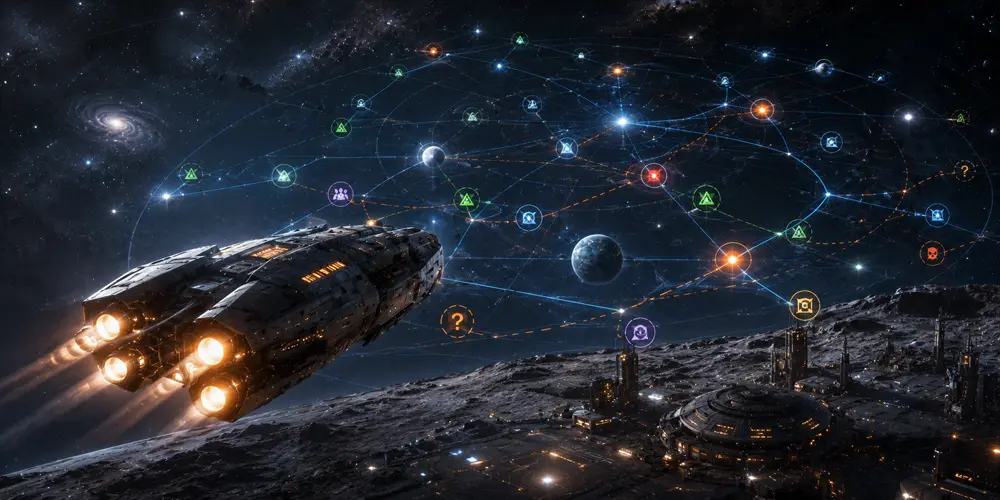
Use a subsector map as your campaign board. The map gives players visible choices and helps them understand distance, jump routes, fuel needs, and travel risk.
You can use your own generated subsector, a published region, or an online tool such as Traveller Map.
One Starting World
The starting world should be easy to understand.
Give it a starport, a local problem, a few NPCs, and a reason for ships to come and go. The players do not need a full planetary encyclopedia. They need enough information to make decisions.
Three Factions
Factions make the sandbox move even when the players are not watching.
For example:
- A shipping company trying to control freight routes
- A local government hiding a security crisis
- A criminal network using frontier ports
- A scout service team investigating unexplained signals
- A mining corporation pushing into disputed territory
Give each faction a goal, a resource, and a problem. That is enough to create conflict.
Six Patrons
Patrons are the lifeblood of Traveller adventures. They offer jobs, favors, contracts, secrets, and trouble.
Each patron hook should fit in one sentence:
- A broker needs a sealed cargo delivered before a rival ship arrives.
- A scout wants discreet help investigating a missing survey team.
- A noble hires the crew to retrieve a passenger who does not want to be found.
- A belter offers coordinates to a derelict ship in exchange for passage offworld.
- A customs officer asks the crew to carry a message outside official channels.
- A scientist needs transport to a restricted moon before corporate security arrives.
Short hooks are better than long plots. Let the details develop at the table.
Ten Rumors
Rumors tell the players what might be worth chasing.
Some rumors should be true. Some should be partly true. Some should be wrong in interesting ways.
Examples:
- A jump point near the gas giant has become unreliable.
- A merchant captain vanished after refusing a customs inspection.
- A mining colony found something under the ice.
- A noble family is quietly hiring offworld muscle.
- A derelict scout ship was seen drifting near the outer system.
- A local union is preparing to shut down the starport.
- A corporate research team brought back a contaminated sample.
- A pirate transponder was detected, but no ship was found.
- A low-tech world nearby is buying advanced medical equipment.
- A passenger is paying double for a route no one wants to take.
Six Recurring NPCs
Recurring NPCs make the sandbox feel connected.
Use simple labels at first:
- The suspicious starport administrator
- The ambitious broker
- The overworked scout officer
- The charming smuggler
- The corporate troubleshooter
- The mechanic who knows too much
If the players care about an NPC, expand that character later.
How to Run the First Session
Start the campaign with the crew already together.
They might share a ship, owe money, serve the same patron, work for the same company, or be stranded at the same starport. Do not spend the first session trying to justify why the party exists. Give them a reason to act immediately.
A strong first session needs three things:
- A problem on the starting world
- A reason the crew is involved
- At least two possible ways forward
For example, the crew arrives at a frontier starport and discovers that their fuel contract has been suspended. The port authority blames a local labor dispute. A broker offers a job that would solve the crew’s cash problem. A scout officer quietly suggests the labor dispute is a cover for something stranger.
Now the players have choices.
Do they take the broker’s job? Investigate the scout’s lead? Negotiate with the union? Try to leave anyway? Look for illegal fuel? Sell cargo? Call in a contact?
That is sandbox play.
Use Jobs, Rumors, and Consequences
A Traveller sandbox runs on opportunities and consequences.
Jobs give the crew immediate direction. Rumors give them optional mysteries. Consequences make their decisions matter.
After each session, ask three questions:
- What did the crew change?
- Who benefited?
- Who is now angry, afraid, interested, or desperate?
Then update the sandbox.
If the crew exposes a smuggling ring, someone loses money. If they rescue a scientist, someone else loses leverage. If they abandon a patron, that patron may spread warnings. If they take illegal cargo through a high-law system, customs might remember their transponder.
Do not punish players for making choices. Let the world react logically.
Make the Ship Matter
In Traveller, the ship is not just transportation. It is home, business, lifeboat, debt, leverage, and vulnerability.
Use the ship to create sandbox pressure.
- Fuel costs make route planning meaningful.
- Maintenance costs push the crew toward jobs.
- Cargo space creates trade decisions.
- Passengers create complications.
- Damage creates urgent repair needs.
- Ship reputation affects future work.
The best Traveller sandbox choices often begin with a practical question:
Can we afford this jump?
That single question can lead to trade deals, risky contracts, questionable patrons, salvage attempts, and desperate negotiations.
For ship-related tools and travel help, try the Traveller RPG Blog, including calculators and referee resources.
Use Factions to Keep the Sandbox Moving
Factions prevent the sandbox from feeling static.
Each faction should want something. They should act even when the player characters are elsewhere. Their actions create news, rumors, missions, and conflict.
You do not need complex faction rules. Use this simple format:
- Name: Who are they?
- Goal: What do they want?
- Resource: What gives them power?
- Problem: What is in their way?
- Next move: What will they do if no one stops them?
Example:
Frontier Freight Combine wants to dominate shipping across three worlds. Its resource is a small fleet of subsidized merchants. Its problem is a growing independent captain network. Its next move is to pressure the starport authority into raising docking fees for non-member ships.
That faction can create trade problems, patron jobs, rivals, rumors, legal pressure, and campaign villains without requiring a scripted plot.
Common Traveller Sandbox Mistakes
Over-Preparing the Map
Do not write pages of lore for worlds the players may never visit. Prepare enough to improvise, then expand only when the crew shows interest.
Hiding All the Hooks
Players need leads. If every mystery is buried, the sandbox feels empty. Put rumors, job offers, news, and visible problems in front of them.
Making Patrons Too Vague
A patron should want something specific. “A mysterious stranger needs help” is weaker than “A mining executive needs the crew to recover a survey drone before the union finds it.”
Ignoring Money Pressure
Traveller works better when ship expenses, cargo, repairs, and debt matter. Money pressure gives players a reason to take risks.
Forgetting Consequences
If the players make bold choices and nothing changes, the sandbox feels flat. Track who noticed, who profited, and who now has a reason to act.
Trying to Predict the Players
You cannot predict every decision. Prepare flexible situations instead of fixed outcomes.
How Much Prep Is Enough?
For a new referee, enough prep means you can answer the next obvious question without freezing.
You do not need to know every detail. You need enough material to keep play moving.
Before a session, prepare:
- Where the crew starts
- What immediate opportunities are available
- Who wants something from them
- What danger or complication may appear
- What changes if they do nothing
That last question is important.
A good sandbox is not waiting for the players to activate it. The world is already moving. The players decide where they interfere.
Player Buy-In Matters
A sandbox campaign works best when players understand what kind of game they are joining.
Before play begins, ask the group what they are most interested in:
- Merchant trading
- Exploration
- Espionage
- Mercenary work
- Smuggling
- Military service
- Frontier survival
- Political intrigue
- First contact
You do not have to give them exactly what they ask for every session, but their answers tell you which parts of the sandbox deserve the most attention.
A merchant campaign needs trade routes, brokers, rivals, cargo problems, and ship expenses.
An exploration campaign needs unknown worlds, survey data, anomalies, hazards, and scientific mysteries.
An espionage campaign needs factions, secrets, false identities, informants, and consequences.
The sandbox should fit the crew the players want to play.
Next Steps for New Referees
New referees should not have to learn everything at once. Build your campaign one useful piece at a time.
Start with the free Introduction to Traveller PDF for a beginner-friendly overview.
Then explore the Traveller RPG Blog for tutorials, tools, calculators, referee advice, and campaign resources.
For players still learning the game, the article How To Play Traveller: Traveller RPG Character Creation is a useful next step.
For campaign planning, the Ultimate Guide to Playing Mongoose Traveller RPG gives readers a broader foundation.
Final Thoughts
The Traveller sandbox is not difficult because it requires endless preparation. It feels difficult because the universe seems huge.
The solution is to make the universe playable.
Start with one world. Add nearby destinations. Create a few factions. Write short patron hooks. Seed rumors. Track consequences. Let the players choose where to go next.
That is the heart of a Traveller sandbox.
You are not writing a novel for the players to follow. You are building a region of space that responds when they push on it.
When the crew starts making plans, chasing leads, avoiding enemies, arguing over jump routes, and caring about the people they meet, the sandbox is working.
Next step: Explore more referee tools, campaign advice, and beginner resources on the Traveller RPG Blog, or download the free Introduction to Traveller PDF.