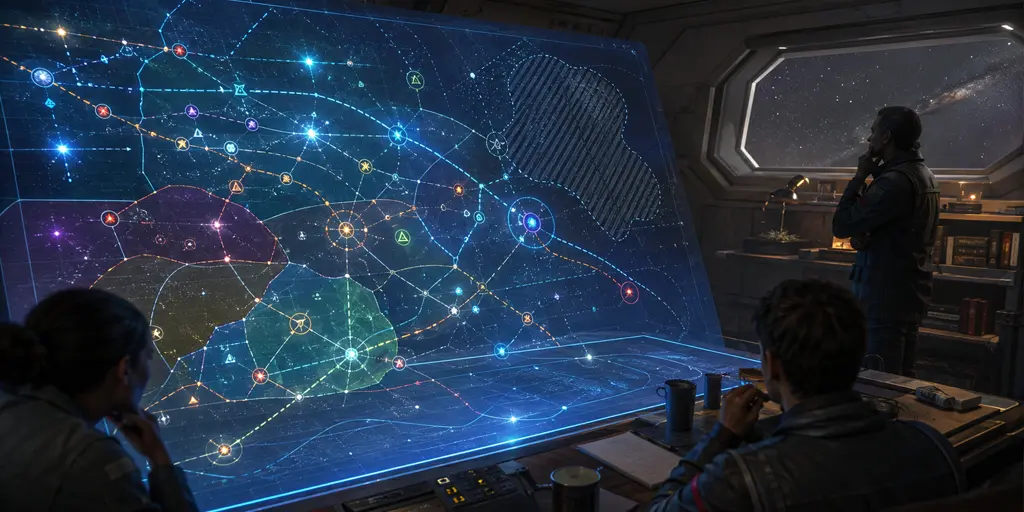
Generate a Traveller subsector, interpret its worlds and routes, preserve useful surprises, and turn procedural results into missions, factions, and campaign pressure.
Traveller Gives You Results, Not a Finished Campaign
Traveller can generate a subsector quickly. A series of rolls establishes where systems exist, what their main worlds are like, which starports serve them, how advanced their societies are, and what broad trade conditions apply.
That does not mean the campaign is finished.
A generated world profile tells you what exists. It does not automatically tell you why the world matters, who depends on it, what happens when its supply route fails, or why the Travellers should risk going there.
That is the referee’s work.
The goal is not to replace random generation with a carefully prewritten map. It is to use the unexpected results Traveller gives you, discover the relationships between them, and change only what the campaign genuinely needs.
The dice tell you what is there. The referee decides why it matters.
A useful working sequence is:
- Generate. Use the game’s procedures to establish systems and main worlds.
- Read. Examine the results before deciding whether anything is wrong.
- Connect. Identify routes, dependencies, borders, shortages, and competing interests.
- Interpret. Explain unusual combinations through history, economics, politics, or local conditions.
- Alter carefully. Change a result only when the campaign gains something specific in return.
- Convert the region into play. Create missions, factions, consequences, and reasons to travel.
This approach preserves the constraints and surprises that make Traveller world generation valuable while giving the referee enough control to build the intended campaign.
The exact generation rolls, Dice Modifiers, characteristic tables, trade-code requirements, and travel-zone procedures belong in the official Traveller rules. This guide focuses on what to do with the results after they appear on the page.
How to Use This Guide
- Phase 1: Generate the Region
- Phase 2: Interpret the Results
- Phase 3: Connect the Worlds
- Phase 4: Turn the Region Into a Campaign
- Worked Example: Four Worlds Become a Campaign
- Complete Traveller Subsector Workflow
Phase 1: Generate the Region
Choose a Published, Modified, or Original Subsector
Before generating worlds, decide how much of the setting already exists.
You do not need a complete sector history or a finished political map. You only need to know whether the campaign will use established material, original material, or a combination of the two.
Using a Published Subsector
A published subsector gives you established geography, history, political relationships, recognizable worlds, and supporting material. It can reduce preparation because many large-scale questions have already been answered.
It also creates obligations. Players may know the setting better than the referee. Official events may affect nearby worlds. A small change can create questions about surrounding canon.
A published subsector works well when:
- The campaign depends on established Charted Space events.
- The players enjoy recognizing known worlds and factions.
- You want to spend less time generating regional background.
- Published adventures or sourcebooks will provide much of the campaign material.
Using an Original Subsector
An original subsector gives the referee control over secrets, history, politics, and discovery. The players cannot arrive with more setting knowledge than their characters, and unexpected generated results can shape the campaign from the beginning.
The main risk is overbuilding. Faced with a blank map, a referee may try to invent every government, settlement, moon, corporation, military base, and historical event before the first session.
That is rarely necessary.
An original subsector works well when:
- Discovery is central to the campaign.
- You want the map to grow through play.
- The campaign needs a self-contained region.
- You want freedom from established continuity.
- The players enjoy uncovering a setting nobody at the table already knows.
Using a Modified Published Subsector
A modified subsector provides a useful middle path. You can retain established geography while changing the local political situation, unexplored secondary worlds, faction relationships, travel restrictions, or recent history.
You might keep the systems and main-world profiles while changing:
- Which faction controls a disputed route.
- Why a world has received a travel warning.
- What happened to an abandoned station.
- Which secondary body contains a valuable resource.
- Whether a local government is stable or close to collapse.
- How much reliable information reaches the frontier.
Make the Choice With Campaign Questions
- Do I want discovery or familiarity?
- Is the campaign tied to official history or events?
- Do the players already know Charted Space well?
- Do I need a region that can stand alone?
- Will changing established material create unnecessary cognitive load?
- Would a published map save preparation, or make me feel restricted?
There is no single correct answer. The useful answer is the one that supports the kind of decisions you want the players to make.
Generate the Subsector Map Before You Explain It
For an original subsector, begin by determining which hexes contain systems using the procedure in your chosen Traveller rules.
Do not decide what every system should be before rolling. Let the map produce irregularity.
Random placement can create:
- Dense clusters of nearby systems.
- Long chains of reachable worlds.
- Wide gaps that low-jump ships cannot cross.
- Isolated systems with little outside contact.
- Potential jump mains.
- Strategic bridge worlds.
- Peripheral clusters connected to regions beyond the current map.
These patterns are not cosmetic. They determine where ships can go, how information travels, which worlds can support one another, and where authority becomes difficult to maintain.
Read the Whole Map
Do not evaluate each occupied hex in isolation. Once system presence has been determined, step back and examine the whole subsector.
- Where are the densest clusters?
- Which systems are reachable by Jump-1?
- Which routes require Jump-2 or better?
- Are any systems effectively isolated?
- Which world forms the only bridge between two regions?
- Which edge systems imply connections beyond the current map?
| Map Pattern | What It Suggests | Campaign Use |
|---|---|---|
| Dense cluster | Frequent traffic and overlapping influence | Trade, diplomacy, competition, and passenger movement |
| Long chain | Dependence on intermediate stops | Route control, missed connections, patrols, and delays |
| Isolated system | Limited contact and weak outside support | Exploration, secrecy, local autonomy, and outdated information |
| Single bridge world | A chokepoint between larger regions | Tolls, blockade, espionage, and strategic conflict |
| Large empty region | Difficult or impossible routine travel | Frontier, mystery, political boundary, or expedition planning |
| Edge cluster | Connections continue beyond the mapped region | Migration, invasion, outside trade, and campaign expansion |
Do Not Repair the Map Too Soon
A generated map may look inconvenient. One group of worlds may be separated from the rest. A promising route may contain an awkward gap. A system may appear to be a perfect bottleneck.
Do not move systems immediately.
First ask what the inconvenience creates.
A disconnected cluster may explain why its technology, politics, or culture developed differently. A difficult route may support specialist couriers or long-range traders. A bridge world may become wealthy, heavily defended, politically unstable, or vulnerable to blockade.
In Traveller, inconvenience often produces the campaign.
Ready to begin mapping the region? Download the free Blank Subsector Map PDF and mark the systems, jump routes, gaps, and chokepoints as you work through the next sections.
Check Jump Geography and Fuel Access
A subsector is not connected merely because systems appear near one another on the page.
Its practical geography depends on jump capability, starport fuel, wilderness refuelling, maintenance support, political restrictions, and the risk of reaching a system that cannot support departure.
A route that works for a Jump-3 naval vessel may not exist for a Jump-1 free trader. A system that appears isolated to ordinary merchants may still receive scouts, couriers, or specially equipped ships.
Choose a Reference Ship
When examining the map, use the likely campaign ship as your reference.
If the Travellers begin with a Jump-1 merchant, mark the systems it can reach safely. If the campaign uses a longer-range exploration ship, mark the routes that become available only because of that capability.
This immediately identifies routine destinations, one-way journeys, fuel-cache routes, specialist corridors, and regions where the Travellers possess a strategic advantage.
Gas Giants Change the Map
A poor starport does not always make a system unusable. A gas giant may provide an alternative source of fuel, allowing ships to cross a marginal region without turning every world into a well-served commercial stop.
That access still carries consequences. Wilderness refuelling may require additional in-system travel. It may expose the ship to weather, debris, equipment failure, patrols, raiders, or observation. The fuel may be unrefined. Local authorities may regulate or forbid the operation.
| Fuel Situation | Effect on Travel | Adventure Pressure |
|---|---|---|
| Reliable starport fuel | Supports regular transit | Inspections, congestion, fees, and controlled access |
| Unrefined fuel only | Raises operational and maintenance risk | Engineering problems, delays, and difficult decisions |
| Gas giant refuelling | Makes a marginal route possible | Ambush, rescue, weather, surveillance, and exposure |
| No viable fuel | Creates an inaccessible or potentially one-way route | Fuel caches, tanker missions, specialist ships, and expedition planning |
| Restricted fuel | Places movement under political control | Permits, bribery, smuggling, blockade, and favoritism |
| Hidden fuel source | Creates a secret or unofficial route | Exploration, criminal advantage, espionage, and route discovery |
Generate the Main World, Not the Entire System
The standard Traveller world-generation process describes the most important and most travelled world in a system.
That main world may be a planet, moon, planetoid, asteroid settlement, orbital habitat, or another significant inhabited body.
It is not necessarily the system’s largest world, most habitable body, original colony, or only inhabited location.
This distinction matters because referees often treat the generated profile as a complete description of the entire system. That can make the setting feel smaller than it should and create unnecessary contradictions.
Use Minimum Viable System Design
Create secondary locations only when they affect a mission, trade route, fuel source, faction, contradiction, or player decision.
Useful secondary locations include mining moons, orbital habitats, abandoned colonies, naval stations, pirate bases, fuel refineries, research platforms, hidden settlements, and asteroid industries.
Each secondary location should earn its place by creating access, resources, danger, conflict, or a reason to travel.
Prepare According to Distance From Play
For the starting world: Prepare the starport experience, one local law likely to affect the crew, two or three active factions, one current shortage or conflict, and several jobs or rumors.
For nearby worlds: Prepare a one-sentence interpretation, one important import or export, one restriction or hazard, one faction, and one reason to visit.
For distant worlds: Keep only the generated profile, route position, and one rumor until the Travellers decide to approach.
Phase 2: Interpret the Results
Read the UWP as a Playable Situation
A Universal World Profile is not a row of unrelated labels. It is a compact description of connected physical, social, legal, and technological conditions.
The conceptual sequence includes starport, size, atmosphere, hydrographics, population, government, law, technology, bases, trade classifications, travel zone, and the additional interpretation supplied by the referee.
A UWP is not eight separate facts. It is a compact situation.
Size affects the physical environment. Atmosphere and hydrographics affect where people can live and how settlements operate. Population influences the scale of government and institutions. Government and law affect what Travellers may carry, say, buy, or do. Technology influences transport, medicine, infrastructure, surveillance, weapons, and dependence on imports.
For every generated main world, ask:
- What is easy here?
- What is difficult?
- What must be imported?
- What can be exported?
- Where does the population actually live?
- What does the law prevent the Travellers from doing?
The surprising interaction is often more useful than the obvious one.
| World Element | What the Travellers Experience | Campaign Question |
|---|---|---|
| Starport | Fuel, repairs, customs, traffic, and access | Who controls arrivals and departures? |
| Environment | Protective equipment, restricted movement, and settlement design | What keeps people alive here? |
| Population | Crowding, labor availability, market size, or isolation | Why do this many people live here? |
| Government | Permits, officials, local factions, and public authority | Who actually makes decisions? |
| Law Level | Inspections, banned equipment, surveillance, and penalties | What normal Traveller behavior causes trouble? |
| Technology | Available medicine, communications, transport, and industry | What must be imported or maintained from elsewhere? |
Preserve Contradictions Before You Correct Them
Some generated worlds appear contradictory.
A low-population world may have advanced technology. A high-population world may have poor facilities. A restrictive government may depend heavily on outside commerce. A marginal starport may serve a strategically important route.
These combinations are not automatically mistakes. They are prompts.
Before rerolling, ask whether the condition could be temporary, imported, externally maintained, politically concealed, or unevenly distributed.
| Apparent Contradiction | Possible Interpretation | Adventure Pressure |
|---|---|---|
| High technology, low population | Research enclave, automated colony, or inherited infrastructure | Specialist recruitment, maintenance crisis, or corporate secrecy |
| Large population, poor starport | Isolation, political neglect, recent collapse, or restricted trade | Shortages, migration, smuggling, or infrastructure contracts |
| Strict law, active trade | Foreign commerce is permitted through tightly controlled channels | Customs pressure, licensed brokers, confiscation, or corruption |
| Poor world, valuable route position | The world survives by controlling transit rather than producing goods | Tolls, foreign influence, sabotage, or blockade |
| Low technology, good starport | The port is an offworld enclave or externally maintained installation | Cultural division, dependency, labor conflict, or technology theft |
Use Travel Zones as Active Campaign Conditions
A travel warning should change decisions. It should not be a decorative mark beside the world profile.
When a system receives a travel restriction or warning, decide what creates the danger, who issued the warning, whether it is current, and who still goes there despite the risk.
A travel zone creates missions when different groups assess the danger differently. A government may exaggerate the risk to hide an internal crisis. Merchants may understate it because they need cargo moved. Refugees may describe conditions that officials deny. A scout report may be months out of date.
Change Results for a Clear Campaign Benefit
There are times when changing a result is the right choice.
A generated map may prevent the intended campaign ship from reaching the region. A result may duplicate several nearby worlds without creating useful variation. A government or technology result may undermine a campaign premise that everyone has already agreed to play.
Before changing anything, state the benefit clearly.
Good reasons include:
- The change makes the campaign’s core travel loop possible.
- The change creates a required starting location.
- The change removes repetition without erasing useful complexity.
- The change supports an agreed campaign premise.
- The change creates a more meaningful choice for the players.
Weak reasons include:
- The result looks strange.
- The map is not symmetrical.
- The world is inconvenient.
- The referee would not have chosen it.
Alter only when the campaign gains something specific in return.
Phase 3: Connect the Worlds
Separate Physical Routes From Commercial Routes
Earlier, you marked which journeys were physically possible. Now decide which of those connections are routinely used—and why.
A jump connection shows that travel is possible. It does not prove that ships use the route regularly.
- Possible route: A ship with the required jump capability and fuel can make the journey.
- Commercial route: Traders and passenger ships use the connection regularly.
- Communications route: Messages, official couriers, or strategic traffic move through the connection.
- Unofficial route: Smugglers, pirates, scouts, or specialists use a poorly documented or restricted connection.
| Route Type | What Sustains It | Typical Problems |
|---|---|---|
| Possible route | Jump range and fuel access | No regular traffic, uncertain data, or difficult departure |
| Commercial route | Reliable demand, profit, infrastructure, and security | Competition, piracy, tariffs, delays, and price shocks |
| Communications route | Political, military, administrative, or corporate importance | Interception, censorship, outdated intelligence, and courier failure |
| Unofficial route | Secret fuel, specialist knowledge, or avoidance of authorities | Betrayal, navigation risk, hidden tolls, and criminal control |
Identify What Moves Along Each Route
For every regular route, decide what moves in each direction.
Use broad categories rather than calculating the entire economy: food, fuel, industrial components, medical supplies, passengers, specialists, raw materials, replacement parts, and official dispatches.
A useful route should contain some imbalance.
One world may export food but depend on imported machinery. Another may provide advanced medicine while relying on neighboring worlds for labor. A mining system may produce valuable ore but lack the population and infrastructure needed to process it.
These imbalances create work for Travellers.
Build Dependencies Instead of Isolated World Descriptions
A subsector becomes playable when worlds need one another.
For each important world, identify one resource, route, market, workforce, technology, ally, or fuel source it cannot afford to lose.
Then identify who benefits from that dependency and who wants to change it.
Use this sentence:
World A needs something from World B, but World C controls the route.
Then add pressure:
If the relationship fails, someone gains and someone loses.
Find Mains, Backwaters, and Chokepoints
After generating worlds and assessing routes, classify the region from the perspective of the campaign ship.
Mains support regular trade, passenger traffic, news, patrols, and political influence. When one link fails, delays and shortages spread along the route.
Backwaters sit outside routine traffic, lack dependable fuel, offer weak commercial demand, or require uncommon jump capability. They preserve local autonomy, old technology, hidden facilities, outdated information, and forgotten obligations.
Chokepoints control access between regions through jump distance, fuel, repair facilities, navigation information, or political permission. They may be wealthy, fortified, corrupt, contested, or dependent on outsiders.
Add Polities After You Understand the Routes
Political borders make more sense after you understand jump geography, fuel access, communications, and economic dependencies.
A polity should not be drawn merely to divide the map into neat shapes. Ask how authority moves between systems.
- What holds the polity together?
- What does the central authority want?
- Which world benefits most?
- Which world resents the arrangement?
- What route or resource is essential?
- What could cause the polity to fracture?
Phase 4: Turn the Region Into a Campaign
Convert the Region Into Factions
Factions should emerge from the subsector’s relationships rather than being added as unrelated background.
Begin with the people and organizations that control or depend on fuel, trade, starports, communications, navigation data, military protection, industrial capacity, food production, or access to isolated worlds.
For each faction, define four things:
- What does it control?
- What does it need?
- What threatens it?
- What does it want the Travellers to do?
Factions become more useful when their goals overlap.
A port authority may want smugglers stopped but depend on their unofficial fuel route. A government may condemn a merchant combine while relying on its ships. A patrol force may know that a travel warning is outdated but lack the personnel to investigate.
The Travellers enter the gap between official policy and practical necessity.
Create Immediate Missions From the Map
You do not need a separate adventure-generation system to begin play. The subsector already contains missions.
Choose one route, one dependency, and one interested faction. Then ask what has changed.
| Regional Situation | Immediate Mission | Long-Term Consequence |
|---|---|---|
| A bridge world closes its port | Move emergency cargo through an alternate route | The alternate route weakens the bridge world’s influence |
| A colony loses imported machinery | Deliver parts before production stops | A rival supplier gains leverage over the colony |
| A gas giant route becomes unsafe | Investigate missing refuelling ships | Trade shifts toward a politically controlled port |
| A warning isolates a valuable world | Verify the danger and recover current information | Reopening the route threatens those profiting from isolation |
| An unofficial route is discovered | Survey and document the passage | Merchants, navies, and criminals compete to control it |
Ask What Happens Without the Travellers
Every useful campaign situation should continue moving if the Travellers do nothing.
- Who acts first?
- What resource becomes scarce?
- Which route closes?
- Which faction gains power?
- Who suffers?
- What news reaches the crew later?
This makes the subsector feel active without requiring a scripted plot.
Use AI to Interpret, Compare, and Organize
AI can help a referee work through a large set of generated results, but it should not quietly become the authority over the setting.
Useful tasks include summarizing UWP implications, suggesting explanations for unusual combinations, comparing dependencies, identifying chokepoints, generating faction goals, turning shortages into missions, and organizing notes.
A useful prompt should include the world profile, the campaign ship’s jump capability, known nearby worlds, the intended campaign style, which results must remain unchanged, and the kind of output you need.
Interpret this Traveller world profile as a frontier trade stop. Preserve all generated characteristics. Give me three possible explanations for its unusual technology and population combination, the imports it depends on, two factions affected by that dependency, and three missions that could emerge if shipments stop.
Ask for multiple possibilities rather than one definitive answer. The referee should choose what becomes true.
Explore more practical tools for campaign preparation on the CyborgPrime AI Tools page.
Worked Example: Four Worlds Become a Campaign
Consider a small four-world cluster generated without a predetermined story.
| World | Generated Situation | Immediate Implication |
|---|---|---|
| Aster | Agricultural population with limited heavy industry | Exports food but needs machinery and replacement parts |
| Brasson | Industrial world with a large urban population | Produces machinery but depends on imported food |
| Cinder Gate | Poor local economy but the only safe bridge between clusters | Controls transit, fuel access, and communications traffic |
| Damaris | Small high-technology enclave near a hidden fuel source | Offers an unofficial route that could bypass Cinder Gate |
The generated facts create a dependency: Aster needs Brasson’s machinery, Brasson needs Aster’s food, and Cinder Gate controls the normal route between them.
Cinder Gate’s government collects transit fees and uses them to maintain the port. A merchant combine wants lower costs. A smuggling network has discovered Damaris’s hidden fuel source. Damaris fears that public knowledge of the route will end its isolation.
The first mission practically writes itself: a food convoy is delayed at Cinder Gate after new inspections are imposed. Brasson faces shortages. The merchant combine hires the Travellers to test the Damaris route.
Success creates a larger consequence. If the alternate route becomes reliable, Cinder Gate loses revenue and political leverage. Its government may suppress the discovery, the smugglers may try to preserve their monopoly, and Damaris may demand that the Travellers keep the route secret.
No world needed a long history before play. The campaign emerged from geography, fuel, dependencies, and interested factions.
A Practical Traveller Subsector Workflow
- Choose the setting relationship. Decide whether the subsector is published, modified, original, or connected to an established region.
- Generate system locations. Use the official procedure and preserve the initial pattern.
- Mark jump access. Evaluate the map using the campaign’s likely ship.
- Check fuel and departure. Identify starport fuel, gas giants, restrictions, and dangerous one-way routes.
- Generate main worlds. Record the official results without trying to explain everything immediately.
- Read each UWP as a connected situation. Note the most important physical, social, legal, and technological consequences.
- Circle contradictions. Treat unusual combinations as questions before considering changes.
- Mark route types. Separate possible, commercial, communications, and unofficial routes.
- Add dependencies. Decide what important worlds need from one another.
- Draw political influence. Build polities around routes, communications, resources, and practical control.
- Create factions. Give control, need, threat, and a request to each major group.
- Generate missions. Choose a dependency and decide what has just gone wrong.
- Prepare only what is near play. Leave distant details open until the Travellers approach them.
- Alter only with a stated benefit. Record why the change improves the campaign.
Before-Play Checklist
- Which worlds can the campaign ship reach safely?
- Where can it refuel and leave again?
- Which world controls an important route?
- What dependency creates immediate pressure?
- Which faction wants the situation changed?
- What happens if the Travellers do nothing?
Traveller Worldbuilding Frequently Asked Questions
What Is a Traveller Subsector?
A Traveller subsector is a mapped group of star systems used as a practical campaign region. Its systems, jump routes, fuel access, world profiles, governments, trade relationships, and political pressures help determine where ships can travel and what situations the Travellers encounter.
Should I Reroll Unusual Traveller World Results?
Usually, interpret the result before rerolling it. An unusual combination may suggest imported technology, an offworld enclave, a declining starport, uneven development, or a hidden dependency. Change the result only when doing so produces a clear campaign benefit that cannot be achieved through interpretation.
Is the Main World the Only Inhabited Body in a System?
No. The generated main world is the system’s most important or most travelled world, not necessarily its only inhabited location. Other planets, moons, stations, belts, and settlements can be developed when they affect a mission, faction, trade relationship, fuel source, or campaign decision.
Does Every Jump Connection Become a Trade Route?
No. A jump connection only shows that travel is physically possible for a ship with sufficient range and fuel. A commercial route also requires demand, profit, infrastructure, information, and acceptable risk. Communications, military, exploration, and unofficial routes may follow different paths.
How Much of a Subsector Should I Prepare Before Play?
Prepare the starting world in detail, nearby worlds in broad practical terms, and distant worlds only as profiles, route positions, and rumors. Develop additional locations when the Travellers choose to approach them. This keeps preparation focused while preserving flexibility.
Can AI Generate a Traveller Subsector for Me?
AI can help interpret profiles, compare routes, suggest dependencies, organize notes, and generate possible factions or missions. It works best when you provide the generated results and clear constraints. The referee should still decide which interpretations become true and which details belong in the campaign.
From Random Worlds to a Living Campaign
Traveller world generation works because it gives the referee constraints that were not chosen in advance.
The map may contain awkward gaps. The worlds may produce strange combinations. A poor port may occupy a critical location. A distant colony may depend on a route that barely functions.
Those results are not obstacles to worldbuilding. They are the raw material.
Generate first. Interpret second. Connect third. Alter only when the campaign gains something specific.
When worlds depend on one another, routes can fail. When routes can fail, factions compete. When factions compete, the Travellers have decisions to make.
That is when a collection of world profiles becomes a campaign.
For more practical guidance on turning Traveller rules, worlds, and campaign decisions into playable material, explore Beyond the Horizon: The Ultimate Guide to Playing Mongoose Traveller.
Worldbuilding & Subsector Tools
Get more Traveller RPG worldbuilding resources, subsector tools, referee advice, and campaign-preparation support.