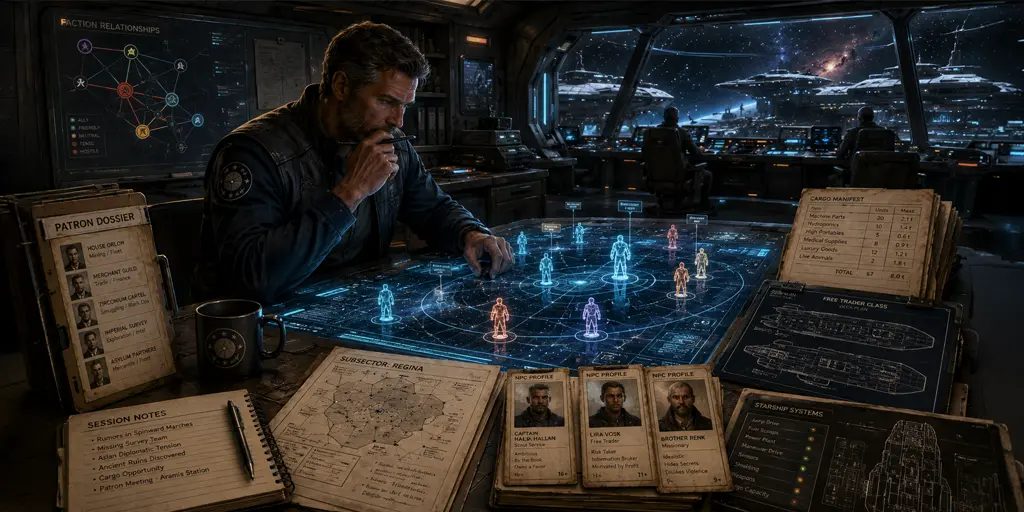

A Traveller sandbox starts moving when the crew chooses what matters, takes one concrete action, and lets the consequences create the next decision.
The referee finishes describing the starport. The ship needs money. A contact has disappeared. Several worlds are within jump range. Everyone waits for the next mission to become obvious.
That pause is common, especially for players used to linear adventures or still learning how Traveller RPG campaigns work. In those games, initiative can feel risky: the correct route may be hidden, prepared scenes may seem easy to miss, and acting without permission may look like derailing the campaign. A Traveller sandbox asks for a different habit.
You do not need to invent the setting, seize control from the referee, or plan ten sessions ahead. You need to decide what the crew wants, ask for the information required to act, and declare a specific next step.
A Traveller Sandbox Is a Situation, Not a Storyline
Linear adventures often train players to find the intended mission, follow the prepared sequence, and wait for the next scene. Sandbox play begins somewhere else: with a situation that contains pressures, opportunities, people, places, and unresolved problems.
The referee portrays that situation and decides how the world responds. The players decide what matters to their characters and what the crew attempts next.
The story is the record of the crew’s decisions and the consequences that followed.
This does not mean every choice is equally wise or every plan will succeed. It means there may be several defensible directions, and the campaign develops through the exchange between player action and referee response.
Start With What the Crew Wants
A crew does not need a grand destiny before it can act. A short-term objective is enough.
- Pay the ship mortgage.
- Repair or upgrade the ship.
- Reach a particular world.
- Find a missing person.
- Build a profitable trade route using the crew’s knowledge of Traveller trade and commerce.
- Clear a character’s name.
- Help a contact.
- Escape an enemy.
- Acquire information.
- Protect a community.
- Investigate something unusual.
- Earn enough to retire comfortably.
Ask one question:
What does the crew want badly enough to spend time, money, or reputation pursuing?
The answer does not have to last forever. It only has to matter enough to guide the next decision.
Use Pressure, Opportunity, and Curiosity
When several possibilities compete for attention, sort them into three useful categories.
| Source | What It Means | Traveller Examples |
|---|---|---|
| Pressure | Something gets worse if the crew ignores it. | A mortgage deadline, damaged life support, enemy surveillance, an impatient patron. |
| Opportunity | Something useful or valuable may be gained. | Profitable cargo, salvage rights, political favor, an unclaimed contract. |
| Curiosity | Something is interesting enough to investigate. | An altered transponder, a missing scout report, an abandoned ship, a distress signal. |
Then ask: Which pressure, opportunity, or mystery matters most right now? The answer gives the crew a focus without requiring the referee to declare a main quest.
Convert Interest Into a Concrete Action
Vague intentions make it difficult for the referee to respond. A concrete action gives the world something to answer.
Replace Vague Declarations
- Instead of “We investigate,” say what you examine, who you question, or where you go.
- Instead of “We look for work,” say which broker, port office, contact, or market you approach.
- Instead of “We prepare,” say what you buy, repair, calculate, secure, or assign.
Use This Action Formula
We want to [goal], so we will [specific action] using [resource, skill, contact, or approach].
For example:
- We want to find profitable cargo, so we will compare local brokers using our steward’s contacts.
- We want to identify the ship following us, so we will alter course and monitor whether it matches our maneuver.
- We want to rescue the survey crew, so we will buy updated charts and jump to their last reported location.
- We want to verify the shipment, so we will inspect the cargo seal before signing the contract.
The players still do not decide what the inspection reveals or whether the contact is trustworthy. They decide what their characters attempt.
Stop Looking for the Correct Decision
Traveller characters often act with incomplete information. A reasonable decision can still produce danger, cost, delay, or embarrassment. That does not mean the players misunderstood the adventure.
It helps to separate three kinds of choice:
- A bad decision ignores known information or works against the group’s agreed goals without a reason.
- An uncertain decision chooses among incomplete, risky, or competing options.
- An interesting decision reveals what the crew values and creates consequences worth playing through.
Choosing one opportunity also means leaving others unresolved. A rival may move first. A patron may lose patience. A market may change. Those are not punishments for failing to locate the correct plot. They are the moving parts of a sandbox.
In a sandbox, the goal is not to predict the referee’s preferred outcome. The goal is to make a decision your crew can own.
Ask the Referee for Information, Not Direction
Useful questions reduce uncertainty without handing the decision back to the referee.
| Direction-Seeking | Information-Seeking |
|---|---|
| What are we supposed to do? | Which worlds can we reach with our current fuel? |
| Which mission should we take? | Which contract appears most urgent, profitable, or risky? |
| Where does the plot want us to go? | Do we know anyone at either destination? |
| What is the right choice? | What risks are obvious before we commit? |
The referee supplies the facts your characters could know. The players decide what those facts mean for the crew.
Use Character History as a Decision Engine
Traveller character creation already gives players material for proactive play. Allies, contacts, rivals, enemies, careers, mishaps, benefits, debts, obligations, skills, and former worlds can all create reasons to act.
- A former scout follows up on a missing survey vessel.
- An ex-merchant investigates a suspicious trade contract.
- A naval veteran helps an old crewmate facing charges.
- A scholar diverts the ship to examine anomalous ruins.
- A character with an enemy avoids one port and chooses another.
- A character with a contact asks for work instead of waiting for a random patron.
A quiet or cautious character can still drive play. Proactive roleplaying does not require a loud personality. It requires a clear priority and a declared action.
Make Crew Decisions, Not Six Separate Solo Decisions
A sandbox can stall even when every player has ideas. The problem is often not a lack of options but a lack of a lightweight way to choose among them.
- State the immediate situation. Summarize the current location, problem, and available leads.
- Name one concern or opportunity each. Keep the first round brief.
- Identify any hard deadline. Time pressure may narrow the choice.
- Choose one crew objective. Decide what matters for the next stretch of play.
- Agree on the first action. Do not solve the entire problem before acting.
- Assign roles. Decide who talks, researches, pilots, repairs, watches, or negotiates.
- Act before reopening the whole discussion. New information can justify a new decision later.
When the Crew Disagrees
- Identify what each option protects, risks, or gains.
- Look for a reversible first step, such as one call, inspection, meeting, or calculation.
- Split tasks only when the crew can still function and everyone remains involved.
- Use a captain or agreed operational decision-maker when time pressure matters.
- Remember that unanimous enthusiasm is not required for every routine action.
A captain is a group convention for resolving operational deadlock, not a license for one player to control the others.
Use the Smallest Useful Commitment
Players often freeze because every option feels like a permanent campaign decision. Reduce the size of the commitment.
Do not decide which faction to support forever when you only need to decide whether to attend one meeting. Do not plan the entire trade route when you only need to choose the next cargo. Do not solve the whole mystery when you only need to inspect one signal.
Choose the next meaningful action, not the next ten sessions.
Useful small commitments include one jump or ship journey, one negotiation, one surveillance attempt, one favor, one contract, one rescue, or one information-gathering action.
The Five-Step Traveller Sandbox Decision Loop
- Name the pressure. What changes if the crew does nothing?
- Choose the objective. What does the crew want from this situation?
- Gather only necessary information. What must the crew know before acting?
- Declare a concrete action. What does the crew physically do next?
- Reassess after the consequence. What changed, and what matters most now?
This loop can be repeated whenever the table goes quiet. It keeps the decision small enough to make while leaving room for the referee’s world to surprise the crew.
Worked Example: Three Leads at the Starport
The crew arrives at a starport with a mortgage payment due in two weeks and a damaged maneuver drive. An old contact asks them to transport a sealed passenger. A lucrative cargo contract goes in the opposite direction. Rumors also mention a derelict scout ship nearby.
The Passive Response
The players discuss all three leads, ask which one is the main mission, and wait for the referee to provide a stronger clue. Every new detail creates another round of speculation.
The Active Response
The crew decides that keeping the ship financially operational is the immediate objective. They ask:
- Must the maneuver drive be repaired before the next jump?
- When does the cargo contract expire?
- Where does the passenger need to go?
- Can the passenger and cargo travel on the same route?
- What is publicly known about the derelict?
Then they declare:
We will inspect the maneuver drive, ask our contact for the passenger’s destination, and determine whether the cargo and passenger jobs can be combined. If they cannot, we will take the option that covers the repair and mortgage costs with the lowest legal risk.
The referee can now respond with repair needs, costs, deadlines, hidden complications, NPC reactions, and consequences. The players did not write the adventure. They created a direction the referee could develop.
What the Referee Still Controls
Player initiative works best when the boundary between player decisions and setting authority stays clear.
| Responsibility | What It Covers |
|---|---|
| Players | Character goals, priorities, plans, questions, declared actions, resources, and acceptable risks. |
| Referee | Setting facts, NPC motives, hidden information, opposition, difficulty, consequences, and world changes. |
| Shared | Campaign tone, spotlight balance, table expectations, acceptable subject matter, and group fit. |
Players choose intentions and actions. The referee decides what exists, what happens, and how the world responds. The campaign emerges from that exchange.
Before the Campaign: Agree on What Kind of Crew You Are
A short pre-session or session-zero discussion can prevent later paralysis. Ask:
- What activities should regularly generate play?
- What does the crew need money for?
- Which character relationships should create missions?
- Who normally makes time-sensitive shipboard decisions?
- How much risk is the group comfortable accepting?
- What kinds of opportunities will the crew usually ignore?
Finish by writing one sentence: Our crew usually takes action when... That sentence gives everyone a shared default when several possibilities compete.
Take the First Defensible Step
You do not need the perfect plan, the referee’s preferred choice, or the direction of the next ten sessions. You need an objective, enough information to act, and a concrete first step.
When the Traveller sandbox goes quiet, do not ask where the story is. Decide what your crew wants, take the first defensible step, and let the story appear behind you.
Frequently Asked Questions
What Should Players Do When Nobody Knows What to Do Next?
Name the most urgent pressure, choose one crew objective, ask only for the information required to act, and declare one concrete next step.
Does Proactive Sandbox Play Mean Players Invent Setting Facts?
No. Players choose goals, questions, plans, and actions. The referee determines setting facts, hidden information, opposition, and consequences.
What if the Crew Chooses the Wrong Mission?
A sandbox usually does not have one correct mission. The crew can make a reasonable choice with incomplete information and then respond to the consequences.
How Can Quiet Players Contribute to Crew Decisions?
Invite each player to name one concern or opportunity before open discussion begins. A player can contribute a clear priority without performing a forceful personality.
How Long Should the Group Spend Choosing the Next Action?
Routine decisions should usually take only a few minutes. Major commitments may deserve more discussion, but the group can often begin with a smaller, reversible step.
What Is the Best Question to Ask the Referee?
Ask for information that affects the decision, such as deadlines, known risks, reachable worlds, available contacts, or visible costs. Avoid asking the referee to choose for the crew.
Related Traveller RPG Resources
- Traveller RPG Beginner Guide
- Traveller Character Creation Guide
- Traveller Trade and Commerce Guide
- Join other Traveller fans on the CyborgPrime Discord server.
Get More Traveller Guides for Confident Play
Get practical beginner resources that help your crew make decisions, connect character goals to campaign opportunities, and keep Traveller sessions moving.
No spam. Just Traveller beginner guides, play tips, campaign resources, and CyborgPrime updates. Unsubscribe anytime.