Search

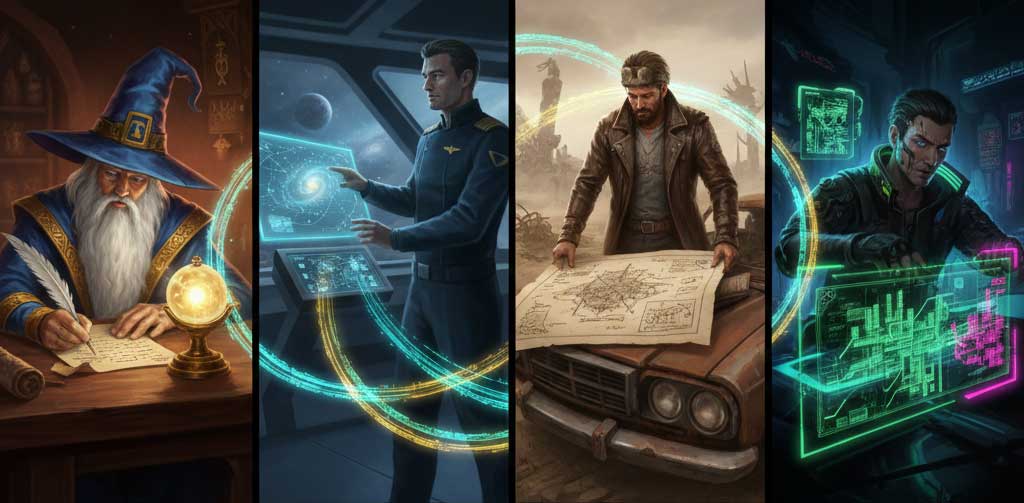
Characters from differnt genres, Dugeons and Dragons, Pathfinder, Call of Cthulhu, Traveller, and more.

AI for Dungeons & Dragons, Pathfinder, Call of Cthulhu & Traveller Game Masters

Use AI to turn scattered session notes and campaign facts into clearer preparation while keeping every ruling, consequence, and piece of canon under human control.

Most advice about AI for game masters focuses on generating more: more encounters, more NPCs, more lore, and more boxed text. That can be entertaining, but volume is rarely the main problem. The harder problem is turning everything your campaign has already produced into information you can find, trust, and use.

A practical AI-assisted workflow helps a human game master organize campaign records, compare possible consequences, check continuity, and prepare the next session. It does not decide what is true, make rulings for the table, or replace the judgment that gives a campaign its identity.

The best place to begin is between sessions. Choose one recurring source of friction, give the system structured material, review the output, and save only what you approve.


The Real Problem Is Campaign Complexity

Preparation becomes difficult as a campaign accumulates decisions. An NPC who began as a minor contact now has a grievance, two loyalties, and information the players may have misunderstood. A faction has changed its plan because of an event six sessions ago. A promise made in passing should now produce a consequence. None of this requires more imagination. It requires reliable retrieval and follow-through.

Common sources of friction include:

  • NPC motivations that are buried in old notes.
  • Faction timelines that conflict or quietly stop moving.
  • Consequences that were implied but never brought back into play.
  • Session notes scattered across documents, chats, notebooks, and virtual tabletops.
  • Useful information that exists but cannot be found quickly during play.
  • Preparation that must be repeated because earlier work was never organized.

For a Traveller referee, this might mean tracking patron motives, ship obligations, rival crews, trade contacts, and events across several worlds. In an investigative game, it may mean preserving what each character knows without letting a summary accidentally solve the mystery. In a faction-heavy fantasy campaign, it may mean remembering which groups can act, what they want, and how player choices changed their options.

Start with one recurring failure point. “Help me turn last session into usable preparation” is a better first problem than “generate my campaign.”


What AI Is Good At—and What the GM Must Control

AI is most useful when it transforms, sorts, compares, or reformats material that the GM has supplied. This reference separates appropriate assistance from decisions that should remain with the human running the game.

WorkflowAI Can Help WithGM Remains Responsible For
Organization Sorting, summarizing, and indexing Deciding what is true
Preparation Expanding approved ideas Selecting what enters play
Analysis Comparing goals and consequences Choosing the world’s response
Presentation Drafting summaries and handouts Tone, secrets, and final wording

Treat generated material as a proposal, not a ruling. The GM remains the authority layer that separates established campaign truth from plausible invention. This is especially important for rules answers, hidden information, player-facing consequences, and anything that could limit player agency.


Five High-Value AI Workflows for Game Masters

Turn Session Notes Into Campaign Intelligence

Raw notes record what happened, but they often mix facts, guesses, table chatter, reminders, and unresolved questions. Ask the system to classify the notes into:

  • Confirmed events.
  • Character decisions.
  • Changed relationships.
  • New consequences.
  • Open threads.
  • Facts requiring GM review.

The review category matters. A player’s theory is not automatically a fact, and an improvised detail may need confirmation before it becomes permanent. Correct the classification before saving it.

Maintain an NPC and Faction Register

A useful register tracks goals, resources, relationships, secrets, recent actions, current attitude, and the next likely move. The AI can compare those fields and suggest where a record is incomplete or inconsistent.

Keep interpretation provisional. “The port official probably retaliates” is a generated possibility. “The port official ordered the ship impounded” becomes canon only after the GM approves it and records it as an event.

Convert Worldbuilding Into Playable Situations

Worldbuilding becomes useful at the table when it creates decisions. Ask the system to transform approved setting material without replacing it:

  • A setting fact becomes an interested NPC.
  • A political condition becomes a conflict with competing interests.
  • A location becomes a decision point.
  • A historical event creates a present consequence.
  • A technology creates both an opportunity and a risk.

This approach preserves the GM’s world while testing how its parts can produce play. The final situation should still leave room for player choices that the preparation did not predict.

Prepare a Compact Session Brief

A session brief is a retrieval tool, not a script. Keep it short enough to scan while running the game. Useful fields include:

  • Current situation.
  • Likely player directions.
  • Active NPCs.
  • Faction moves.
  • Useful locations.
  • Available clues.
  • Possible complications.
  • Rules requiring review.

“Likely player directions” should describe options the current situation makes visible, not a sequence the players must follow. The brief supports improvisation because the GM can see the pressures and people involved.

Run a Continuity Check

A continuity check compares the latest approved records with earlier material. Ask it to flag:

  • Contradictions.
  • Forgotten promises.
  • Inactive threats.
  • NPC knowledge errors.
  • Timeline conflicts.
  • Player decisions without consequences.
  • Information that lacks a source.

A flag is not proof of an error. Review the source material, decide whether the difference is intentional, and update the record only after that decision.


A Complete Between-Session AI Workflow

This operating model turns one session into preparation for the next without allowing generated suggestions to overwrite the campaign.

  1. Capture the session. Gather notes, major decisions, new names, improvised facts, and unresolved questions.
  2. Separate facts, beliefs, and uncertainties. Distinguish established events from character beliefs, player theories, and details awaiting confirmation.
  3. Update campaign records. Add approved changes to NPC, faction, location, timeline, and open-thread records.
  4. Check continuity. Compare the changes against existing records and source references.
  5. Model plausible faction responses. Generate a small number of reactions based on established goals, resources, and knowledge.
  6. Choose which pressures advance. The GM selects the responses that fit the campaign and decides when they become visible.
  7. Create the next-session brief. Summarize the active situation, likely directions, relevant people, useful clues, and rules to review.
  8. Save only the approved version as campaign truth. Archive generated possibilities separately or discard them.

Worked Example: The Exposed Official

Suppose the players expose a corrupt customs official during a public hearing. The session notes contain the evidence they presented, the official’s denial, a merchant captain’s testimony, and a rumor that a criminal syndicate funded the scheme.

First, the AI extracts confirmed consequences: the official’s reputation is damaged, the merchant captain is now publicly involved, and the syndicate connection remains unproven. It then compares three established factions and proposes plausible reactions:

  • The official’s political allies attempt to discredit the witnesses.
  • The merchant guild offers the players protection in exchange for cooperation.
  • The syndicate quietly investigates how much the players actually know.

The GM does not accept all three automatically. The political allies may lack the resources to act immediately. The merchant guild response could create a useful choice at the start of the next session, while the syndicate investigation can advance in the background.

The GM approves those two responses, records them separately, and updates the session brief. The opening situation now includes a guild representative offering terms. A background note reminds the GM that an unknown observer is checking the players’ contacts. The AI helped compare consequences, but the GM chose the timing, intensity, and form of the world’s response.

After you understand this workflow, explore CyborgPrime AI Tools for Game Masters for the human-led preparation and campaign-management lane.


How to Keep AI From Damaging Campaign Continuity

The central safeguard is simple: generated text must never become campaign truth merely because it sounds plausible. Build visible boundaries into the records.

  • Label established facts. Record what is confirmed in play or approved by the GM.
  • Label character beliefs separately. A character may be sincere and still be mistaken.
  • Label generated suggestions. Keep proposed consequences, names, and interpretations outside authoritative records until reviewed.
  • Preserve source references. Note the session, document, or approved entry behind important facts.
  • Do not overwrite records automatically. Review changes before merging them.
  • Review changes before archiving. A clean summary can still contain a subtle error.
  • Use edition-specific rules references. Check the correct rule source rather than trusting a generalized answer.
  • Protect sensitive information. Do not place private player details or confidential material into systems that should not receive it.
  • Maintain a recoverable source file. Keep the authoritative campaign record outside a single conversation or temporary workspace.

A useful hierarchy is: established facts, character beliefs, GM secrets, generated suggestions, and discarded ideas. Each category has a different level of authority and a different audience. Keeping them separate prevents a polished summary from leaking secrets, flattening uncertainty, or inventing canon.


AI During Live Play

Live-session use is optional. Most groups will gain more value from between-session organization because it avoids interruptions and gives the GM time to review the result.

Appropriate live uses may include:

  • Searching an approved campaign index.
  • Retrieving a previously established NPC fact.
  • Reformatting approved information for quick reference.
  • Producing a short list from GM-approved parameters.

Poor live uses include:

  • Making rules decisions without verification.
  • Choosing consequences autonomously.
  • Speaking for the GM without review.
  • Generating long interruptions while players wait.
  • Introducing new canon without clearly marking it.

During play, speed is only useful when the answer is trustworthy and concise. A slow search through an approved index is usually better than a fast invention presented as fact.


Example: A Campaign Intelligence System

Structured source material makes AI assistance more dependable because the system can compare explicit records instead of reconstructing the campaign from a loose conversation. Frank’s published case study, How Structured Worldbuilding Turned AI Into a Superhero Campaign Intelligence System, shows this operations-assistant approach in a campaign context.

As you read it, focus on the method rather than the genre:

  • Source material is structured.
  • Important records persist outside a single exchange.
  • A human approves changes.
  • Continuity is tracked across characters, factions, and events.
  • AI supports campaign operations instead of replacing the live game master.

The same principles can support Traveller, fantasy, horror, superhero, and other campaigns because they address information management rather than a particular rules engine.


Human-GM Tools and Virtual GM Lite Solve Different Problems

AI Tools and AI OPS support human-led preparation, organization, and campaign management. Virtual GM Lite is a separate route for solo science-fiction text-adventure play. The full Virtual GM remains in development, so it should not be treated as an available replacement for a human referee.

This guide stays in the human-GM workflow lane. Readers specifically seeking solo play can explore Virtual GM Lite for solo RPG play.


Start With One Workflow

You do not need a large database, a complicated prompt library, or live-session automation to begin. Use the notes from your most recent session.

  1. Collect the notes in one place.
  2. Ask for confirmed facts, decisions, consequences, and unresolved threads.
  3. Correct the classification and remove unsupported additions.
  4. Save the approved version as the session record.
  5. Use that record to create a one-page brief for the next session.

Repeat the process for several sessions before adding more complexity. The goal is not to automate every part of preparation. It is to build a dependable loop that reduces one kind of friction.

For guided learning, worked examples, and community discussion around human-led AI workflows, the AI Game Master Academy is a relevant secondary route after you have tried the basic process yourself.


Common Mistakes

Generating More Than You Can Review

Bulk output creates another preparation burden. Ask for a small number of options and require each one to connect to established campaign information.

Treating Output as Canon

Keep generated suggestions visibly separate until the GM approves them. Plausibility is not authority.

Using One Enormous Prompt

Break the workflow into stages: classify, update, compare, choose, and summarize. Smaller steps make errors easier to find.

Mixing Brainstorms With Authoritative Records

Store ideas and campaign truth in separate sections or files. Otherwise discarded possibilities may return later as false facts.

Trusting Rules Answers Without Checking the Source

Verify the correct game and edition. A concise, confident answer can still combine rules from different sources or omit an exception.

Automating Work You Enjoy

Keep the parts of preparation that express your voice or give you energy. Use AI where it removes friction, not where it removes the reason you enjoy running games.

Using AI Without a Defined Problem

Choose a repeated difficulty and judge the workflow by whether it improves that task. “Use AI somewhere” is not a useful objective.

Promising Privacy, Memory, or Accuracy

Capabilities and terms vary by system and may change. Do not assume permanent memory, confidential handling, or reliable accuracy without checking the current service and maintaining your own campaign records.


Frequently Asked Questions

Does AI replace the game master?

No. The game master remains responsible for rulings, tone, secrets, consequences, player agency, and the final campaign record. AI can organize and compare material, but it does not carry authority at the table.

Do I need AI during live sessions?

No. Between-session use is normally the strongest starting point because the GM can review the output without interrupting play. Live use is best limited to retrieval and reformatting of approved information.

Is this only for Traveller?

No. The workflow is system-independent. Traveller referees may use it for patrons, factions, ships, and events across worlds, while other game masters can apply the same structure to clues, relationships, locations, or political conflicts.

Do I need a paid ChatGPT account?

Not as a universal requirement for these workflow principles. They can be adapted to different tools and access plans. Individual CyborgPrime tools may have their own current access requirements, which should be checked on the relevant page.

Can AI remember an entire campaign?

Do not rely on unlimited or flawless memory. Persistent reliability depends on how campaign information is stored, supplied, reviewed, and retrieved. Maintain an authoritative source file that you control.

Is AI-generated campaign material automatically accurate?

No. Check it against approved campaign records and the correct rules sources. Generated material should remain provisional until the GM reviews it.


Turn Existing Campaign Knowledge Into Better Prep

AI is most valuable when it turns information the GM already has into clearer, more usable preparation. A dependable workflow captures the session, separates facts from uncertainty, updates records, checks continuity, models a few plausible responses, and produces a compact brief. Human judgment decides what becomes true and what reaches the table.

Explore AI Tools for Game Masters to continue with CyborgPrime’s human-led AI preparation and campaign-management resources.


Get More Practical AI Game Master Workflows

Get campaign-organization ideas, preparation workflows, and AI-assisted referee guidance that help you turn session material into usable next steps.

No spam. Just AI-assisted game mastering tools, course updates, workflow ideas, and CyborgPrime news. Unsubscribe anytime.


Related Articles

Information

Join Us On Discord:
CyborgPrime Games on Discord

Visit Our Facebook Group:
Traveller RPG Headquarters on Facebook

Help Support Us On Patreon:
CyborgPrime on Patreon

Contact Us
(505) 490-NERD
support@cyborgprime.com

Affiliates

This website contains affiliate links. We may receive a commission when customers make a purchase. We only promote products or services we believe in and are not responsible for any issues that may arise. The commission is paid by the publisher.

Newsletter

Get notified of sales and events:
We won't spam you.
Unsubscribe any time.