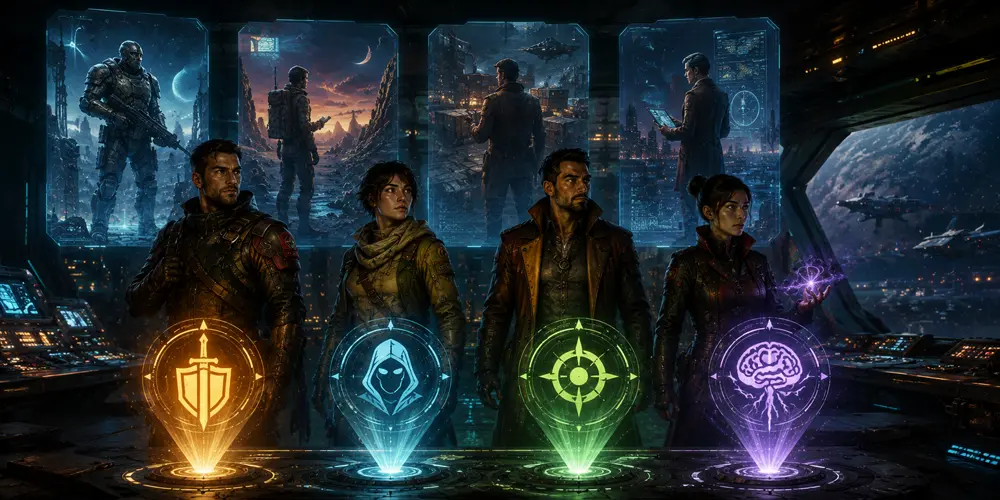
Traveller 5E keeps the classic Traveller career system, but once your character leaves service and begins adventuring, classes and subclasses take over. Here's how the two systems work together.
Why Does Traveller 5E Have Classes?
For longtime Traveller players, one of the biggest questions surrounding Traveller 5E is simple:
Why does Traveller need classes at all?
Traditional Traveller has never relied on classes in the same way fantasy roleplaying games do. Characters are defined by their careers, skills, life experiences, and the choices they make during character creation.
Traveller 5E does not abandon that approach.
Instead, it introduces classes after the classic Traveller character creation process is complete.
The result is a hybrid system that preserves Traveller's lifepath character generation while providing the advancement structure that many 5E players expect.
Simple version: in Traveller 5E, your career is your past, while your class is how you advance once play begins.
The Traveller 5E Character Flow
- Generate your Traveller character through lifepath creation
- Serve one or more careers
- Muster out of service
- Choose a class
- Begin adventuring at Level 1
- Select a subclass at Level 3
- Advance through experience, milestones, or referee-selected progression methods
That structure preserves the core Traveller experience while adding a familiar 5E-style advancement system.
Careers Still Come First
If you have played Traveller before, the overall flow will feel familiar.
Your character still begins with a background shaped by education, prior service, careers, promotions, survival rolls, and mustering out.
You still spend years building a history before the campaign begins.
That part of Traveller remains intact.
Only after your character leaves service and begins adventuring do classes enter the picture.
This distinction is central to understanding Traveller 5E.
Careers Are Backgrounds, Not Classes
One of the most important design decisions in Traveller 5E is that careers are not being converted into classes.
The design team specifically chose to keep careers functioning as part of a character's background.
That means a former Marine is not automatically locked into a Fighter class.
A former Scout is not automatically required to become a Ranger.
Instead, careers describe who your character was before the campaign started.
Classes describe how your character develops once the adventure begins.
For example:
- A former Marine might become a Fighter, Rogue, or Psion.
- A former Scout might become a Ranger or Rogue.
- A former Merchant might become a Rogue.
- A former Agent could become a Fighter or Rogue.
This separation preserves one of Traveller's greatest strengths: characters are shaped by their history rather than defined entirely by their role in combat.
Do More Career Terms Make You Higher Level?
No.
A character who serves multiple terms does not begin the campaign at a higher level.
Whether your character served one term or five terms, they still begin adventuring at Level 1 unless the referee decides otherwise.
What additional terms do provide is greater access to proficiencies and training.
Characters who spend more time in service are more likely to gain access to uncommon weapon proficiencies, tool proficiencies, and a wider variety of skill options.
That means longer careers increase character breadth rather than character level.
What Classes Are Available in Traveller 5E?
The Traveller 5E design team has focused on adapting non-magical 5E classes to fit Traveller's science-fiction setting.
Confirmed classes discussed so far include:
- Fighter
- Rogue
- Barbarian
- Ranger
These classes provide familiar advancement structures while remaining compatible with Traveller's technology-focused setting.
The Ranger Has Changed
One of the most interesting adjustments involves the Ranger.
Traveller 5E removes the Ranger's traditional spellcasting.
Instead of functioning as a half-caster, the class has been redesigned around non-magical abilities that fit a science-fiction setting.
This approach reflects Traveller's long-standing emphasis on technology, expertise, preparation, and exploration rather than supernatural powers.
Traveller 5E Subclasses Explained
Subclasses work similarly to standard 5E progression.
Characters choose a subclass at Level 3.
The design discussion describes twelve subclasses across the available non-magical classes.
Like classes themselves, these subclasses are designed around science-fiction concepts rather than fantasy archetypes.
Example Subclass: Xenobiologist
The Xenobiologist is a Ranger subclass focused on studying alien life.
By collecting specimens from alien creatures, Xenobiologists can create specialized serums that replicate useful biological traits.
This encourages exploration, research, and discovery rather than relying solely on combat solutions.
The subclass can also learn enough about alien instincts and behavior to influence or confuse creatures during encounters.
Example Subclass: Grifter
The Grifter is a Rogue subclass focused on social manipulation, deception, and influence.
Abilities discussed by the design team include blending into social situations and manipulating the emotions and perceptions of those around them.
It is a perfect example of a Traveller character solving problems through conversation rather than combat.
What About Magic?
Traveller has traditionally been a science-fiction game rather than a fantasy game.
Because of that, Traveller 5E does not focus on traditional spellcasting classes.
The emphasis remains on technology, planning, expertise, and science-fiction problem solving.
Optional guidance may be available for groups that want to introduce magic into their own settings, but it is not a core focus of Traveller 5E.
Psionics Continue in Traveller 5E
Psionics have long been part of Traveller, including modern Mongoose Traveller.
Traveller 5E appears to continue that tradition with a dedicated Psion class designed specifically for the 5E-style framework.
Rather than using traditional spell slots, the Psion class uses a unique system built around "expressions."
Characters prepare expressions and attempt to activate them through successful rolls.
Exceptional success can trigger additional surge effects and mastery effects that enhance the power in dramatic ways.
The result appears to be a distinctly Traveller approach to psionic abilities rather than a simple reskinned fantasy spellcaster.
Can You Multiclass?
Yes.
Traveller 5E supports multiclassing using the familiar rules structure that 5E players expect.
This opens the door to a wide variety of character concepts and combinations.
How Advancement Works
Once adventuring begins, progression works much like standard 5E.
The referee can use experience points, milestones, campaign-specific advancement methods, or other progression systems that fit the campaign.
Traveller 5E intentionally remains flexible in this area.
Why Traveller 5E Didn't Turn Careers Into Classes
The design team considered making careers into classes.
Ultimately, they decided against it because it would fundamentally change the structure of Traveller.
Classic Traveller follows a simple pattern:
- Serve a career
- Leave the service
- Begin adventuring
Traveller 5E preserves that structure.
Careers remain part of your past.
Classes represent your future.
That design choice may ultimately be one of the most important decisions in the entire system.
Final Thoughts
Traveller 5E classes are not replacing Traveller's famous lifepath system.
Instead, they build upon it.
Your career still defines where you've been.
Your class defines what happens next.
For Traveller veterans, that should be reassuring.
For 5E players, it provides a familiar progression system without sacrificing the rich character histories that have always made Traveller unique.
See the Traveller 5E Classes Discussion
Want to hear the designers explain how classes, subclasses, multiclassing, and psionics work in Traveller 5E? Watch the full discussion below.