Traveller 5E Critical Locations goes beyond traditional deck plans, providing tactical maps, story hooks, and encounter locations designed to help referees run memorable science-fiction adventures.
What Is Traveller 5E Critical Locations?
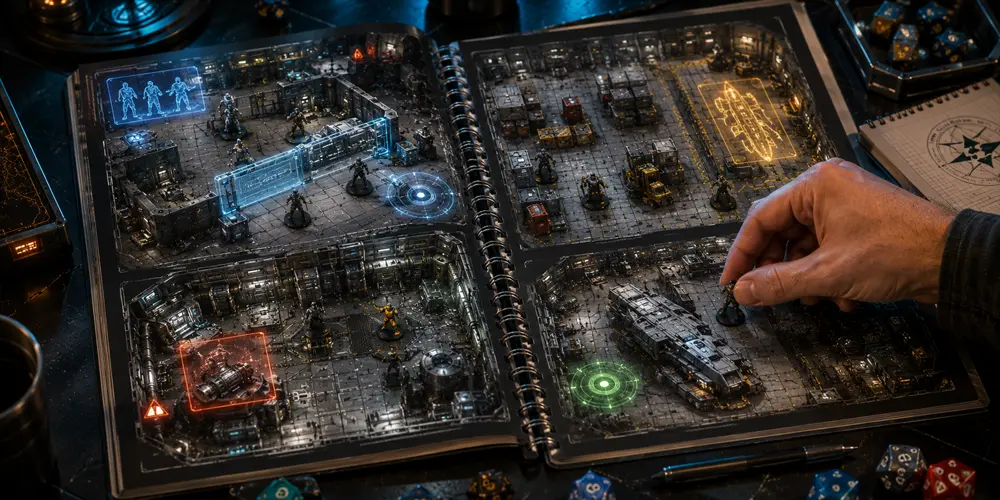
Traveller 5E Critical Locations is a deck plan and map collection designed for use with miniatures, tactical encounters, and science-fiction roleplaying scenes.
Instead of focusing only on complete starship layouts, Critical Locations provides ready-to-use places where adventures can actually happen.
These include shipboard areas, starport locations, security checkpoints, planetary environments, and other encounter spaces useful in Traveller 5E and other sci-fi RPG campaigns.
Traditional Deck Plans vs Critical Locations
Traditional Traveller deck plans usually answer one question:
Where is everything on the ship?
They show the bridge, engineering section, staterooms, cargo space, power plant, and other key parts of a vessel.
That is useful for navigation, context, and roleplaying.
Critical Locations is doing something different.
It answers a more immediate referee question:
Where is this encounter happening?
That makes it useful for boarding actions, investigations, negotiations, escapes, ambushes, security searches, and sudden firefights.
Built for Miniatures and Tactical Play
Critical Locations is designed around one-inch grid maps.
That matters because Traveller 5E is being built for players who are familiar with 5E-style tactical play and miniature-ready encounters.
The maps are intended to work with Traveller 5E miniatures, including adventurers, Army, Navy, Marine, and Starport Security figures.
For more on that side of the project, see Traveller 5E Miniatures: Adventurers, Squads, and Starport Encounters.
Fifty Maps Designed for Flexibility
The Critical Locations collection includes 50 one-inch grid maps.
The goal is flexibility.
Rather than giving referees one narrow location for one narrow use, the maps are designed to cover a wide range of common science-fiction situations.
Examples discussed for the collection include:
- Starship engineering sections
- Sick bays
- Large bridges
- Cargo offices and cargo areas
- Security checkpoints
- Spaceport locations
- Space lounges
- Hangars
- Planetary environments
- Alien worlds
That variety is important because Traveller adventures rarely stay in one place for long.
A crew may start in a starport lounge, move to a ship hangar, investigate something on a desert world, and end the session in a shipboard firefight.
The Hidden Feature: Story Seeds and Adventure Hooks
One of the strongest features of Critical Locations is that the maps are not just empty battle grids.
The collection is also intended to support referees with descriptions, story seeds, and ideas that help turn locations into playable scenes.
That matters because a good map should do more than show walls and doors.
It should make the referee ask questions.
Why is this security checkpoint so heavily armed?
Is this a frontier outpost under threat?
Is the local government paranoid?
Is the crew walking into a restricted facility, a military installation, or a starport that has seen too many smuggling incidents?
When a map inspires those kinds of questions, it becomes more than a visual aid.
It becomes an adventure generator.
A Tool for Improvising Referees
Traveller campaigns often move in unexpected directions.
Players may ignore the planned patron, chase a rumor, land on a world the referee barely prepared, or decide that the suspicious warehouse is now the most important place in the subsector.
Critical Locations is designed to help with that kind of moment.
The collection includes a reference system intended to help referees quickly find a suitable map during play.
For example, a referee looking for a desert planet location with alien technology can use the reference tools to locate a map that fits the situation instead of stopping the session to build one from scratch.
That makes the collection especially useful for sandbox Traveller campaigns.
Why the Spiral-Bound Format Matters
The physical format is also part of the design.
Critical Locations is described as a spiral-bound, lay-flat map book.
That may sound like a production detail, but it has real table value.
A lay-flat book is easier to use during play because the map stays open on the table.
The format also allows a full spread to function as one large location.
At the same time, the center binding can naturally divide a map into two usable halves.
For example, one side of a spread might show a hangar while the other side shows a security office or armory.
The referee can use the full spread when needed or focus on one side when the scene only requires part of the location.
Not Just for Traveller
Although Critical Locations is built for Traveller 5E, the maps are useful beyond one rules system.
Science-fiction referees can adapt these locations for other campaigns, including space opera, military sci-fi, exploration games, cyberpunk-adjacent settings, or homebrew science-fiction worlds.
Any game that needs starports, ship interiors, security facilities, alien terrain, hangars, or frontier installations can potentially benefit from this kind of map collection.
What Makes Critical Locations Useful?
The biggest strength of Critical Locations is that it focuses on places where things happen.
Traditional deck plans help players understand a ship.
Critical Locations helps referees run scenes.
That difference matters.
A bridge is useful when the crew is arguing with the captain.
A sick bay matters when someone is injured, poisoned, infected, or hiding evidence.
A cargo area becomes important when the manifest does not match the shipment.
A security checkpoint becomes memorable when the players are carrying something illegal.
Those are the moments Traveller is built for.
Future Tactical Maps and Ship Deck Plans
The design discussion also mentioned possible future directions for Traveller 5E maps and deck plans.
These possibilities included more planetary maps, unusual terrain, alien animal lairs, archaeological sites, asteroid communities, undersea habitats, space stations, full tactical ship deck plans, and possible one-inch hex versions.
Those should be treated as future possibilities rather than confirmed contents of Critical Locations.
For now, the important point is that Critical Locations establishes a useful format for tactical science-fiction encounter maps.
See the Traveller 5E Deck Plans Discussion
Want to hear the design team explain the map book, its format, and how the locations are intended to work at the table?
Final Thoughts
Traveller 5E Critical Locations is best understood as a referee toolkit.
It is not just a book of deck plans.
It is a collection of tactical locations, encounter spaces, visual prompts, and story-starting maps built for science-fiction roleplaying.
For Traveller referees, that may make it one of the most practical tools in the Traveller 5E lineup.
Because when the players suddenly start trouble at a starport checkpoint, board a suspicious ship, raid a cargo facility, or investigate alien ruins, the most useful map is not always a full starship deck plan.
Sometimes, it is the exact critical location where the story turns.