
Learn how Traveller trade and commerce can turn passengers, freight, mail, speculative cargo, smuggling, ship debt, trade codes, and merchant careers into long-term campaign engines.
Traveller Trade and Commerce
Mongoose Traveller is a science-fiction tabletop roleplaying game full of danger, opportunity, debt, starships, strange worlds, cargo runs, hard choices, and strange deals made in starport bars.
One of the most distinctive parts of Traveller is trade. Characters can make money by carrying passengers, hauling freight, transporting mail, buying and selling speculative cargo, taking risky contracts, operating on the wrong side of the law, or trying to keep a mortgaged ship flying one more month.
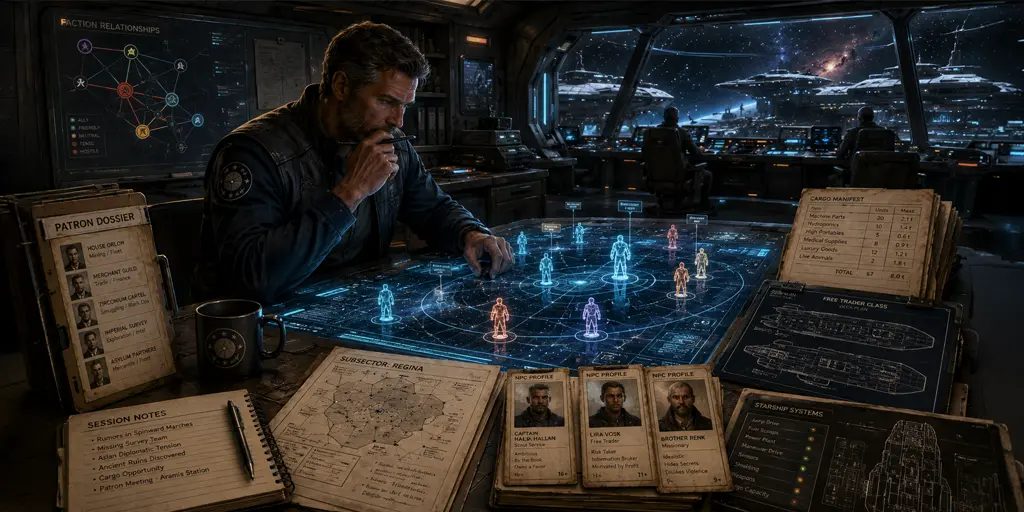
Trade is not just an accounting mini-game. Used well, it becomes a campaign engine. It tells the crew where to go next, why they need money, who they owe, what cargo is worth fighting over, what trade codes matter, and what kinds of trouble follow them from port to port.
This guide provides an overview of the main ways characters can make money through trade and commerce in Mongoose Traveller, including merchant campaigns, chartered passengers, freight, mail, speculative trading, smuggling, ship debt, trade codes, and ship ownership.
Merchant Campaigns Are Built on Pressure
A Traveller merchant campaign works best when the crew has freedom, but not comfort.
The ship lets them choose routes, jobs, passengers, cargoes, patrons, and risks. The bills make those choices matter. Mortgage payments, repairs, fuel, life support, berthing fees, cargo losses, and crew expenses all turn trade into pressure.
That pressure creates adventure without forcing the Referee to railroad the players. The crew can choose the safe cargo run, the suspicious passenger, the risky speculative deal, the patron job with strings attached, or the smuggling contract that could solve this month’s problem and create next month’s disaster.
A good merchant campaign is not just about making money. It is about deciding what risks are worth taking when the ship, the cargo, the crew, and the next payment are all on the line.
Why Trade Matters in Traveller
In many Traveller campaigns, the ship is not just transportation. It is a home, workplace, investment, debt obligation, cargo platform, social hub, and source of constant problems.
Trade gives the crew practical reasons to move through the subsector. Instead of waiting for a patron to hand them a mission, the players can chase routes, cargoes, passengers, rumors, debts, rival merchants, market shortages, and opportunities.
Good trade play can support:
- Merchant campaigns
- Free trader crews
- Speculative cargo runs
- Smuggling stories
- Passenger drama
- Ship mortgage pressure
- Starport intrigue
- Corporate rivals
- Patron jobs
- Exploration with economic consequences
Ship Debt, Cargo, and the Business Game
Trade becomes especially powerful when the crew owns or operates a ship.
A ship gives the characters independence, but it also gives them expenses. Fuel, repairs, life support, salaries, berthing fees, docking charges, cargo losses, passenger problems, insurance, legal fees, and mortgage payments all put pressure on the crew.
That pressure is useful. It gives the players a reason to take risks.
A merchant ship campaign often works best when the characters are always asking:
- Can we afford the next jump?
- Can we make the mortgage payment?
- Is this cargo worth the risk?
- Do we trust this passenger?
- Can we beat a rival ship to market?
- What happens if the cargo spoils, gets stolen, or turns out to be illegal?
- Do we follow the safe route or the profitable route?
For a practical ship-ownership estimate, use the Traveller Ship Mortgage Calculator to estimate ship payments, maintenance costs, and monthly ownership pressure.
Trade Codes Turn Worlds into Markets
Trade codes are one of the easiest ways to make Traveller commerce feel connected to the setting.
A world is not just a dot on the map. Its population, starport, law level, tech level, resources, restrictions, and trade codes all suggest what people need, what they produce, what they import, what they export, and what kinds of trouble follow the money.
For a merchant crew, trade codes can answer practical campaign questions:
- What cargo might be cheap here?
- What cargo might sell well at the destination?
- What shortages or luxuries create opportunity?
- What goods are restricted, illegal, or politically sensitive?
- What local authorities, corporations, criminals, or rivals care about this shipment?
- What happens if the crew arrives late, understocked, damaged, or carrying the wrong cargo?
Use trade codes as inspiration, not just modifiers. They can create rumors, cargo hooks, patron jobs, customs trouble, rival merchants, smuggling opportunities, and economic consequences for player choices.
Chartered Passengers
Transporting passengers is one of the most straightforward ways to make money as a trader in Traveller.
Characters who own or operate a ship can offer passage to business travelers, nobles, refugees, tourists, workers, scientists, officials, criminals, pilgrims, or anyone else who needs to get from one world to another.
Passenger service can also create strong roleplaying opportunities. A passenger might be a patron, spy, fugitive, noble, infected researcher, undercover agent, blackmail target, or future enemy.
Passenger Service Skills
The key to passenger service is balancing comfort, safety, cost, and reliability. A good Steward helps keep passengers comfortable. A Medic helps keep passengers alive, especially if low berths are involved.
The Steward skill commonly appears in careers such as:
- Citizen
- Entertainer
- Merchant
- Noble
The Medic skill may appear through several paths, including:
- Background Skills
- University
- Agent
- Army
- Citizen
- Marine
- Navy
- Rogue
- Scholar
- Scout
Characters who have both Steward and Medic can be especially valuable on passenger ships.
Finding Passengers
The following skills are commonly useful when looking for passengers:
- Broker: Useful for arranging deals and commercial passenger contracts.
- Carouse: Useful for networking, social contacts, and informal passenger opportunities.
- Streetwise: Useful for finding less formal, desperate, or questionable passengers.
Careers that often support these skills include Citizen, Entertainer, Merchant, Noble, Rogue, Agent, Drifter, and Scout, depending on the skill and assignment.
What Makes Passengers Easier to Find?
Passenger availability depends heavily on the origin world, destination world, route, and local conditions.
Things that can improve your chances of finding passengers include:
- A skilled Steward on the crew
- Offering low passage
- An origin or destination world with population 6+
- An origin or destination world with Starport A or B
- An origin or destination world with Amber Zone status
Things that can reduce your chances of finding passengers include:
- Offering high passage
- Distant destinations
- An origin or destination world with population 1 or less
- An origin or destination world with Starport E or X
- An origin or destination world with Red Zone status
Remember that passengers require space. You need staterooms, low berths, luggage space, life support, food, safety procedures, and crew capable of handling problems during the trip.
Moving Freight and Mail
Transporting goods and mail is another reliable way to earn money in Mongoose Traveller.
Freight and mail are especially useful because they can give the crew a practical reason to travel somewhere they already wanted to go. If the ship is jumping to another system anyway, carrying cargo can help pay for fuel, repairs, mortgage payments, and crew expenses.
Hauling Freight
Freight comes in different cargo sizes, including major, minor, and incidental cargo lots. A ship with spare cargo space may be able to pick up freight heading toward the same destination as the crew.
Payment depends on how much freight is carried and how far it is transported, usually based on the shortest route.
A small ship with modest cargo space can still make meaningful money if it consistently hauls freight along useful routes. Freight will rarely make the crew rich overnight, but it helps keep the ship operating.
Finding Freight
The following skills are often useful when looking for freight:
- Broker: Finding commercial cargoes and negotiating deals.
- Streetwise: Finding informal, urgent, questionable, or off-book cargoes.
Things that can improve your chances of finding freight include:
- Shipping incidental cargo
- An origin or destination world with population 6+
- An origin or destination world with Starport A or B
- An origin or destination world with Tech Level 9+
Things that can reduce your chances of finding freight include:
- Shipping major cargo
- Distant destinations
- An origin or destination world with population 1 or less
- An origin or destination world with Starport E or X
- An origin or destination world with Tech Level 6 or less
- An origin or destination world with Red Zone or Amber Zone status
Freight creates practical shipboard concerns. Cargo must be secured, protected, tracked, loaded, unloaded, and sometimes defended. A cargo hold is not just a number on a sheet; it is a location where adventure can happen.
Hauling Mail
Mail cargoes may include digital mail in secure data containers, official correspondence, parcels, personal messages, packages, legal documents, diplomatic pouches, or other time-sensitive deliveries.
Think of mail service as a cross between space FedEx, space UPS, and an independent postal contract.
No special skill may be required to find mail, but the availability of mail often depends on the same kinds of world and route factors that affect freight.
Things that can improve your chances of finding mail include:
- An origin or destination world with population 6+
- An origin or destination world with Starport A or B
- An origin or destination world with Tech Level 9+
- An armed ship
- High-ranking Scout or Navy personnel aboard
- A strong SOC modifier in the party
- A high freight traffic modifier
Things that can reduce your chances of finding mail include:
- An origin or destination world with population 1 or less
- An origin or destination world with Starport E or X
- An origin or destination world with Tech Level 6 or less
- An origin or destination world with Red Zone or Amber Zone status
- A low freight traffic modifier
Mail can be profitable, but it can also create complications. If someone wants a container intercepted, stolen, forged, delayed, or secretly inspected, the crew may discover that mail is not always boring.
Speculative Trading
Speculative trading is riskier and more complex than carrying freight. Instead of being paid to transport someone else’s goods, the crew buys cargo with their own money and tries to sell it later at a profit.
The key to speculative trading is finding the right goods, understanding the market, reading trade codes, negotiating purchase and sale prices, and avoiding routes where the cargo will be hard to move.
This is where merchant campaigns can become very interesting. The players are not just accepting jobs. They are making business decisions.
Finding a Supplier
The skill used to find a supplier depends on the type of goods and the method used to locate them.
- Broker: Finding suppliers through normal starport and commercial channels.
- Admin: Finding suppliers through formal systems, records, contracts, databases, or bureaucracy.
- Streetwise: Finding illegal, restricted, black-market, or unofficial suppliers.
A better starport usually makes it easier to find suppliers, especially for legitimate trade goods.
Determining Goods Available
The availability of goods depends on local market size, population, trade codes, starport quality, and the kind of cargo being sought.
Low-population worlds may have fewer goods available. High-population worlds are more likely to have larger markets and more opportunities.
Consult the Trade section of the Traveller Core Rulebook Update 2022 for the official tables and modifiers.
Determining Purchase Price
Broker is the key skill for negotiating purchase price.
Trade goods may have purchase modifiers based on the current world’s trade codes. These modifiers can make some goods cheaper or more expensive depending on where the crew buys them.
Things that can improve your purchase price include:
- A strong Broker skill
- Favorable trade code modifiers
- A weak supplier Broker skill
- Good timing
- Useful information
Things that can hurt your purchase price include:
- A weak Broker skill
- Unfavorable trade code modifiers
- A skilled supplier
- Limited supply
- Buying under pressure
Selling the Goods
When selling speculative cargo, the crew must find a buyer and negotiate a sale price.
The final price is affected by the destination world’s trade codes, the seller’s Broker skill, the buyer’s Broker skill, and the rules for that cargo type.
If the price is poor, the crew may be able to wait and try again later. That decision creates another tradeoff: hold the cargo and risk expenses, delays, and trouble, or sell now and free up the hold for the next opportunity.
Smuggling and Questionable Cargo
Smuggling is speculative trading with extra risk.
Illegal or restricted goods may offer higher profits, but they can also attract customs agents, law enforcement, pirates, rivals, informants, angry clients, or criminal syndicates.
Smuggling works best when the campaign treats it as more than a die roll. The crew needs routes, contacts, fake paperwork, hidden compartments, corrupt officials, fast ships, plausible cover stories, and a plan for when inspections go badly.
Useful smuggling-related skills may include:
- Streetwise for black-market contacts
- Broker for deals and pricing
- Admin for paperwork and permits
- Deception for cover stories
- Stealth for concealment
- Electronics for sensors and security systems
- Pilot for risky approaches and escapes
Smuggling can be profitable, but it should create consequences. Every illegal job is also an adventure hook.
Merchant NPCs, Brokers, Rivals, and Cargo Contacts
Trade campaigns need people as much as they need cargo.
A merchant crew will meet brokers, customs officers, freight agents, passengers, rivals, investors, creditors, smugglers, port officials, corporate representatives, and patrons. Those NPCs turn commerce into relationships, favors, debts, grudges, and opportunities.
For quick merchant-campaign NPC support, use Human Resource Database / HRD Merchants as brokers, rival traders, cargo contacts, passengers, patrons, freight agents, smugglers, or people waiting at the next starport with a problem.
Merchant NPCs are especially useful when the crew needs:
- A cargo broker with a suspiciously profitable deal
- A rival trader racing for the same market
- A passenger who is not what they claim to be
- A port official who can delay the ship
- A lender, investor, or creditor applying pressure
- A smuggler who knows a route around customs
- A patron who can solve one problem by creating another
Useful Traveller Tools for Trade Campaigns
Trade campaigns depend on distance, time, routes, and ship economics. These tools can help you plan merchant runs and make ship operations easier at the table:
- Traveller RPG Ship Travel Time Calculator - Estimate how long in-system trips take.
- Traveller RPG Ship Distance Traveled Calculator - Estimate distance traveled over time at a given thrust.
- Traveller 100D Jump-Clearance Calculator - Estimate safe jump distance from a world or star.
- Traveller Ship Mortgage Calculator - Estimate ship payments and ownership pressure.
Give Your Merchant Crew a Ship They Can Use
If your campaign focuses on trade, the ship becomes a recurring location. A good deck plan helps players understand where cargo is stored, where passengers sleep, where trouble starts, and what parts of the ship matter during emergencies.
Use deck plans for cargo loading, stateroom assignments, passenger scenes, customs inspections, smuggling complications, emergency landings, boarding actions, repairs, and derelict exploration.
CyborgPrime publishes Traveller-style starship deck plans and VTT-ready maps for Roll20 and other virtual tabletops.
- Free Far Trader Illustrated Deck Plans: Download the Far Trader deck plans
- Traveller VTT maps and Roll20 assets: Browse CyborgPrime on Roll20
- More CyborgPrime Traveller and sci-fi RPG products: Browse CyborgPrime on DriveThruRPG
Trade and Commerce Summary
Trade and commerce can play a major role in Mongoose Traveller. Passengers, freight, mail, speculative cargo, smuggling, ship ownership, trade codes, and merchant NPCs all give players ways to pursue wealth, independence, debt relief, status, and trouble.
The best trade campaigns are not only about profit. They are about decisions.
Where does the crew go next? Which cargo is worth the risk? Who do they trust? What debts are coming due? What happens when the most profitable deal is also the most dangerous?
With the right ship, crew, contacts, skills, trade routes, and luck, your Travellers can become honest merchants, desperate free traders, corporate operators, smugglers, private couriers, or something in between.
Keep Building Your Traveller Toolkit
If this guide helped you think about trade and commerce, Beyond the Horizon: The Ultimate Guide to Playing Mongoose Traveller expands on the ideas in this article series with more practical guidance for players and referees.
Running or preparing a Traveller campaign? Explore the CyborgPrime AI Tools for Game Masters for trade routes, patrons, cargo complications, worldbuilding, and referee prep.
Your Turn. What Do You Do?
What kind of Traveller business would your crew build: passenger service, freight hauler, speculative trader, mail courier, smuggling operation, or something stranger?
Please share your thoughts in the Comments section below.
If you found this article helpful, please give it a good rating at the top. Thanks!
Get More Traveller Trade and Starship Resources
Want more Traveller RPG articles, ship tools, trade-campaign ideas, deck-plan updates, and referee resources?
Join my private mailing list and I’ll let you know when new Traveller-related tools and posts are published.
YES! Please notify me of new Traveller RPG tools and posts!
You can also join me and other Traveller fans on the CyborgPrime Discord server.