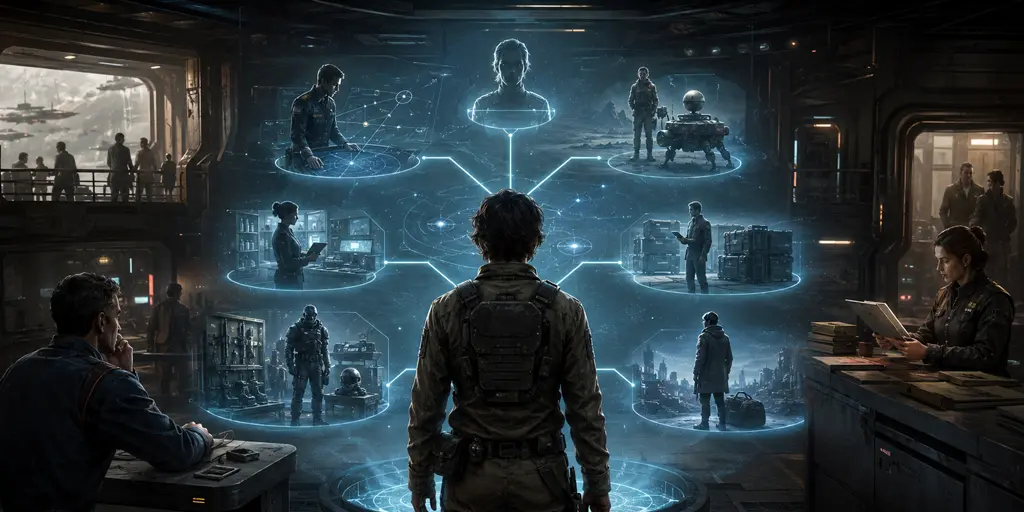
Learn how Traveller RPG careers work, why Traveller careers are not classes, how to choose a character path, and how lifepath results create skills, history, contacts, rivals, enemies, debts, benefits, and adventure hooks.
Part of the Traveller character creation learning path. Start with the Traveller Character Creation Guide if you want the full lifepath overview.
Traveller RPG Careers Explained
Careers are one of the defining parts of Mongoose Traveller character creation. Instead of beginning play as a blank slate, your Traveller begins with a history.
That history may include jobs held, skills learned, risks taken, people met, enemies made, debts owed, ships served on, injuries survived, and opportunities lost.
In Traveller, a career describes what your character did before the campaign begins. It helps create the person who walks into the first session.
For the complete official list of careers, rules, skills, events, and benefits, refer to the Traveller Core Rulebook Update 2022.
If you want to try Traveller before buying the full rulebook, you can also get the Traveller Explorer's Edition, a low-cost introductory Traveller PDF.
Once you have chosen your Background Skills, the next major decision is your first career.
Quick Character Creation Links
Careers make the most sense when you understand the whole Traveller lifepath process. These related guides can help:
- Traveller Character Creation Guide
- Mongoose Traveller Character Creation: Rolling Characteristics
- Mongoose Traveller Character Creation: Background Skills
- Traveller Character Creation: Best Background Skills
- Mongoose Traveller Character Creation: Mustering-Out Benefits
- Mongoose Traveller RPG Character Development: Fleshing Out Your Character
- What To Do When Traveller Character Creation Gives You the Wrong Career
New to Traveller? Download the free Introduction to Traveller PDF.
Are Traveller Careers Like Classes?
No. Traveller careers are not classes.
If you are coming from Dungeons & Dragons or another class-based fantasy RPG, it is tempting to think of Traveller careers as classes and assignments as subclasses. That comparison can help for a moment, but it can also lead you in the wrong direction.
A fantasy class usually describes what your character is during play. A Traveller career describes what your character did before play.
| Fantasy Class | Traveller Career |
|---|---|
| Defines what your character is during play | Describes what your character did before play |
| Often controls powers, abilities, and advancement | Creates skills, events, benefits, contacts, rivals, and history |
| Usually follows a fixed progression path | Can change during character creation |
| Often answers “what role do I play?” | Often answers “what happened to me before the campaign?” |
A Traveller character might serve one term as an Agent, fail to qualify for another career, drift for a term, attend university, become a Scholar, and begin play as an investigator with academic contacts and a criminal enemy.
That character is not locked into a class. They are a person with a messy work history.
What If You Do Not Get the Career You Wanted?
Traveller character creation can change your plans.
You might sit down wanting to create a Marine and end up with a Scholar. You might plan for a Scout and end up as a Merchant. You might imagine a noble officer and end up with a wounded Drifter carrying bad debts and worse memories.
That is not a mistake. It is part of the point.
Traveller’s lifepath system creates characters shaped by opportunity, failure, risk, survival, and surprise. Sometimes the dice push your character away from the concept you had in mind and toward something more interesting.
When that happens, you have several good options:
- Roll with it. Treat the unexpected career as the character’s real history.
- Adjust the concept. Keep the core idea, but explain how the career changed the character.
- Talk to the Referee. Ask whether a small swap, reroll, or campaign-specific adjustment makes sense.
- Save the result as an NPC. A character you do not want to play may still become a useful patron, rival, contact, or backup character.
- Start again. Character creation should create playable inspiration, not trap you with a character you dislike.
For more help with that situation, read What To Do When Traveller Character Creation Gives You the Wrong Career.
Before You Choose a Career: Start with a Flexible Concept
Before choosing a career, it helps to sketch a simple character concept. You do not need a full biography. A few useful ideas are enough to guide your choices.
Ask yourself:
- Where was your character born?
- What kind of homeworld shaped them?
- Did they grow up rich, poor, comfortable, isolated, or desperate?
- Did they come from a high-tech world, a low-tech world, or something in between?
- What made them leave home?
- What did they want before the lifepath system changed things?
- Are they ambitious, loyal, curious, reckless, dutiful, bitter, or running from something?
Then stay flexible. Traveller characters often become stronger when the dice complicate your first idea.
Pre-Career Education: University or Military Academy
During the first three terms of character creation, some characters may choose pre-career education such as university or military academy.
You can also create a “gap years” story by entering a regular career for one or two terms, then applying for university or military academy later if your character still qualifies.
Reasons to Apply to University
- Improve selected skills.
- Improve EDU.
- Open doors into certain careers.
- Create an academic background, social network, or useful credential.
Reasons to Apply to Military Academy
- Gain military service skills.
- Prepare for a specific branch of service.
- Improve EDU and possibly SOC.
- Enter the associated military branch more directly.
- Create a clear military background before active service.
If your character does not feel like someone who would attend school or academy, skip pre-career education and go straight into a career. That is a perfectly valid Traveller path.
Main Careers in Mongoose Traveller
There are twelve main career choices in Mongoose Traveller. Each career has three assignments or specialties, giving you room to shape the character without locking them into a class.
- Agent
- Army
- Citizen
- Drifter
- Entertainer
- Marine
- Merchant
- Navy
- Noble
- Rogue
- Scholar
- Scout
There are also two special careers: Psion and Prisoner. These are special cases, and most characters do not begin with either path unless the character generation process sends them there or the Referee permits it.
Careers and specialties shape your character, but they do not create a permanent class identity. A character might move through several careers before play begins. The result is not a build path. It is a biography.
Career Qualification
Each career has a qualification roll based on one of your character’s characteristics. This roll represents whether your character is accepted into that line of work.
If you fail to qualify for the career you wanted, the story changes. You may be drafted, become a Drifter, or pursue another path depending on the rules and the Referee’s campaign.
Careers with lower qualification numbers are easier to enter. When choosing a career, look for paths where your character has strong characteristic modifiers.
Do not treat a failed qualification roll as wasted time. It can explain why your character changed direction, missed an opportunity, joined the wrong service, or took work they never expected to take.
Skills and Training
Each term spent in a career gives your character a chance to gain or improve skills. These skills represent what the character learned through training, work, survival, accidents, promotions, and experience.
Career skill choices also connect back to your starting background skills. Before you commit to a career, you may want to compare your choices against the best Traveller background skills so you do not accidentally duplicate a skill your first career is likely to provide.
How Skill Results Work
If a skill is listed without a number, increase that skill by 1 level.
For example, if you receive Investigate and do not already have it, you gain Investigate 1. If you already have Investigate 1, it becomes Investigate 2.
If a skill is listed with a number, you receive that skill at the listed level. If your skill is already equal to or higher than that level, it usually does not increase.
For example, Recon 1 means you gain Recon 1 if you do not already have it at that level.
That does not have to feel like a wasted result. It may simply confirm that your character already has the expected level of training for that role.
Career Basic Training
For your first career only, you gain all six Service Skills for that career at level 0 as basic training.
For later careers, you usually choose one skill from the Service Skills list for that career and gain it at level 0.
For example, if Agent is your first career, basic training gives you broad familiarity with the Agent service skill set. If you later switch to Entertainer, you do not receive the full Entertainer basic training package; you gain a smaller amount of new training from that career.
This is one reason the first career matters. It gives your character a foundation, even if their life later changes direction.
Survival
Surviving a career term does not usually mean avoiding death. It means your character made it through that term without a mishap that forced them out of the career.
For military characters, a failed survival roll might mean injury, disaster, operational failure, political fallout, or being removed from service.
For civilian characters, it might mean bankruptcy, scandal, betrayal, burnout, blacklisting, legal trouble, or a serious professional mistake.
Survival rolls are not just mechanical hurdles. They tell you what kind of trouble followed your character before the campaign started.
Career Events
If your character survives the term, they roll for a career event.
Events can be good, bad, strange, lucky, dangerous, or morally complicated. Some provide benefits. Others create new problems. Many create useful roleplaying hooks.
A law enforcement character might be offered a bribe. A merchant might make a powerful contact. A scout might discover something they were not supposed to find. A noble might become entangled in a political dispute.
Career events are one of Traveller’s strongest character creation tools because they connect rules to story.
Life Events
Sometimes the rules direct you to the Life Events table. These events happen outside your career.
Life events can represent relationships, disasters, windfalls, betrayals, family trouble, discoveries, unusual opportunities, or personal complications.
For players, life events help explain who the character is. For Referees, they create ready-made adventure hooks.
Career Advancement
Each career has an Advancement roll. This determines whether your character gains rank, status, extra benefits, or additional skills.
Advancement can make a character more competent and more connected, but staying in a career longer also means taking more risks. More terms can mean more skills and benefits, but also aging, injuries, enemies, mishaps, and unwanted obligations.
Traveller character creation is full of that push-your-luck tension.
Commissions
Military characters may be able to attempt a Commission roll. A successful commission makes the character an officer and may change their advancement path.
This can be useful if you want a character with leadership experience, formal authority, military contacts, rank-based benefits, or a complicated service history.
It can also create tension. An officer may have old loyalties, former subordinates, rivals, duties, or enemies who remember them.
Mustering-Out Benefits
Characters collect mustering-out benefits when they leave a career. These benefits may include cash, equipment, contacts, ship shares, weapons, stat improvements, pensions, or other long-term results of service.
Benefits matter because they shape what your character brings into the campaign.
Some careers are better for money. Some are better for ships. Some are better for status, equipment, weapons, contacts, or specialized tools.
For more detail on this stage, read Mongoose Traveller Character Creation: Mustering-Out Benefits.
Aging and Injury
At the end of each term, your character grows older. Eventually, aging can become a real risk.
Characters can also suffer injuries from mishaps, career events, life events, or aging. An injured character may begin play with reduced characteristics, medical debt, or a story about what went wrong.
These results can be frustrating if you expected character creation to be a clean optimization process. But in Traveller, scars and complications are part of what make characters feel lived-in.
Connections Between Player Characters
Traveller allows player characters to create Connections before play begins.
If two players agree, an event from one character’s history can involve another player character. If they explain how their histories connect, both characters may gain an additional skill.
This is one of the best ways to avoid the “random strangers meeting for the first time” problem.
Connections can represent shared military service, family ties, business partnerships, debts, betrayals, favors, old rescues, failed jobs, academy days, shipboard service, or mutual enemies.
Use Connections to make the player characters feel like a crew before the first adventure begins.
Choosing Whether to Continue
At the end of a term, the player decides whether the character continues in the same career, changes careers, or ends character generation and begins play.
Ask yourself:
- Are you happy with the character’s current skills?
- Do you want more money, benefits, rank, or ship shares?
- Are you willing to risk aging, injury, mishaps, or unwanted career changes?
- Does the character already feel interesting enough to play?
- Would another term make the character better, or just more complicated?
If the character still feels unfinished, continue. If they already have enough skills, history, and problems, stop and bring them into the campaign.
Getting Something Unexpected
Traveller character creation can produce characters you did not expect.
Maybe you wanted a space marine and ended up with an entertainer. Maybe your scholar became a drifter. Maybe your merchant gained enemies, debt, and a battered old ship. Maybe your noble washed out of military academy and became an Agent with something to prove.
That unpredictability is part of Traveller’s charm.
Sometimes the best characters are the ones you discover through the lifepath system rather than design in advance.
For more advice on handling unexpected lifepath results, read What To Do When Traveller Character Creation Gives You the Wrong Career.
Referee tip: Keep unused characters, abandoned lifepath results, quick NPCs, name lists, and ready-made contacts. They are useful for pickup games, replacement characters, rivals, patrons, passengers, crew members, and background NPCs.
Need Ready-to-Use Career-Based NPCs?
If you want quick examples of career-based characters at the table, the Sci-Fi RPG Starter Pack bundles ready-to-use marines, merchants, modern name generators, and starship complications for busy sci-fi referees.
Use it when you need pregenerated NPCs, backup characters, contacts, rivals, passengers, crew members, or quick names during character creation or live play.
Traveller Career Summary
Mongoose Traveller careers give characters more than skills. They create a history.
By the time character creation ends, your Traveller may have served in the military, attended university, survived a disaster, gained a rival, made an ally, taken on debt, earned ship shares, suffered an injury, changed direction completely, or discovered they were never the person you first imagined.
That history gives the Referee useful hooks and gives the player a stronger sense of who the character is before the first adventure begins.
The most important thing to remember is this:
A Traveller career is not a class. It is the story of what happened before play began.
Build a Stronger Traveller Character
If this guide helped you understand careers, continue through the full character creation series:
- Traveller Character Creation Guide
- Rolling Characteristics
- Background Skills
- Best Background Skills
- Mustering-Out Benefits
- Character Development
- Wrong Career Advice
For deeper advice, expanded examples, and practical guidance for players and referees, check out Beyond the Horizon: The Ultimate Guide to Playing Mongoose Traveller.
Need quick NPCs, names, contacts, rivals, passengers, crew, or backup characters? The Sci-Fi RPG Starter Pack includes ready-to-use marines, merchants, modern name generators, and starship complications for busy sci-fi referees.
Running or preparing a Traveller campaign? Explore CyborgPrime AI Tools for Game Masters for campaign prep, worldbuilding, character ideas, patrons, and referee support.
Your Turn. What Do You Do?
What Traveller career would you choose for your next character? Would you stay in one career, switch careers, or push your luck for one more term?
Please share your thoughts in the Comments section below.
If you found this article helpful, please give it a good rating at the top. Thanks!
Get More Traveller Character Creation Help
Want more help with Traveller careers, background skills, characteristics, mustering-out benefits, lifepath events, and character development?
Join the Traveller Character Creation list and I’ll send character creation tips, career guides, skill resources, and CyborgPrime updates.
You can also join me and other Traveller fans on the CyborgPrime Discord server.