Creating a Traveller is only the beginning—the real challenge is turning skills, crew teamwork, preparation, and hard choices into survival and success.
Character creation gives you a Traveller with skills, history, contacts, equipment, and complications. It does not automatically teach you how to use those things well at the table. Good Traveller play is less about winning every roll and more about improving the situation before the dice hit the table.
This guide focuses on what happens after character creation: supporting the crew, using skills intelligently, preparing for missions, choosing equipment, surviving danger, and turning your character’s past into future play. New players who still need the broader foundation can begin with the free Introduction to Traveller. Players still building a character can use the Traveller Character Creation Guide.
Central principle: Traveller rewards players who gather information, prepare intelligently, cooperate with the crew, manage risk, and turn consequences into further play.
The Traveller Player Mindset
Traveller works best when the crew treats problems as situations to understand rather than obstacles that demand an immediate roll. A locked hatch might be opened, bypassed, cut through, accessed with credentials, or avoided entirely. A hostile official might be persuaded, delayed, researched, bribed, out-ranked, or given a reason to cooperate. A firefight might be prevented by changing the route, timing, cover, or objective.
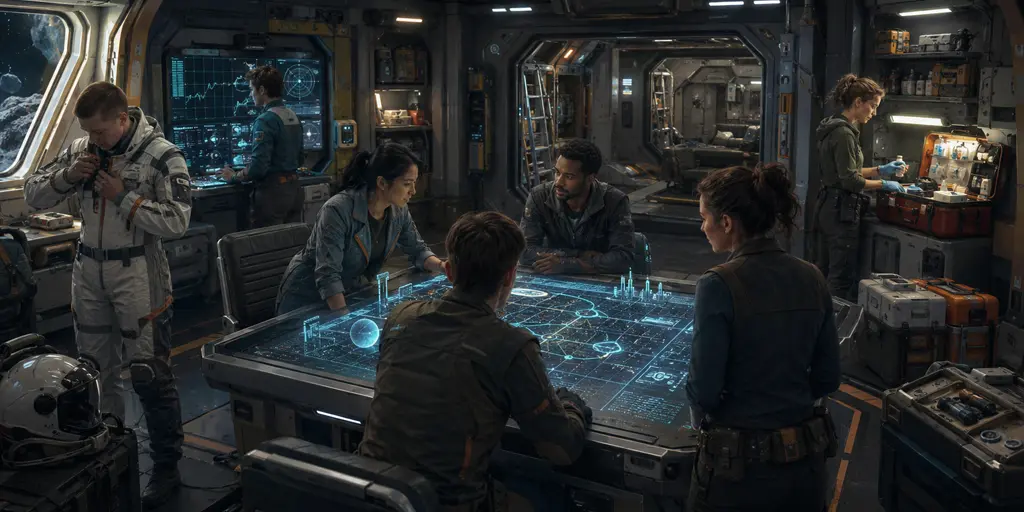
The crew succeeds together. One character may be the best pilot, medic, broker, or engineer, but the mission rarely depends on only one skill. Useful players share information, create favorable conditions, protect specialists, and keep the crew focused on the objective.
Preparation is part of play. Maps, environmental readings, legal restrictions, schedules, identities, tools, medical supplies, transport, and extraction plans can matter as much as a high skill level. Information is not background decoration; it is part of the crew’s loadout.
Combat is dangerous rather than automatic. Violence can solve a problem, but it can also create injuries, legal consequences, damaged equipment, lost allies, and enemies who remember the crew. Retreat, negotiation, deception, surrender, and delay are not failures when they preserve the crew or achieve the objective.
Your character’s history should shape decisions. Careers, contacts, rivals, mishaps, debts, injuries, and old loyalties are not finished once character creation ends. They explain what your Traveller notices, fears, values, avoids, and pursues.
Finally, failure should create a new situation. A failed attempt may cost time, expose the crew, damage trust, attract attention, or force a different route. The question is usually not “Did the adventure stop?” but “What changed, and what do we do now?”
Join and Support the Crew
A Traveller crew usually needs several responsibilities covered, but those responsibilities are not permanent character classes. A former scout can negotiate. A broker can operate sensors. A medic can help plan an infiltration. A naval engineer can become the crew’s investigator because their history gives them the right contacts.
Crew roles are current responsibilities, not permanent character classes.
Before a campaign or mission begins, agree on how the group makes decisions, divides rewards, pays expenses, handles shared debts, and responds when one character’s goals conflict with the crew’s interests. A useful Traveller session zero can establish those expectations before pressure exposes them.
| Role | Main Contribution | Backup Contribution |
|---|---|---|
| Pilot | Operates ships and vehicles | Navigation, sensors, escape planning |
| Engineer | Repairs and maintenance | Damage control and technical diagnosis |
| Medic | Treatment and stabilization | Medical planning and hazard review |
| Broker | Trade and negotiation | Research, contacts, and documentation |
| Security | Protection and tactical control | Reconnaissance and route security |
Choose a main responsibility and at least one backup contribution. The backup does not need to match your highest skill. It only needs to answer a recurring crew need. A character who can handle communications, monitor exits, organize evidence, keep track of local laws, or prepare equipment is contributing even when another Traveller makes the decisive check.
Contribute Outside Your Specialty
A lower skill does not mean your character has nothing useful to do. Specialists perform better when the rest of the crew creates the right conditions around them.
- Assist with a defined task. Hold a component, cross-check data, translate jargon, manage a patient, or feed the specialist useful information.
- Ask questions that change the plan. Who controls access? What happens after the alarm? Which exit remains open? What evidence would persuade the official?
- Prepare tools and surroundings. Move the injured crewmate to cover, establish lighting, isolate a system, clear a workspace, or ready the correct kit.
- Protect attention. Watch for danger while another character works, handle interruptions, maintain communications, or control the route back.
- Pursue a secondary objective. Record evidence, identify witnesses, secure transport, verify credentials, or contact someone who can help.
The best assistance is specific. “I help” gives the Referee little to work with. “I compare the signal against our previous recordings while the sensor operator isolates the source” explains what the character contributes and why it might matter.
Use Traveller Skills Effectively
A task check is shaped by more than the skill written on the character sheet. The relevant characteristic, difficulty, situational modifiers, time, tools, assistance, and consequences all affect the decision. The Traveller Skills Index can help players understand where their abilities apply, but effective play begins by describing an approach rather than naming a skill and rolling immediately.
Use Zero-Level Skills as Real Capabilities
A zero-level skill generally represents basic familiarity. It can provide backup capability, support assistance, and help a Traveller handle routine parts of a larger problem. Those modest capabilities matter in a game built around crews.
A character with a zero-level technical, social, vehicle, or survival skill may not replace the expert under pressure, but can recognize basic procedures, prepare the work, notice obvious mistakes, and keep the mission moving. The guide to Traveller background skills provides useful context for how those broad foundations enter play.
Describe the Characteristic Behind the Approach
Players should explain what the character is doing and how they are doing it. The Referee decides which characteristic fits the situation.
- Strength may matter when forcing machinery or moving a heavy obstruction.
- Dexterity may matter for delicate work, balance, speed, or precise control.
- Endurance may matter during sustained exertion, exposure, or prolonged effort.
- Intellect may matter when diagnosing a new problem or improvising a solution.
- Education may matter when applying learned technical or institutional knowledge.
- Social Standing may matter when status, reputation, or institutional influence changes access.
The point is not to shop for the best modifier. The point is to make the fictional approach clear enough that the Referee can judge what applies.
Take Time, Use Tools, and Create Assistance
Use this comparison to turn a rushed task check into a safer, better-supported approach.
| Situation | Weak Approach | Better Approach |
|---|---|---|
| Locked hatch | Roll immediately | Inspect the mechanism, identify the access system, and obtain suitable tools |
| Injured crewmate | Treat in the open | Move to cover, control the scene, and prepare the medical kit |
| Unknown signal | Guess what it means | Record it, compare it with known data, and analyze changes over time |
| Negotiation | Everyone talks at once | Choose a lead, define the desired outcome, and feed the lead useful facts |
Time and tools are not decorations. Research, sensors, computers, specialist kits, medical equipment, credentials, and a controlled workspace can change whether a task is possible, how risky it is, or what failure means.
Before You Roll
Use this quick decision check whenever the crew faces an uncertain task:
- Can information solve the problem?
- Should a specialist lead?
- Can tools remove uncertainty?
- Would more time improve the situation?
- Can a contact provide access, context, or leverage?
- Can the problem be bypassed?
- Can the crew change the conditions before acting?
- What happens if the attempt fails?
- Is the risk worth the likely result?
This does not mean avoiding every roll. It means rolling after the crew understands what it is risking and has made the best practical choices available.
Prepare for the Mission
Mission preparation turns a vague job into a shared plan. Before departure, establish the objective, success condition, unknowns, assignments, environment, laws, equipment, transportation, communications, medical support, extraction plan, and likely consequences of failure.
Define the Objective and Success Condition
“Investigate the station” is broad. “Identify the source of the signal and return with evidence without alerting station security” gives the crew something it can plan around. A clear success condition also prevents the group from drifting into unnecessary danger after the main task is complete.
Assign Work Before Pressure Begins
Decide who leads navigation, negotiation, technical work, medical response, security, communications, and extraction. Assign a backup for the functions the crew cannot afford to lose. A plan that depends on one conscious, available specialist is fragile.
Treat Information as Equipment
Useful mission information may include maps, law levels, environmental data, personnel records, ship specifications, communication frequencies, credentials, market data, medical risks, escape routes, shift schedules, and faction relationships.
A crew carrying excellent weapons but no map, legal context, medical plan, or way home is not well equipped. It is merely armed.
Choose Equipment for the Actual Mission
Equipment should match the objective, environment, duration, law level, concealment requirements, distance from support, expected danger, transportation, and extraction plan. The best equipment solves the mission without creating unnecessary problems.
Mission-Specific Gear Beats Habitual Loadouts
A vacc suit may be essential for a damaged station and obstructive at a formal meeting. Heavy armor may protect a character in open conflict but attract attention, violate local restrictions, or make discreet movement impossible. A weapon that cannot be carried legally or concealed appropriately may create the very encounter the crew hoped to avoid.
Pack for the likely hazards and the consequences of being wrong. Medical supplies, atmosphere protection, communications, illumination, power, tools, restraint equipment, documentation, and emergency transport often matter before weapons do.
Check Law, Access, and Social Consequences
Before carrying weapons, armor, controlled technology, or suspicious tools, learn what local authorities permit and how enforcement works. Legality is not the only concern. An item may be legal but socially alarming, professionally inappropriate, or impossible to explain at a checkpoint.
Plan for Survival and Recovery
Environmental danger is common in science-fiction travel. Vacuum, hostile atmospheres, radiation, temperature, fire, disease, rough terrain, and distance from medical support should influence the loadout. Players preparing for those risks can continue with the guide to survival and exploration skills in Traveller.
Survive Combat and Other Danger
Danger in Traveller includes more than firearms and melee. Decompression, radiation, fire, disease, vehicle crashes, shipboard emergencies, arrest, and detention can end a mission just as effectively as hostile gunfire.
Enter Danger With a Purpose
Enter danger with an objective, a position, an exit plan, and a reason.
Useful combat objectives include escaping, rescuing someone, delaying pursuit, capturing a target, retrieving an item, protecting a person, disabling a system, reaching transport, preventing pursuit, or forcing surrender. “Defeat everyone” is rarely the only possible objective and often creates unnecessary risk.
Use Cover, Range, Armor, and Movement
Before shooting, ask where the crew can take cover, where opponents can move, which ranges favor the available weapons, and how the group will leave. Armor matters, but it does not make a character invulnerable. Position and timing often determine whether armor is tested at all.
Prepare Medical Support Before the First Injury
Know who carries medical supplies, who can provide immediate aid, where the casualty will be moved, and how the crew will reach better treatment. Do not wait for someone to fall before deciding who protects the medic or controls the route to extraction.
Normalize Retreat, Negotiation, and Surrender
Retreat is intelligent when the objective is lost, the crew is outmatched, or continued fighting creates more risk than value. Negotiation can preserve relationships and reveal information. Surrender can keep characters alive when resistance has become pointless. These decisions are not automatically cowardly; their value depends on the crew’s goals and the consequences.
Roleplay Your Lifepath Results
Your character sheet contains more than mechanical options. It also contains reasons for the character to make particular choices. Use the character creation lifepath as active campaign material rather than finished backstory.
Turn Career History Into Play
Ask what the character learned beyond the listed skills, who remembers them, why they left, what obligations remain, and which habits still shape their behavior. A former naval officer may understand procedure but distrust command. A merchant may know how to read a contract and also recognize the name of a dangerous broker. A scholar may have access to institutions while carrying an old professional rivalry.
Give Contacts Needs and Limits
Contacts can provide information, favors, access, shelter, employment, equipment, introductions, or trouble. A useful contact is not an unlimited resource. They have their own risks, loyalties, needs, and boundaries.
When asking for help, state what the character wants, why the contact might agree, and what the contact may expect in return. This turns a name on the sheet into a relationship.
Use Rivals as More Than Enemies
A rival may be a competitor, former colleague, relative, critic, political opponent, rejected partner, or another person pursuing the same goal. Rivals can cooperate temporarily, provide reluctant information, expose the character’s weaknesses, or force difficult choices without becoming simple combat targets.
Let Events and Mishaps Leave Marks
Past events can create fear, injury, debt, reputation, regret, loyalty, or unfinished business. Decide what the character avoids because of a mishap, what they refuse to abandon, and what kind of situation brings an old memory back to the surface.
Pursue a Personal Goal
Personal goals give the character direction between jobs. A Traveller might repay a debt, restore a reputation, find someone, build a business, acquire a ship, protect a community, solve a mystery, or earn status. The goal should create choices rather than demand that the whole campaign revolve around one character.
Use Downtime to Change the Campaign
Downtime is not passive bookkeeping. It is a chance to heal, train, maintain equipment, trade, contact allies, investigate, pursue projects, repair relationships, develop a business, research mysteries, and prepare for future risks.
Choose downtime actions that create an advantage, answer a question, repair a weakness, or move a personal goal forward. A trader might study a market before the next jump. An engineer might source a difficult component. A medic might investigate a recurring illness. A character with a strained contact might spend time rebuilding trust.
Downtime lets players change the campaign instead of waiting for the next job.
Traveller for Players From Class-Based RPGs
Players coming from class-based fantasy games already understand teamwork, character identity, risk, and shared adventure. The main adjustment is that Traveller distributes capability through skills, history, equipment, relationships, and circumstances rather than a fixed class progression.
| Class-Based Assumption | Traveller Adjustment |
|---|---|
| My class defines my job | Skills and circumstances define the current role |
| Combat is expected | Combat is one dangerous option among several |
| Leveling is the main growth | Training, reputation, resources, and relationships also matter |
| The party follows encounters | The crew investigates, plans, travels, and negotiates |
| Gear is combat optimization | Gear determines which problems can be solved safely |
| Failure blocks progress | Failure changes the situation and demands a response |
Keep the strengths you already bring from class-based games, but shift your attention from fixed roles and expected encounters to flexible responsibilities, preparation, and consequences.
What Good Traveller Play Looks Like
A strong Traveller player understands the objective, shares useful information, supports specialists, uses preparation and tools, and knows when a roll is unnecessary. They choose equipment for the mission, treat combat as dangerous, and retreat or negotiate when that better serves the crew.
They also use career history, contacts, rivals, mishaps, and personal goals to make decisions. Between missions, they take actions that change relationships, resources, knowledge, and future opportunities.
You do not need the highest skill at the table to contribute. You need to understand what the crew is trying to achieve and help create the conditions that make success more likely.
Build Your Traveller Player Toolkit
Continue building practical judgement for character development, crew play, equipment, and decision-making with Beyond the Horizon: The Ultimate Guide to Playing Mongoose Traveller.
New to the game or helping another player get started? Use the free Introduction to Traveller before the next session.
Related Reading
- Traveller Character Creation Guide
- Traveller Skills Index
- Traveller RPG Session Zero
- Survival and Exploration Skills in Traveller
Frequently Asked Questions
Can a Traveller with low skills still contribute?
Yes. A useful crew member can gather information, prepare tools, protect a specialist’s attention, monitor danger, handle communications, or pursue a secondary objective. Specific support is more valuable than simply saying, “I help.”
Should players always roll when a task is uncertain?
No. First ask whether information, preparation, better tools, more time, assistance, or a different route can reduce the risk. Roll when uncertainty still matters and the consequences are clear.
How much mission preparation is enough?
Prepare until the crew understands the objective, major hazards, legal limits, assignments, communications, medical support, and extraction plan. Preparation should improve decisions without replacing play.
When is retreat the right choice?
Retreat is sensible when the objective is already lost, the crew is badly outmatched, or continued danger creates more cost than value. Leaving alive can preserve the campaign and create better options later.
What should a new Traveller player focus on first?
Focus on the crew’s objective, your main responsibility, one backup contribution, the likely consequences of failure, and what information or preparation could improve the situation before the dice are rolled.
Get More Practical Traveller Player Guides
Build better crews, prepare for difficult missions, and make stronger decisions at the table with more beginner-friendly Traveller resources.
No spam. Just player guides, practical tools, beginner resources, and CyborgPrime updates. Unsubscribe anytime.