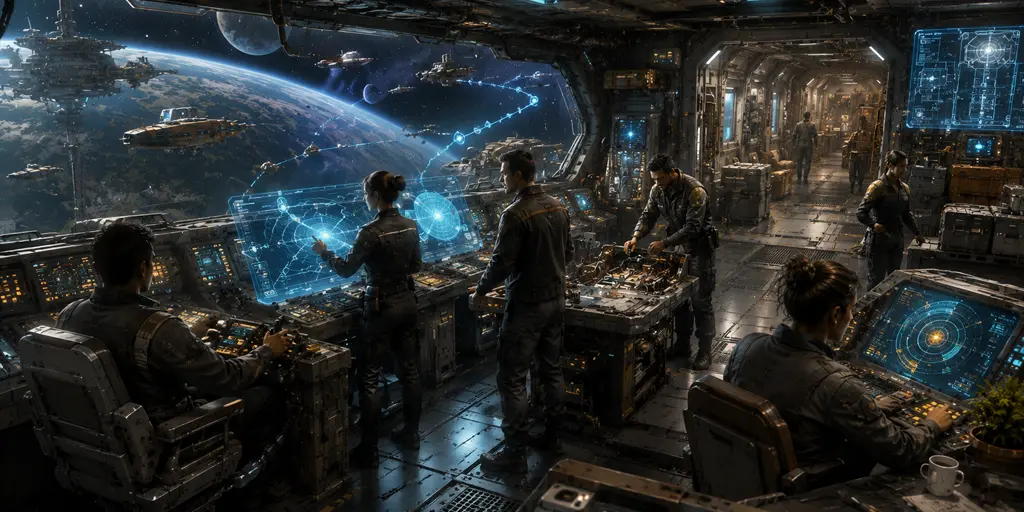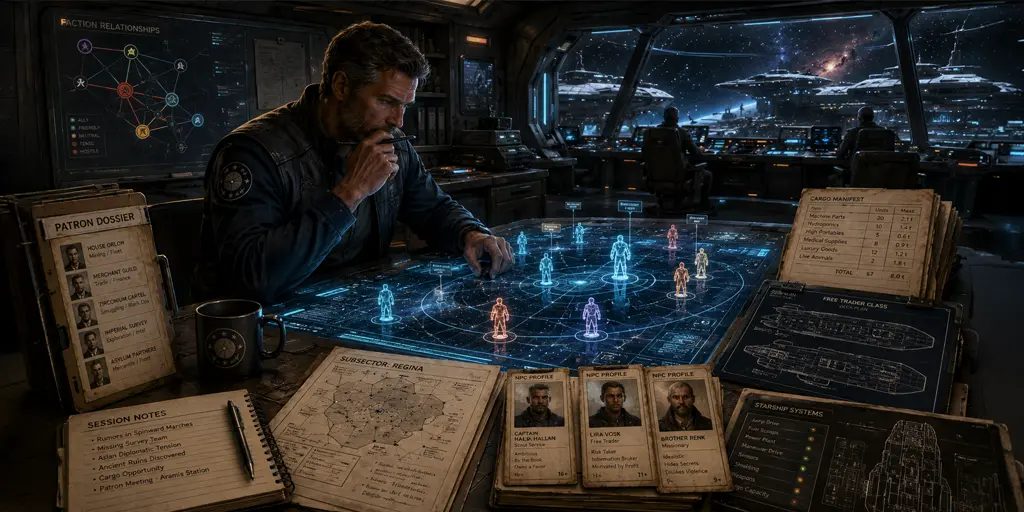

A starship crew needs more than assigned seats—every player needs to understand what they are responsible for when travel becomes dangerous.
Owning a Ship Is Not the Same as Operating One
A Traveller group can receive a ship, name one character the pilot, call another the engineer, and assume the rest will sort itself out. That approach often survives until the first difficult jump, customs inspection, damaged drive, sick passenger, suspicious sensor contact, or combat encounter. Then everyone discovers that no one agreed who was watching which problem.
A starship is a shared operational system. Its crew responsibilities exist between dice rolls: someone checks the route, monitors the machinery, watches local traffic, verifies the manifest, prepares passengers for emergencies, and decides when the current plan has become too dangerous.
A crew role is therefore not just the skill used when the Referee calls for a check. It is the part of the ship’s operation a character watches, understands, plans for, and takes responsibility for.
Exact staffing varies by vessel, campaign, rules edition, and automation level. A large ship may divide these duties among several specialists. A small ship may combine them among three or four Travellers. The goal is not to impose a universal roster. The goal is to make responsibilities visible so every player can request useful information and make meaningful decisions.
The Three Parts of Every Crew Role
Every useful crew role has three connected parts:
- Operational responsibility: the system, mission function, or group of people the character watches.
- Decision responsibility: the questions that player should answer when choices must be made.
- Mechanical responsibility: the skills and checks that commonly support those choices.
The pilot, for example, does more than roll Pilot. The pilot tracks the ship’s position, evaluates possible maneuvers, warns the crew about unsafe approaches, and decides how to move when seconds matter. The skill supports the role; it does not define the whole role.
Major Traveller Starship Crew Roles
Use this table as a quick orientation before assigning positions. The later sections explain what each role contributes during actual play.
| Crew Role | Primary Responsibility | Common Decisions |
|---|---|---|
| Captain or shipmaster | Coordinates priorities, authority, and mission direction. | Negotiate, withdraw, pursue, fight, or change objectives. |
| Pilot | Controls movement in normal space. | Approach, dock, evade, land, hold position, or escape. |
| Astrogator | Plans and verifies interplanetary and jump routes. | Choose routes, confirm data, balance fuel, time, and risk. |
| Engineer | Keeps the ship capable of completing its mission. | Allocate power, stabilize failures, repair, or shut systems down. |
| Sensors | Builds the crew’s picture of nearby space. | Track contacts, assess uncertainty, stay passive, or scan actively. |
| Communications | Manages information entering and leaving the ship. | Answer, authenticate, encrypt, delay, deceive, or remain silent. |
| Gunner | Uses weapons to achieve the crew’s tactical intent. | Select targets, engagement range, weapons, and desired effect. |
| Medic | Preserves crew and passenger health and duty capacity. | Triage, quarantine, treatment priority, and medical diversion. |
| Steward | Manages passenger welfare, safety, and expectations. | Resolve complaints, protect reputation, and identify social risks. |
| Purser, broker, or cargo officer | Runs the commercial and administrative side of the voyage. | Accept contracts, track cargo, assess profit, and manage exposure. |
| Security officer or marine | Protects people, systems, and controlled spaces. | Control access, contain threats, search, board, or repel boarders. |
| Small-craft pilot | Operates boats, launches, cutters, drones, and auxiliary craft. | Scout, transfer, recover, rescue, land, or evacuate. |
| Scientist or mission specialist | Interprets the information that makes the voyage worthwhile. | Set mission requirements, evaluate evidence, and protect discoveries. |
No ship needs every line as a separate full-time post. What matters is that each essential responsibility belongs to someone and has a backup when practical.
Captain or Shipmaster
The captain coordinates the crew, sets priorities, represents the vessel, and makes final decisions when authority must be clear. This is a coordination role, not permission to make every choice for every player.
What the captain actually does
- Defines the immediate objective and keeps the larger mission picture visible.
- Chooses between competing risks when specialists cannot satisfy every priority.
- Represents the ship to authorities, patrons, passengers, and other captains.
- Decides when to negotiate, withdraw, surrender, pursue, or fight.
- Resolves uncertainty about who has authority in an emergency.
- Makes sure critical responsibilities have been assigned.
Leadership, Tactics, Advocate, Admin, Diplomat, Persuade, and Broker may support the job, depending on the situation. The captain should ask: What are we trying to preserve? Which risk can we accept? When do we abandon the current plan?
The captain should not override specialists casually, control other characters’ actions, or become the only person allowed to speak. Rank does not replace competence.
Pilot
The pilot controls the ship’s movement in normal space. That includes departure, approach, docking, landing, orbital maneuvers, collision avoidance, evasive action, and safe relative position.
The pilot evaluates whether the vessel can physically perform the captain’s intended action. They coordinate with sensors for situational awareness and engineering for thrust, power, and damage limits. Pilot is the obvious supporting skill, while Flyer, Vacc Suit, Sensors, Navigation, or Mechanic may matter in particular scenes.
The pilot’s recurring questions are practical: Where are we relative to everything else? What maneuvers remain possible? How quickly can we arrive or escape? What changes if the drive output drops?
Piloting is not astrogation. The pilot moves the ship through realspace. The astrogator plans the route and jump solution. One Traveller may perform both jobs, but the responsibilities remain distinct.
Astrogator
The astrogator plans and verifies interplanetary and interstellar routes. They check destination data, evaluate fuel and jump limitations, identify fallback destinations, confirm safe timing, and coordinate the jump sequence with the pilot and engineer.
Astrogation and Navigation commonly support the role, with Science, Electronics, and Sensors sometimes contributing. The astrogator should ask: Is the destination data reliable? Which route best balances time, fuel, safety, and opportunity? Are we truly in a safe position to jump? What is the fallback if the preferred route becomes unavailable?
A strong astrogator turns route selection into a campaign decision rather than a loading screen. The crew may choose between a faster path, a safer refueling stop, a profitable detour, or a poorly charted shortcut. The Traveller jump travel and astrogation guide provides a natural next step for crews that want to explore that decision in more depth.
Engineer
The engineer keeps the ship capable of performing its mission. Repair is part of the job, but it begins long before damage is rolled.
What the engineer actually does
- Monitors drives, power, fuel systems, life support, and machinery.
- Performs preventive maintenance and tracks spare parts.
- Diagnoses faults before deciding how to fix them.
- Prioritizes repairs and supervises damage control.
- Advises the captain about safe operating limits.
- Controls shutdowns, temporary repairs, and emergency power allocation.
Engineer specialties, Mechanic, Electronics, Vacc Suit, and relevant Sciences may support these decisions. The engineer asks: What is failing? What will fail next? Which system must remain online? Can we repair this now, or only stabilize it? What must we sacrifice to keep operating?
Preventive maintenance also creates useful play during travel. A part approaching failure, contaminated fuel, improvised repair, or overdue overhaul can become a choice before it becomes a catastrophe.
Sensor Operator
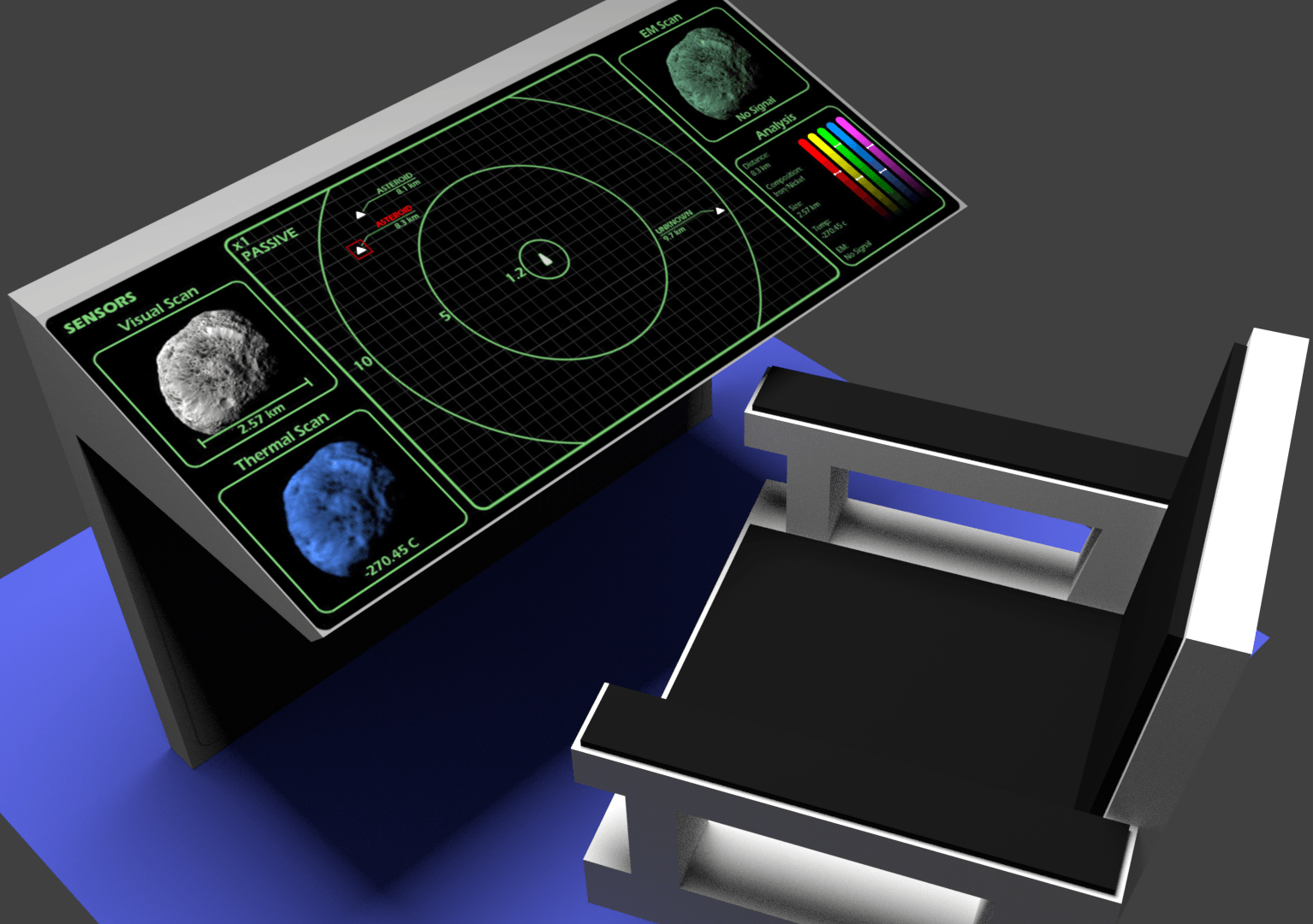
The sensor operator determines what the crew knows about nearby space. They detect and track ships, hazards, transmissions, emissions, and anomalies; estimate range and vector; distinguish signal from noise; and maintain the tactical picture used by the captain, pilot, and gunners.
Electronics (Sensors), Recon, Science, Navigation, and related specialties may support the role. The key questions are: What is out there? What is it doing? What can it detect about us? Which contact matters most? What remains uncertain?
Sensors are not merely a combat function. They support docking, traffic safety, rescue, exploration, customs encounters, navigation, and the discovery of adventure hooks. Choosing between passive observation and active transmission can itself reveal the ship’s priorities.
Communications Operator
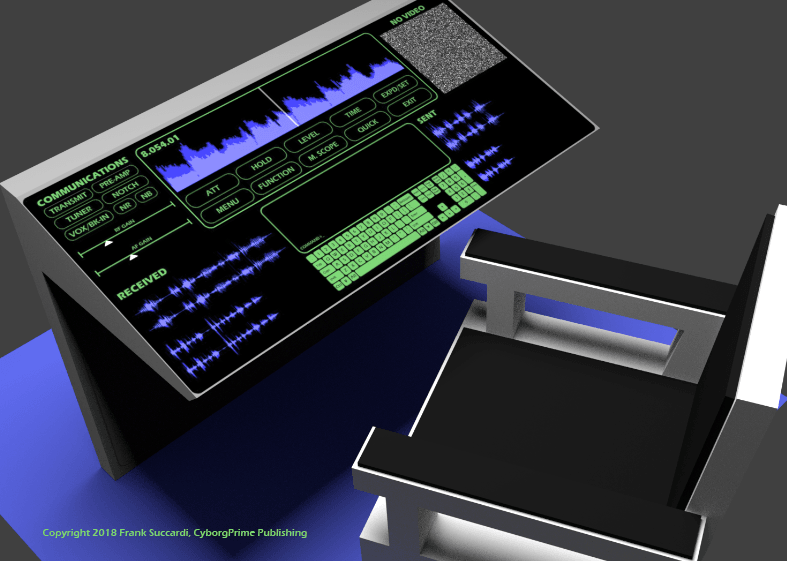
The communications operator manages information entering and leaving the vessel. They select channels and protocols, authenticate messages, handle transponders, monitor traffic, preserve records, and watch for jamming, spoofing, interception, or suspicious silence.
Electronics (Comms), Admin, Language, Diplomat, Advocate, Sensors, and Computer may all become relevant. The operator should ask: Who is transmitting? Can we trust the message? Who might hear our reply? Should we answer, delay, deceive, or remain silent? What record are we creating?
Small crews often combine sensors and communications, but the responsibilities are different. Sensors answers “What is out there?” Communications answers “What information are we exchanging, with whom, and at what risk?”
Gunner
The gunner operates the ship’s weapons and helps shape the tactical engagement. They maintain firing solutions, recommend viable ranges, coordinate with the pilot and sensor operator, conserve limited resources, and choose how to achieve the crew’s intended effect.
Gunner specialties, Electronics, Sensors, Tactics, Mechanic, and Vacc Suit may support the post. The gunner asks: Which target matters? Are we trying to deter, disable, or destroy? Which weapon fits that outcome? What political or legal consequence follows if we fire?
The captain decides whether the ship fights. The gunner decides how to use the weapons effectively once that decision has been made.
Medic
The medic protects the crew’s ability to function. They maintain supplies and records, treat injuries and illness, prepare for foreseeable risks, advise whether someone can remain on duty, handle contamination or quarantine, and coordinate triage and evacuation.
Medic is central, while Science, Survival, Vacc Suit, Admin, and Electronics may contribute depending on the equipment and hazard. The medic asks: Who needs treatment first? Can this person continue duty? What supplies are being consumed? Is the threat injury, disease, radiation, poison, contamination, or stress? Must the ship divert for care?
Medical decisions create operational consequences. Losing the pilot for a shift, isolating a passenger, spending scarce supplies, or changing course for treatment affects the whole crew.
Steward or Passenger Services
The steward manages passenger welfare, safety, hospitality, and the social environment aboard ship. They receive and brief travelers, manage accommodations and schedules, handle complaints, notice suspicious behavior, protect the ship’s reputation, and prepare civilians for emergencies.
Steward, Carouse, Diplomat, Persuade, Admin, Recon, Medic, and Profession may support the role. The steward asks: What do the passengers need? Which passenger is becoming a problem? What promises has the ship made? What are people revealing? How will this voyage affect the vessel’s reputation?
The steward is not merely a cook. Passenger management can influence revenue, security, diplomacy, recurring clients, and the direction of an adventure.
Purser, Broker, or Cargo Officer
This role manages the voyage’s commercial and administrative reality. The officer tracks cargo, manifests, freight, passengers, contracts, payments, operating expenses, and delivery requirements. They also coordinate loading, identify customs or legal issues, and preserve the records needed when something goes wrong.
Broker, Admin, Advocate, Profession, Streetwise, Electronics, and Diplomat may support these duties. The officer asks: What are we carrying? Who owns it? What did we promise? Is the job still profitable? What happens if the cargo is delayed, damaged, inspected, or stolen?
Commercial tools can help the player make these decisions without turning the session into bookkeeping. The Traveller ships mortgage calculator helps crews understand the financial pressure behind their vessel, while the Traveller ship travel time calculator can support scheduling and delivery choices.
Security Officer or Marine
Security protects the vessel, crew, passengers, and controlled spaces. The officer establishes access control, plans for boarding and sabotage, maintains security equipment, conducts searches, handles prisoners, protects civilians, and organizes defense around the actual deck plan.
Gun Combat, Melee, Tactics, Recon, Investigate, Vacc Suit, Athletics, and Leadership may support the job. Security asks: Where is the threat? Which spaces must remain under crew control? Who may carry weapons? How can we contain the problem without puncturing the hull or damaging life support?
Shipboard security is different from fighting in an open field. Confined passages, pressure doors, machinery, civilians, and fragile systems make positioning and restraint as important as firepower.
Small-Craft Pilot
A small-craft operator handles launches, cutters, pinnaces, air/rafts, drones, and other auxiliary vehicles. They transfer people and cargo, conduct reconnaissance, support rescue, scout hazardous approaches, extend the crew’s reach, and recover boarding or landing teams.
On a large vessel this may be a dedicated position. On a small ship it is usually a secondary role assigned to someone who will not be occupied elsewhere during launch and recovery.
Scientist, Survey Specialist, or Mission Specialist
Not every vital crew role is part of basic ship operation. A mission specialist interprets the information that makes the voyage worthwhile.
Possible specialties include planetary survey, geology, xenology, archaeology, atmospheric science, robotics, computer systems, intelligence analysis, salvage, trade, diplomacy, or legal affairs. The specialist defines mission requirements, interprets discoveries, identifies professional risks, decides which samples or records matter, and prevents the crew from destroying valuable evidence through ignorance.
Sensors may detect an anomaly. The scientist explains why it matters. Security may secure a site. The archaeologist identifies what must not be touched. The cargo officer may see a container; the legal specialist recognizes disputed ownership.
Owner, Captain, and Crew Are Not the Same Thing
A ship can have a legal owner, mortgage holder, operating captain, pilot, employer, mission commander, senior shareholder, and informal crew leader. One Traveller may hold several of those identities, or each may belong to a different person.
The distinction creates useful tension:
- The owner wants to protect the asset.
- The captain wants to complete the mission.
- The pilot refuses an unsafe maneuver.
- The engineer says the ship cannot sustain the requested output.
- The cargo owner demands immediate delivery.
- The crew wants to stop and rescue survivors.
These conflicts work when they are treated as competing responsibilities rather than excuses to obstruct other players. Make the stakes explicit, let specialists explain the consequences, and decide how authority works before the crisis.
How Small Traveller Crews Combine Roles
A crew of three to five characters cannot place a specialist at every station. Use this example as a starting point, not a mandatory arrangement.
| Character | Primary Role | Backup Role |
|---|---|---|
| Character 1 | Captain / Broker | Steward |
| Character 2 | Pilot | Astrogator |
| Character 3 | Engineer | Damage control |
| Character 4 | Sensors / Communications | Medic or gunner |
Combine jobs that are unlikely to demand full attention at the same moment. Avoid giving one character every critical technical responsibility. Account for sleep, injury, boarding parties, split operations, and simultaneous combat duties. Automation can reduce workload, but someone should still be accountable for checking the result and responding when it fails.
Primary and Backup Responsibilities
Every ship benefits from a simple crew responsibility sheet. Record each character’s:
- primary role;
- backup role;
- routine duty;
- emergency station;
- watch assignment;
- authority limits;
- critical equipment;
- relevant skills; and
- unresolved training gap.
Redundancy is not wasted character design. It keeps the vessel functioning when the pilot is injured, the engineer is off-ship, the sensor operator joins a boarding party, or the captain is unavailable.
What Each Role Does During Routine Travel
Routine travel becomes more engaging when everyone has a recurring duty instead of waiting for arrival.
| Role | Routine Duty |
|---|---|
| Captain | Reviews objectives, risks, schedules, and crew readiness. |
| Pilot | Maintains flight plans, approach readiness, and maneuver status. |
| Astrogator | Checks route data and prepares the next jump. |
| Engineer | Conducts maintenance and monitors ship systems. |
| Sensors | Watches contacts, hazards, and environmental changes. |
| Communications | Monitors traffic and handles reports and identification. |
| Medic | Checks supplies, patient status, and medical readiness. |
| Steward | Manages passenger welfare and onboard routine. |
| Cargo officer | Tracks manifests, payments, and delivery requirements. |
| Security | Maintains access control and emergency readiness. |
The Referee does not need to roleplay every inspection. Ask each player what their character monitors, then use those answers to reveal warnings, opportunities, and complications relevant to that responsibility.
How Roles Work Together During an Emergency
Consider a hostile contact detected while the ship is already operating with an unstable drive:
- Sensors identifies the contact, estimates its vector, and explains what remains uncertain.
- Pilot changes position and reports the available escape paths.
- Engineer explains the drive’s limits and what will happen if thrust increases.
- Captain chooses whether to hide, communicate, run, or prepare to fight.
- Communications manages identification, warnings, deception, or a request for help.
- Security secures sensitive spaces and prepares for boarding.
- Medic establishes a casualty station.
- Other crewmembers assist damage control or protect passengers and mission-critical cargo.
The scene works because each role contributes information and a decision. The emergency is not a queue of unrelated skill checks; it is a coordinated response to one changing problem.
What Each Role Does During Starship Combat
Starship combat becomes clearer when the crew agrees on tactical intent before resolving individual actions:
- Captain: sets the objective—escape, delay, disable, protect, capture, or destroy.
- Sensors: maintains contact quality and threat awareness.
- Pilot: manages position, approach, evasion, and escape paths.
- Engineer: preserves thrust, power, life support, and damaged systems.
- Gunners: choose viable targets and apply weapons toward the intended outcome.
- Communications: handles surrender demands, coordination, warnings, or deception.
- Medic: prepares for casualties and decides who can remain at a station.
- Security: prepares for boarding, internal damage, and loss of access control.
- Mission specialists: protect critical passengers, evidence, cargo, or data.
During combat, avoid assigning one character two simultaneous full-time stations. A pilot who must maneuver continuously cannot also be expected to manage every sensor contact, calculate a jump, fire a turret, and direct repairs.
Crew Roles Create Adventure Hooks
Responsibilities naturally generate stories because each role notices different problems:
- The astrogator discovers the route data is wrong.
- The engineer needs a component that cannot be purchased legally at the next port.
- The steward suspects a passenger is travelling under a false identity.
- The sensor operator detects a weak distress signal off the planned route.
- The cargo officer finds a mismatch in the manifest.
- The medic recognizes symptoms of an emerging outbreak.
- The gunner identifies military-surplus weapons on a supposedly civilian vessel.
- The captain receives conflicting legal orders.
- The pilot learns that the destination port cannot safely accept the ship.
- Security finds evidence that someone accessed a restricted compartment.
These hooks work because the relevant player receives the first clue and must decide what to do with it. The ship becomes a source of play rather than transportation between adventures.
Crew Agreements Before the First Voyage
Before departure, answer these questions together:
- Who is the legal owner of the ship?
- Who is captain during routine operations?
- Who has final authority during an emergency?
- Who may commit the ship to a contract?
- How are profits and expenses divided?
- Who handles passenger and cargo decisions?
- What actions require a crew vote?
- Who takes command if the captain is unavailable?
- What is the policy on weapons aboard ship?
- What risks will the crew refuse?
These agreements do not eliminate conflict. They make conflict playable by clarifying what each person believes they are protecting.
A Simple Crew Responsibility Exercise
- List every character.
- Assign one primary shipboard role to each.
- Assign one backup role to each.
- Identify every critical responsibility with no backup.
- Decide who acts during routine travel.
- Decide who acts during combat.
- Decide who responds to decompression, fire, medical emergency, and boarding.
- Identify one skill the crew needs to learn or hire.
- Give each character one recurring shipboard problem to monitor.
- Revisit the list after three sessions.
For a visual way to think about stations, access points, and emergency routes, explore the Virtual Traveller Scout Ship. More ship-focused articles and utilities are available through the Traveller RPG Blog.
A Ship Is a Team, Not a Title List
A Traveller ship works best when every player knows what part of the vessel belongs to them—not as property, but as responsibility.
The captain should not make every decision. The pilot should not wait passively for a Pilot check. The engineer should not exist only when damage is rolled. Every role should give its player information to request, risks to watch, and decisions that affect the crew.
Once those responsibilities are clear, the ship stops being transportation. It becomes a shared home, business, workplace, and source of adventure.
Frequently Asked Questions
Does every Traveller starship need every crew role listed here?
No. Formal requirements vary by ship, campaign, rules edition, and automation. Treat the list as a responsibility map, not a mandatory roster.
Can one Traveller hold several crew positions?
Yes. Small crews routinely combine jobs. Combine duties that are unlikely to require simultaneous full attention, and assign backups for critical functions.
What is the difference between a pilot and an astrogator?
The pilot controls movement in normal space. The astrogator plans and verifies routes, including jump calculations. One person may do both, but they are separate responsibilities.
Is the captain automatically the ship’s owner?
No. The legal owner, mortgage holder, operating captain, mission commander, and pilot may be different people.
What should a player do when their role has no immediate skill check?
Ask for information, monitor risks, plan ahead, maintain readiness, and make decisions within that role. Crew responsibility exists between rolls.
How can a Referee keep every crew member involved?
Give information to the character responsible for noticing it, then ask that player what they do. Build emergencies from interacting problems rather than isolated checks.
Which role is easiest to overlook?
Sensors, communications, passenger services, cargo administration, and medical readiness are often neglected because they do not always produce dramatic checks. Each can generate important decisions and adventure hooks.
Give the Crew a Ship They Can Actually Operate
Crew responsibilities become more meaningful when the bridge, engineering spaces, cargo areas, staterooms, access points, and emergency routes matter during play. Explore starship deck plans and VTT resources for boarding actions, repairs, investigations, passenger trouble, shipboard combat, and everyday life aboard a Traveller-style vessel.