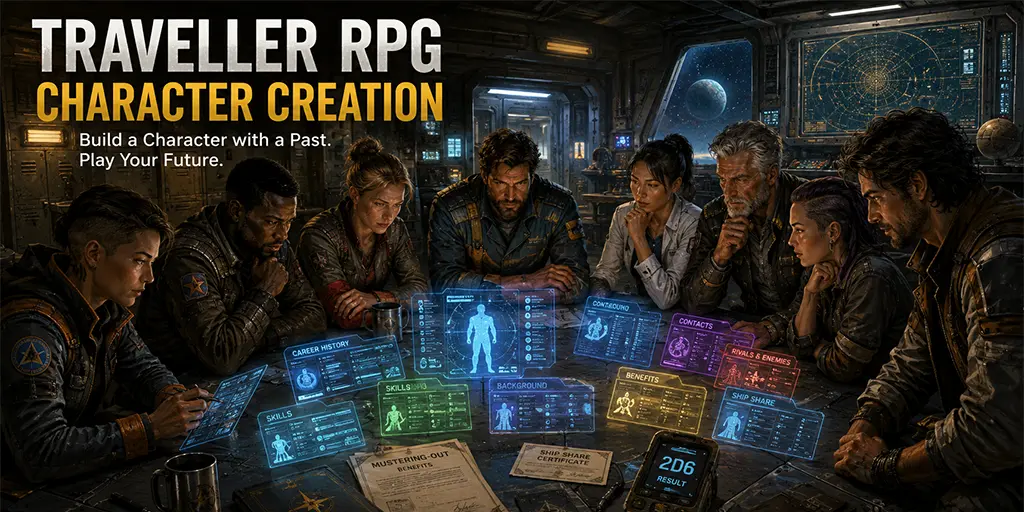
Learn how Traveller RPG character creation works, including characteristics, background skills, careers, skills, events, mishaps, mustering-out benefits, character sheets, and what to do when the lifepath changes your plans.
Traveller Character Creation Guide
Traveller RPG character creation is one of the most memorable parts of the game. Instead of starting as a blank slate, your character enters play with a history: careers, skills, contacts, rivals, enemies, debts, injuries, benefits, ship shares, military service, university education, and sometimes a messy past they would rather not talk about.
This page is the main CyborgPrime hub for Traveller character creation. Use it to understand the full lifepath process, then follow the deeper character creation guides when you want more detail about characteristics, background skills, careers, mustering-out benefits, skills, and what to do when the dice change your plans.
Important: This is a Traveller character creation guide, not an automatic Traveller character generator. It will help you understand the process, choose your next step, and find the right supporting guide. If you are looking for a clickable generator, character sheet, or official rulebook replacement, this page will point you in the right direction, but it does not replace the official Traveller rules.
Traveller has given me thousands of hours of enjoyment with friends. I hope this guide helps you understand character creation, build a Traveller with a past, and get excited to play.
Traveller Character Creation: Start Here Pathway
If you are new to Traveller, use this pathway to move through the character creation process in a practical order.
| Step | What You Learn | Recommended Guide |
|---|---|---|
| 1 | How Traveller character creation works overall | This guide |
| 2 | How to roll and use characteristics | Rolling Characteristics |
| 3 | How background skills shape your early life | Background Skills |
| 4 | How careers, terms, survival, advancement, events, and mishaps work | Careers |
| 5 | What to do when your planned career does not happen | Wrong Career |
| 6 | How mustering-out benefits, cash, gear, pensions, and ship shares work | Mustering-Out Benefits |
| 7 | How Traveller skills work during and after character creation | Traveller Skills Index |
| 8 | How to get quick-reference help while learning | Join the character creation list below |
Build Better Traveller Characters
Get Traveller character creation tips, career guides, skill explanations, mustering-out advice, and quick-reference resources sent to your inbox.
Article Table of Contents
- Introduction to Traveller Character Creation
- Traveller Character Creation Quick Summary
- Guide, Generator, Character Sheet, or Official Rules?
- General RPG Terms
- Traveller Campaign Types
- What Kind of Dice Do I Need?
- Rolling Dice in Traveller
- Traveller Game Terms
- Rolling Up a Traveller Character
- Characteristics in Traveller
- Character Background
- How Long Is a Term?
- School or Career
- Ending Character Creation
- Choosing a Campaign Skill Pack
- Contacts, Rivals, Allies, and Enemies
- Injuries and Medical Bills
- Purchasing Starting Gear
- Traveller Character Creation Next Steps
- Traveller Character Creation Summary
Introduction to Traveller Character Creation
Tabletop roleplaying games are popular again, and my favorite science-fiction tabletop RPG, Traveller, remains one of the best examples of lifepath-based character creation.
One of the reasons I fell in love with Traveller is that character creation is not just a form to fill out. It is a mini-game that creates a life story.
In many RPGs, you start as a young beginning adventurer. In Traveller, you can begin as a fresh 18-year-old with only background skills, or you can begin as an experienced character with several careers behind you.
Your age, experience, skills, contacts, injuries, debts, and benefits are shaped by dice rolls and choices during character creation.
The process simulates a life shaped by plans, opportunities, setbacks, bad luck, and surprising turns. You may sit down intending to create a space marine and end up with a scholar, merchant, scout, drifter, or retired naval officer.
A Personal Example from Real Life
When I was a kid, I wanted to be an astronaut. Life took me in a different direction. I became a programmer, multimedia producer, author, and game designer instead.
Traveller tries to capture that feeling. You may have ambitions, but life events, career choices, mishaps, and opportunities can change the path.
The benefit is that your character enters play with a rich personal history.
Some people dislike this process because they want more control. Thankfully, Traveller includes alternative character generation options for groups that want a more directed approach.
Traveller Pro Tip: Save “dud” characters. They can become NPCs, backup characters, contacts, rivals, patrons, passengers, or pre-generated characters for new players.
Need Ready-to-Use NPCs and Names?
If you want extra NPCs, pregenerated characters, backup characters, and name tables ready at the table, the Sci-Fi RPG Starter Pack bundles ready-to-use marines, merchants, modern name generators, and starship complications for busy sci-fi referees.
Use it when you need quick contacts, rivals, passengers, crew members, backup characters, or unexpected NPC names during character creation or live play.
For the official rules, grab the Traveller Core Rulebook Update 2022. New players may also want the free Introduction to Traveller PDF.
Traveller Character Creation Quick Summary
Here is the short version of how Traveller character creation works.
- Roll characteristics. Generate STR, DEX, END, INT, EDU, and SOC.
- Choose a background. Decide where your character came from and select background skills.
- Choose education or a career. Apply for university, military academy, or a career.
- Resolve a term. Each term usually represents four years of your character’s life.
- Gain skills. Learn from training, service, advancement, education, and life events.
- Roll survival, events, mishaps, and advancement. Your career may go well, go badly, or change direction.
- Create connections. Link your character’s past to other player characters.
- Decide whether to continue. Push your luck for more skills and benefits or stop before age and risk catch up.
- Roll benefits. When you leave a career, collect cash, equipment, contacts, pensions, ship shares, or other rewards.
- Buy starting gear. Equip your character for the campaign.
By the time play begins, your Traveller should have a past, a reason to travel, and several hooks the Referee can use in future adventures.
Traveller Character Creation Guide, Generator, Character Sheet, or Official Rules?
People search for Traveller character creation in several different ways. Some want a guide. Some want a character generator. Some want a character sheet. Some want the official rules. Those are related, but they are not the same thing.
| What You Need | Best Use | Where to Go Next |
|---|---|---|
| Character creation guide | Understand the process before or during character creation. | Stay on this page. |
| Character generator | Automatically create or assist with a character. | Use this guide to understand what the generator is doing. |
| Character sheet | Record characteristics, skills, history, benefits, contacts, and gear. | Use the official sheet or your group’s preferred sheet. |
| Official rules | Use the exact rules, tables, options, and procedures at the table. | Traveller Core Rulebook Update 2022 |
This guide is meant to help you understand the process. It does not replace the official Traveller rulebook.
New players may also want the free Introduction to Traveller PDF.
Some General RPG Terms
Traveller is similar to other roleplaying games. It has players, characters, dice, adventures, campaigns, and a Referee who runs the game world.
Here are some useful terms for new players.
Roleplaying Game
A roleplaying game is a collaborative storytelling game where players portray characters in a shared fictional situation.
One player usually acts as the Referee or Game Master. The Referee describes the world, presents situations, plays non-player characters, and decides how the world responds to player choices.
The other players control their own characters and decide what those characters say, attempt, investigate, risk, avoid, or fight for.
Player
Players portray the main characters in the story. In Traveller, those characters might be scouts, merchants, marines, nobles, rogues, scholars, agents, drifters, or members of a starship crew.
Referee
In Traveller, the Game Master is often called the Referee.
The Referee presents the universe, controls non-player characters, runs adventures, interprets rules, and describes the consequences of player decisions.
Traveller Sessions
Traveller is usually played in sessions. A session might last a few hours, a full evening, or an entire convention slot.
Players can meet in person or play online through a virtual tabletop such as Roll20, Fantasy Grounds, or another VTT platform.
Scenarios
A scenario is a situation or problem the characters deal with during play.
The Referee might begin with a patron offering a job, a distress call, a mysterious cargo, a suspicious passenger, a hostile starport official, or a damaged ship drifting near the jump limit.
Adventures
An adventure is a connected sequence of scenes, choices, challenges, and consequences. It may take one session or several sessions to complete.
Campaigns
A campaign is a series of related adventures. A campaign may follow a merchant crew, naval unit, scout team, mercenary company, exploration mission, political intrigue, or wandering group of Travellers looking for work among the stars.
Traveller Campaign Types
The types of Traveller campaigns you can play are limited only by your group’s imagination and interests.
Common Traveller campaign types include:
- Travellers: A crew of adventurers seeking work, money, influence, and survival among the stars.
- Explorers: A team surveying new worlds, mapping systems, and discovering strange phenomena.
- Traders: A merchant crew buying low, selling high, hauling freight, carrying passengers, and trying to keep the ship profitable.
- Military Personnel: Active-duty military, naval officers, marines, mercenaries, or special operations teams.
- Scientists: Researchers studying strange worlds, alien ruins, unusual stars, dangerous technologies, or lost civilizations.
- Rogues and Smugglers: Characters operating in black markets, shady starports, criminal networks, or morally gray situations.
Work with your group to choose the kind of science-fiction stories everyone wants to explore.
If you are planning your first campaign, you may also like Traveller RPG Session Zero: What to Explain Before Play Begins and How to Start a Traveller RPG Campaign With One Ship, One Debt, and Three Factions.
What Kind of Dice Do I Need to Play Traveller?
Traveller uses standard six-sided dice.
You only need two six-sided dice to play, though having extra dice at the table is useful.
Traveller does not require the full set of polyhedral dice common in many fantasy RPGs. If you have dice from Monopoly, Yahtzee, or another board game, you can start playing.
You may also use a dice app, virtual tabletop roller, or online roller if you play online.
Rolling Dice in Traveller
You roll dice in Traveller when the outcome of an action is uncertain or important.
Most Traveller task rolls use 2D6: roll two six-sided dice, add them together, then apply any relevant modifiers.
During character creation, you roll dice for characteristics, career qualification, survival, advancement, events, mishaps, benefits, and other lifepath results.
That mix of choice and uncertainty is part of what makes Traveller character creation feel different from many other roleplaying games.
Traveller Game Terms
Traveller uses several dice and rules terms that new players should know.
1D6, 2D6, and xD6
When you see a number before “D6,” roll that many six-sided dice.
- 1D6 means roll one six-sided die.
- 2D6 means roll two six-sided dice and add them together.
- 3D6 means roll three six-sided dice and add them together.
If you see a modifier, such as 2D6+1 or 2D6-3, roll the dice and then add or subtract the modifier.
D3
A D3 is a three-point result generated with a normal six-sided die.
- Roll 1 or 2 = 1
- Roll 3 or 4 = 2
- Roll 5 or 6 = 3
D66
D66 is a special roll that produces results from 11 to 66.
Roll two six-sided dice and read them separately. One die is the tens digit and the other is the ones digit. For example, a 3 and a 5 becomes 35.
This creates 36 possible results, often used for random tables.
If you want a deeper explanation, see How To Roll d66 Using Common 6-Sided Dice.
Checks
A check is a roll made when a character attempts something uncertain or important.
Most checks involve rolling 2D6, adding a characteristic modifier, adding a skill level if appropriate, and trying to meet or exceed a target number.
Task Notation
Traveller often writes tasks with a target number and a characteristic.
- DEX 7+ means roll 2D6, add your DEX modifier, and try to get 7 or higher.
- INT 10+ means roll 2D6, add your INT modifier, and try to get 10 or higher.
Dice Modifier
A dice modifier, often written as DM, is a number added to or subtracted from a roll.
- DM -3 means subtract 3.
- DM +4 means add 4.
Natural 2 and Natural 12
A natural roll is the number shown on the dice before modifiers are applied.
Rolling two 1s is a natural 2. Rolling two 6s is a natural 12.
Tech Level
Tech Level, or TL, describes the general technological level of a world, culture, item, or region.
During character creation, Tech Level is mostly useful as background information. A character from a low-tech agricultural world will likely feel different from one raised on a high-tech industrial planet.
For more detail, see Traveller RPG Tech Levels Explained: What They Mean and Why They Matter.
Rolling Up a Traveller Character
Rolling up a character in Traveller is like a mini-game.
Players move through the character creation process, generate characteristics, choose background skills, pursue education or careers, gain skills, experience events, survive mishaps, collect benefits, and decide when the character is ready to begin play.
The result is a character who already has a life behind them.
Traveller Background Generator
Traveller character creation acts like a built-in background generator.
As you proceed through character generation, your character experiences events and mishaps that add to their skills, history, relationships, debts, injuries, and motivations.
What If the Character Does Not Match Your Original Plan?
This is normal. You might sit down wanting to create a marine and end up with a scholar, merchant, scout, drifter, or agent instead.
You have options:
- Roll with it. Treat the unexpected career as part of the fun.
- Adjust the concept. Keep the original personality but change the career path.
- Talk to the Referee. Ask whether a small swap or alternate path fits the campaign.
- Make the character an NPC. Save the result for later if it does not fit this campaign.
- Roll a new character. Sometimes starting over is the cleanest solution.
For a deeper discussion, read What To Do When Traveller Character Creation Gives You the Wrong Career.
Characteristics in Traveller
Traveller uses six main characteristics to describe a character’s physical, mental, educational, and social abilities.
Physical Characteristics
STR — Strength: Physical power, muscle, lifting ability, melee force, and raw physique.
DEX — Dexterity: Agility, coordination, aim, reflexes, balance, and precision.
END — Endurance: Stamina, toughness, resistance to hardship, and the ability to keep going under pressure.
Mental and Social Characteristics
INT — Intellect: Cleverness, perception, quick thinking, problem-solving, and originality.
EDU — Education: Formal training, learning, technical knowledge, academic background, and recall.
SOC — Social Standing: Social rank, reputation, status, class, influence, and sometimes noble standing.
Damage and Physical Characteristics
Traveller does not use hit points the same way many RPGs do.
Physical damage reduces physical characteristics. A character’s ability to keep fighting depends on STR, DEX, and END.
When two physical characteristics are reduced to zero, the character falls unconscious. When all three are reduced to zero, the character dies.
Rolling Characteristics
To generate characteristics, roll 2D6 six times and record the totals.
Then assign those six numbers to STR, DEX, END, INT, EDU, and SOC in the order that best fits your character concept.
For a deeper breakdown, see Mongoose Traveller Character Creation: Rolling Characteristics.
Characteristic Modifiers
Characteristic modifiers act as dice modifiers when making checks.
| Characteristic Score | Modifier |
|---|---|
| 0 | -3 |
| 1–2 | -2 |
| 3–5 | -1 |
| 6–8 | 0 |
| 9–11 | +1 |
| 12–14 | +2 |
| 15–17 | +3 |
| 18–20 | +4 |
To calculate a characteristic modifier, divide the characteristic by 3, round down, then subtract 2.
Normal humans usually have characteristics between 2 and 12 at the start, with 15 often treated as the normal human maximum. Higher scores may be possible through extraordinary means such as cybernetics, advanced drugs, or unusual species traits.
Character Background
Next, choose your character’s background. This helps explain where they came from and why they might become a Traveller.
Choose a Homeworld
Your character can come from an official Traveller world, a world created by the Referee, or a homeworld you invent together.
Consider:
- Was your character raised on a high-tech world or a low-tech world?
- Did they grow up poor, wealthy, isolated, famous, or overlooked?
- Did they leave home by choice, necessity, exile, ambition, debt, or curiosity?
- Does their homeworld explain any of their skills, attitudes, or fears?
Skill Notation
Skills may appear with or without numbers.
If a skill is listed with a number, such as Medic 1, you gain that skill at that level if your current level is lower.
If a skill is listed without a number, such as Medic, increase that skill by 1 level.
During character creation, no skill may normally go above level 4. A character can also never have more total skill levels than 3 × (INT + EDU).
Select Background Skills
Background skills represent what your character learned from their homeworld, upbringing, and early life.
You select a number of background skills modified by your EDU modifier. These skills are usually gained at level 0, meaning basic familiarity.
At this point, your character is 18 years old and could begin play. Most players continue into education or careers to gain more experience before starting the campaign.
For more detail, read Mongoose Traveller Character Creation: Background Skills and Traveller Character Creation: Best Background Skills.
How Long Is a Term?
A term is four years.
Each term represents a major period in your character’s life: education, employment, military service, drifting, crime, research, exploration, or another structured life path.
Even if your character is forced out before completing a term, that term still usually represents four years of life experience.
That is why Traveller characters often begin play with more history than first-level characters in many fantasy roleplaying games.
School or Career: Pursuing Your Character’s Dreams
Just like in real life, a Traveller character can begin adult life by attending university, applying to military academy, or entering a career.
University and military academy count as education careers. You can only enter them during one of your first three terms.
Careers represent broad areas of employment and experience, such as Agent, Army, Citizen, Drifter, Entertainer, Marine, Merchant, Navy, Noble, Rogue, Scholar, or Scout.
For a deeper career-by-career discussion, read Mongoose Traveller Character Creation: Careers.
Qualify for a Career
Whether you choose education or a career, you usually roll to see if you qualify.
Each career lists a qualification roll. If you qualify, you enter that path for the term. If you fail, you may need to drift, submit to the draft, or choose another option depending on the rules.
Each previous career makes it harder to qualify for a new one, representing a scattered work history.
Enter Career, Draft, or Drift
If you qualify, you enter the chosen career and begin resolving that term.
If you fail, you may become a Drifter or submit to the military draft. Sometimes the draft sends a character into a military branch they failed to enter voluntarily.
Receive Basic Training
For your first career, you receive all Service Skills for that career at level 0.
For later careers, you choose one Service Skill from the new career and receive it at level 0.
Choose a Career Specialty
Each career has specialties or assignments. Choose one for the current term. This helps determine which skill tables, survival rolls, advancement rolls, and events apply.
Roll for Skills
During each term, you usually roll for skills on one of the tables available to your character.
These may include Personal Development, Service Skills, specialty tables, Advanced Education, or Advancement Skills.
If you want a broader skill overview, use the Traveller RPG Skills in 60 Seconds Complete Index.
Roll for Survival
Each career specialty has a survival roll.
If you succeed, you continue through the term and roll for an event. If you fail, you experience a mishap and may be forced out of the career.
Have an Event or Mishap
Events and mishaps add story to the character’s past. They may create enemies, allies, injuries, benefits, skill gains, legal trouble, debts, discoveries, promotions, failures, or unusual opportunities.
Establish Connections
Traveller works especially well when players create characters together.
If two player characters can connect their life events into a shared story, both characters may gain an extra skill.
This creates a party with history before the campaign begins.
Roll for Career Advancement
If you survive the term, you usually roll for advancement.
Advancement may increase rank, grant additional skills, and provide extra benefits.
A natural 12 may force the character to continue in the career. An advancement result equal to or lower than the number of terms already served may force the character out.
Age and Check for Aging Effects
At the end of each term, your character ages four years.
Once a character reaches age 34 or older, aging effects may begin to reduce characteristics.
Continue or End Character Creation
At the end of each term, you decide whether to continue in the same career, change careers, change specialty, or end character creation.
You can stop when the character feels ready, or push your luck for more skills, benefits, rank, and story.
Leaving a Career and Rolling for Benefits
When a character leaves a career, they receive benefit rolls representing money, equipment, ship shares, weapons, contacts, pensions, or other rewards.
You usually get one benefit roll per completed term, plus possible extra benefit rolls from rank or advancement.
Only a limited number of benefit rolls can be made on cash tables, so choose carefully.
For a deeper explanation, see Mongoose Traveller Character Creation: Mustering-Out Benefits.
Earning a Pension
If a character serves long enough in a career, they may retire with a pension.
A pension can create a useful income source, but a retired character may also have a long past full of responsibilities, enemies, and unfinished business.
Ending Character Creation
At the end of any term, you may stop character creation and begin play with the character as they are.
You might stop to avoid aging, preserve a strong set of characteristics, avoid more risk, or because the character already has enough story to be interesting.
Many Traveller characters begin play around age 30 to 34, but that is only a common pattern. You can start younger, older, less experienced, or much more seasoned depending on the campaign.
A good stopping point is when the character has enough skills to contribute, enough history to be interesting, and enough unfinished business to create future adventure hooks.
Choose a Campaign Skill Pack and Allocate Skills
Once all characters are ready to begin their adventures, the Referee may choose a campaign skill pack.
Skill packs help the group cover important abilities that may have been missed during character creation.
Players usually go around the table selecting skills from the list until all listed skills have been allocated.
This gives the group a better chance of having the core skills needed for the campaign type.
For example, a merchant campaign may need different support skills than a military, exploration, espionage, or frontier survival campaign.
Contacts, Rivals, Allies, and Enemies
During character creation, your Traveller may meet people who become contacts, allies, rivals, or enemies.
These relationships are valuable. They give the Referee people to bring into the campaign and give the player a stronger connection to the character’s past.
A contact may provide information. An ally may risk something to help. A rival may compete with the character. An enemy may actively cause trouble.
These relationships are also one of the easiest ways to turn character creation into campaign fuel. A single enemy, old commander, former business partner, academic rival, crime boss, or estranged family member can generate several future adventures.
Referee tip: Contacts, rivals, allies, and enemies become much easier to use when you keep a small library of ready-to-drop-in NPCs and names. The Sci-Fi RPG Starter Pack is useful when you need marines, merchants, contacts, rivals, crew members, or starport NPCs without stopping the session.
Injuries and Medical Bills
During character creation, a Traveller may suffer injuries from aging, career events, mishaps, combat, accidents, or dangerous work.
Some medical costs may be covered during character creation. Any unpaid medical bills may become debt the character starts the game with.
This can be frustrating, but it also creates strong motivation. Debt is a great reason to accept risky jobs.
Injury, debt, and recovery also make the character feel like someone who has lived through real events before the campaign begins.
Purchase Starting Equipment
Once character creation is complete, characters purchase starting equipment from their available funds.
Starting gear may include weapons, armor, tools, electronics, survival gear, personal items, trade equipment, or anything else appropriate to the campaign and character background.
At this point, the character is ready to enter the campaign.
When choosing gear, think about the kind of campaign you are about to play. A scout, merchant, marine, scholar, drifter, and noble may all need very different equipment.
Traveller Character Creation Next Steps
After you understand the basic lifepath process, continue with the deeper character creation guides that match your current question.
- Rolling Characteristics: Learn how STR, DEX, END, INT, EDU, and SOC shape your character.
- Background Skills: Understand what your character learned before adult life.
- Best Background Skills: Get practical advice for choosing useful starting skills.
- Careers: Learn how careers, terms, survival, advancement, events, and mishaps work.
- Wrong Career: Learn what to do when the lifepath changes your original concept.
- Traveller Skills Index: Browse short explanations of Traveller skills and practical skill use.
- Mustering-Out Benefits: Understand cash, gear, ship shares, pensions, and other career rewards.
- Fleshing Out Your Character: Turn your lifepath results into personality, goals, and roleplaying hooks.
- Character Creation Checklist: Use a practical checklist before Session One.
Traveller Character Creation Summary
Traveller character creation can produce a detailed character with a complete backstory before the first session begins.
By the time your Traveller is ready to play, they may have:
- Chosen a homeworld
- Selected background skills
- Attended university or military academy
- Pursued one or more careers
- Gained skills and benefits
- Advanced in rank
- Experienced events and mishaps
- Made contacts, allies, rivals, or enemies
- Suffered injuries or taken on debt
- Purchased starting gear
Congratulations. You now have a Traveller character with a past, a reason to travel, and plenty of hooks for future adventures.
Ready to Start Your Traveller Career?
New to Traveller? Download the free Introduction to Traveller PDF.
Want the official rules? Get the Traveller Core Rulebook Update 2022 on DriveThruRPG.
Want the guided article path? Continue with the full series hub: The Ultimate Guide to Playing Mongoose Traveller RPG.
For deeper player and referee advice, check out Beyond the Horizon: The Ultimate Guide to Playing Mongoose Traveller.
Want More Table-Ready Character Support?
Need quick NPCs, names, and ship complications for your first Traveller-style session? The Sci-Fi RPG Starter Pack includes ready-to-use marines, merchants, modern name generators, and starship problems for busy sci-fi referees.
Running or preparing a campaign? Explore CyborgPrime AI Tools for Game Masters for character creation, campaign prep, worldbuilding, and referee support.
Your Turn. What Do You Do?
What kind of Traveller character would you create first: scout, merchant, marine, scholar, noble, rogue, drifter, agent, or something stranger?
Please share your thoughts in the Comments section below.
If you found this guide helpful, please give it a good rating at the top. Thanks!
Get More Traveller Character Creation Help
Want more Traveller character creation tips, career guides, skill explanations, and mustering-out advice?
Join the Traveller Character Creation list and I’ll send you practical resources to help you build better Travellers and get more from the lifepath system.
You can also join me and other Traveller fans on the CyborgPrime Discord server.