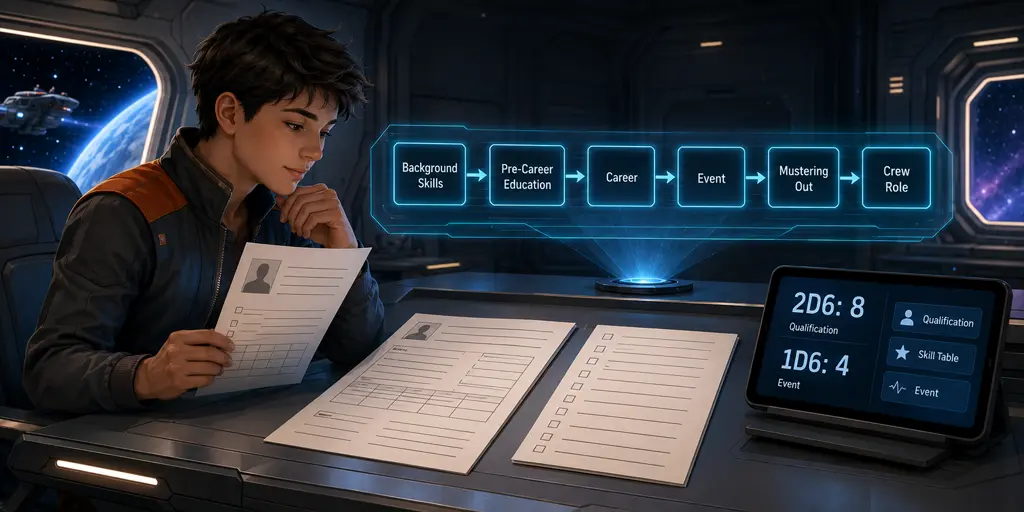
Use this Traveller RPG character creation checklist to understand your rolled character, your crew role, and what to ask before session one.
Traveller Character Creation Does Not Have to Be Overwhelming
Traveller character creation can feel strange if you are coming from RPGs where you simply choose a class, pick a build, select the exact skills you want, buy gear, and start adventuring. In Traveller, you often discover your character through a lifepath. Your characteristics, background skills, education options, careers, events, mishaps, benefits, and connections all help explain who this person was before the campaign began.
That is part of the fun, but it can also feel like a lot the first time you sit down to make a Traveller character.
This article is not a full rules walkthrough. For that, start with How To Play Traveller: Traveller RPG Character Creation or the broader beginner hub, The Ultimate Guide to Playing Mongoose Traveller RPG. This checklist is here to help you know what matters before session one.
By the end, you should know what your character is good at, what their past says about them, how they fit into the crew, and what questions to ask your Referee before play begins.
What This Checklist Is For
This checklist is for new Traveller players who want to arrive at the first session prepared without studying every rule in advance.
You do not need to know every weapon table, starship system, trade rule, or career result before your first game. You do need to understand the basic shape of your character. That means knowing what your character can do, where they came from, why they are adventuring now, and how they help the group.
Traveller is not a fully random character generator, but it is not a point-build system either. You usually choose background skills, you may choose whether to attempt pre-career education, and during careers you often choose which eligible skill table to roll on. Sometimes a life event, reward, or Referee option may let you choose a skill directly. Most of the time, though, the dice determine the exact result, and your job is to interpret the character they hand you.
Use this article before character creation, during character creation, or after you have rolled a character and want to make sense of the results.
1. Know the Campaign Premise
Before you worry about the perfect skill list, ask what kind of Traveller campaign you are joining.
A merchant crew, scout mission, naval campaign, criminal job, exploration sandbox, military tour, trade campaign, or survival story will all reward different kinds of characters. A broker who shines in a trade campaign may feel less central in a military boarding-action game. A marine may be perfect for a dangerous frontier campaign but less useful in a diplomatic mission unless the player also has social or investigative skills.
Ask the Referee a few simple questions before you build too far:
- What kind of campaign are we playing?
- Does the group have a ship?
- Are we already a crew when play begins?
- Is this campaign focused on trade, exploration, combat, politics, mystery, crime, or survival?
- How dangerous is combat expected to be?
- Are there any careers, skills, or character concepts that fit especially well?
You are not asking these questions because Traveller lets you design every detail of your final character. You are asking because campaign context helps you make better background choices, education choices, career choices, table choices, and Referee questions as the lifepath unfolds.
2. Understand Your Characteristics
Your characteristics are the foundation of your Traveller character. They describe your physical ability, mental ability, education, endurance, and social position. They are not the whole character, but they shape how the character feels at the table.
The most important beginner step is simple: know your strongest and weakest characteristics.
A character with strong Dexterity may be good at fast physical tasks, ranged combat, or piloting. A character with high Education may be better suited for technical, scientific, medical, or administrative work. A character with strong Social Standing may have useful connections, status, or access in the right campaign.
You do not have to turn every number into a complicated backstory. Just ask:
- What is my character naturally good at?
- What is my character probably not good at?
- Do these strengths support the campaign premise?
- Do these weaknesses create interesting roleplay?
For a deeper look at this step, read Mongoose Traveller Character Creation: Rolling Characteristics or watch Traveller RPG Characteristics Explained.
3. Choose Background Skills, Then Let the Lifepath Take Over
Background skills are one of the first places where Traveller gives you direct input into your character. Before beginning a career, you receive a number of background skills equal to your EDU DM + 3, from 0 to 6 total depending on your EDU score. These are chosen from the background skills list and taken at level 0.
These skills represent the knowledge your character picked up during adolescence before entering a career. They help explain where your character came from and give them enough basic competence to function in a technological society.
The background skill list includes Admin, Animals, Art, Athletics, Carouse, Drive, Electronics, Flyer, Language, Mechanic, Medic, Profession, Science, Seafarer, Streetwise, Survival, and Vacc Suit.
This is one of the few moments where you can usually make a deliberate choice, so use it well. Choose background skills that help your character make sense in the campaign and give you something useful to do at the table.
If the campaign is about trade and starship travel, skills such as Admin, Streetwise, Mechanic, Electronics, Drive, or Vacc Suit may be useful. If the campaign is about scouts and exploration, skills such as Survival, Science, Animals, Flyer, Seafarer, or Vacc Suit may matter more. If the campaign is social or urban, Carouse, Streetwise, Language, Admin, Art, or Profession may help you contribute outside combat.
After background skills, Traveller character creation becomes much less like building a character from a menu. Most of the time, you are not choosing the exact skill you receive. You are choosing which eligible skill table to roll on, then rolling 1D6. Each entry on that table has an equal chance of coming up.
Sometimes a life event, reward, or Referee option may let you choose a skill directly, but those moments are exceptions. The normal rhythm is: qualify for a career or table, choose the table that seems most useful or interesting, roll the die, and interpret the result.
That means your job is not to force the perfect build. Your job is to make smart background choices and table choices when you can, then understand what the dice are telling you about the character.
When you look at your background skills and early results, ask:
- How many background skills do I receive from my EDU DM + 3?
- Which background skills help my character fit the campaign?
- Which skill tables am I qualified to roll on later?
- Which table gives me the best chance of becoming useful to the crew?
- What does each result suggest about my character’s past?
- If the result really does not fit, should I roll another character or talk to the Referee?
For more help with this choice, read Mongoose Traveller Character Creation: Background Skills and Traveller Character Creation: Best Background Skills.
4. Consider Pre-Career Education Before Starting a Career
Before your Traveller begins a lifelong career, you may have the option to attempt pre-career education. This usually means going to university or attending a military academy.
This is another important point where you may have real input before the dice and career tables take over. Pre-career education usually happens in the first term instead of entering a career, although it can be delayed until the second or third term. From the fourth term onward, pre-career education is no longer available.
University and military academy are not guaranteed. You choose the option, then make an entry roll. If you fail, you must immediately attempt entry into a career, and if that fails, you may be drafted as normal.
University
University is useful if you want a more educated Traveller or want to aim toward technical, academic, professional, or officer-friendly career paths.
If you enter university, you choose a level 0 skill and a level 1 skill from a focused academic list, then increase EDU by +1. If you graduate successfully, you improve both of those chosen skills and increase EDU again.
Graduation can also help you qualify for several careers and may support a later military commission if the first career chosen after university is a military career.
Military Academy
Military academy is useful if you want your Traveller to begin with a strong connection to the Army, Marines, or Navy.
Before applying, you choose which military academy you are trying to enter. If accepted, you gain the Service Skills of that military career at level 0, similar to basic training.
If you graduate and then enter the same military career tied to the academy, you can improve several Service Skills and may gain other benefits. Graduation can also allow automatic entry into the matching military career if it is the first career attempted after graduation.
Pre-career education is worth considering because it can shape your Traveller before the normal career cycle begins. It can give you useful skills, raise EDU, open doors, improve career entry chances, and help explain who your character was before becoming a scout, marine, scholar, trader, agent, drifter, or something stranger.
Ask yourself:
- Does university or military academy fit the character I am starting to imagine?
- Is it worth spending an early term on education instead of a career?
- Would university help me aim toward a technical, academic, social, or officer path?
- Would military academy help me build toward Army, Marines, or Navy service?
- If I fail entry or graduation, am I ready to let that become part of the character’s story?
5. Treat Careers as Your Character’s History
In Traveller, careers are not just classes. They are your character’s past.
A career can tell you what your character trained for, who they worked with, what they survived, what they failed at, what they gained, and why they might now be ready for a risky life among the stars. A character might leave a career with valuable skills, useful benefits, contacts, enemies, debts, scars, or unfinished business.
This is one of the best parts of Traveller character creation. You are not only building a character. You are discovering a history.
You still make choices, but they are not usually “pick any skill you want” choices. First, you attempt to qualify for a career. If you fail, you cannot enter that career that term and must either submit to the draft or take the Drifter career. Once you are in a career, each term usually gives you a choice of which eligible skill table to roll on, such as Personal Development, Service Skills, Assignment Skills, Officer, or Advanced Education. Then you roll 1D to see which skill you actually gain or improve.
Some tables have requirements. For example, Advanced Education or Officer tables may require a certain EDU score, rank, commission, or other qualification. That means part of character creation is not choosing the exact skill you want, but choosing the best table you are allowed to roll on.
Skill results can either give you a new skill, improve an existing skill, or grant a listed level if that level is higher than what you already have. You do not need to master every detail before session one. Just understand what your final skill list lets your character do.
Basic training is another important exception. In your first career, instead of rolling for a skill, you usually receive all the skills on that career’s Service Skills table at level 0. In later careers, you usually choose one Service Skill at level 0 instead. Citizens and Drifters work differently, using the appropriate Assignment Skills for basic training.
After skills and training, each term may test whether your character survives and continues in the career. A failed survival roll sends you to the Mishap table, usually forcing you out of the career and costing that term’s Benefit roll. If you remain in the career, you roll on the Events table to see what happens that term.
This is why Traveller character creation often feels less like building a character and more like discovering a life. You choose a direction, qualify if you can, pick the best table available, roll the dice, survive the consequences, and then interpret the results.
Try not to treat every career result as a pass or fail test of whether the character is “good.” A mishap can create a great campaign hook. A failed advancement roll might explain resentment, ambition, or a career change. A connection made during character creation can become the reason the crew trusts each other in session one.
When reviewing your career history, ask:
- What career did my character try to qualify for?
- What happened if they failed qualification?
- What did my character do before adventuring?
- What did they learn from basic training?
- Which skill tables was I eligible to roll on?
- Which skill tables did I choose to roll on?
- What skills did the dice actually give me?
- Did survival rolls, mishaps, or events change my character’s path?
- Who did my character meet?
- What went wrong?
- Why did they leave?
- What part of that past may come back later?
For a more focused guide to this step, read Mongoose Traveller Character Creation: Careers. You can also watch Mongoose Traveller’s Character Generation Will Blow Your Mind for a video introduction to why Traveller character generation feels so different.
6. Look for Skills That Help the Crew
Traveller is often about crews solving problems together. Your character does not need to be good at everything. In fact, Traveller works better when different characters cover different needs.
Because Traveller character generation is driven by career tables and 1D6 rolls, you may not get to simply pick the exact crew role you imagined. Your main choice is often which qualified skill table to roll on. After that, every entry on that table has an equal chance.
You might want to be the pilot and end up with a character who is better at Admin, Advocate, or Carouse. You might want a combat specialist and end up with a former scholar, merchant, or drifter with a strange but useful mix of skills.
That is part of Traveller’s charm. You are often handed a person, not a build.
As you look over the skills the dice gave you, ask what your character can actually do for the group. Some skills are especially easy to connect to common crew roles:
- Pilot: Flying small craft or starships.
- Astrogation: Plotting jumps and supporting interstellar travel.
- Engineer: Keeping ships and machines working under pressure.
- Medic: Helping the crew survive injury and disaster.
- Gunner: Operating ship weapons or supporting ship combat.
- Broker: Buying, selling, negotiating cargo, and supporting trade.
- Admin: Handling paperwork, bureaucracy, permits, and procedures.
- Advocate: Understanding law, contracts, and legal trouble.
- Recon: Scouting, spotting threats, and gathering information.
- Persuade: Talking people into cooperation.
- Streetwise: Navigating rough ports, criminal contacts, and local trouble.
- Carouse: Socializing, drinking, networking, and finding opportunities.
Do not panic if your character does not have the skill you expected. You have a few options. You can lean into the unexpected result, roll up another character, or talk with your Referee. Some Referees may have an easy fix, allow a small swap, or help connect your existing skills to the campaign in a way that still works.
For quick skill support, use the Traveller RPG Skills in 60 Seconds – Complete Index. You can also watch Traveller RPG Skill Checks Made Super Easy! or Learn Traveller RPG Skills in Under 60 Seconds!.
7. Understand Mustering-Out Benefits and Starting Gear
Mustering-out benefits show what your character brings out of their former life. These benefits might include money, equipment, weapons, ship shares, contacts, pensions, or other useful resources.
For a new player, the important thing is not only what the benefit does mechanically. It is also what the benefit says about the character.
A weapon may suggest military service, danger, or old habits. Ship shares may suggest a connection to the group’s vessel or a reason to care about starship ownership. Cash may suggest a character starting over, investing in a new life, paying off obligations, or looking for the next big score. A contact may be more than a name on a sheet; that person might become a patron, ally, rival, informant, or problem.
Before session one, ask your Referee which starting gear actually matters. You may not need to optimize a shopping list, but you should know whether your character has essentials such as a weapon if the campaign is dangerous, armor if combat is expected, a vacc suit if space exposure matters, tools for technical work, a medkit for medical support, or trade and survival equipment if the campaign focuses on exploration or commerce.
After mustering out, ask:
- What did my character leave their old life with?
- Does this benefit help explain why they are adventuring now?
- Does it create a connection to the ship, crew, patron, or campaign premise?
- What starting gear do I need before session one?
- Is there anything I need the Referee to clarify before play begins?
For more detail, read Mongoose Traveller Character Creation: Mustering-Out Benefits.
8. Decide What Your Character Wants Now
Once the numbers, careers, skills, benefits, and gear are on the sheet, take a moment to answer one simple question: why is this character adventuring now?
The answer does not need to be complicated. In Traveller, a clear motive is often better than a long biography.
Your character might want:
- Money
- Freedom
- Revenge
- Retirement
- Discovery
- Status
- Safety
- Duty
- A new start
- A ship of their own
- A way out of debt
- A reason not to go home
You can also use your career history to sharpen that motive. Maybe your character was forced out. Maybe they left before disgrace caught up with them. Maybe they made one powerful enemy too many. Maybe they are bored, broke, ambitious, loyal, desperate, or curious.
You only need enough motivation to make the first few sessions work. The rest can develop during play.
If you want help turning character creation results into roleplay, read Mongoose Traveller RPG Character Development: Fleshing Out Your Character.
9. Confirm Your Role Before Session One
Before the first session, talk with the Referee and the other players about how your character fits the group.
This matters because Traveller parties are often crews, teams, mercenary units, scouts, traders, troubleshooters, or passengers thrown into trouble together. The campaign usually works better when the players know why the characters are together and what each person brings to the table.
Ask these questions before play begins:
- What role do my rolled skills suggest I can fill aboard the ship or within the group?
- Do we need a pilot, engineer, medic, broker, scout, marine, face, scholar, or investigator?
- Do the characters already know each other?
- Are there required connections between characters?
- What is the starting situation?
- How much starting gear should I worry about?
- How dangerous is combat in this campaign?
- Are there any character concepts that would not fit the tone?
- If my character does not fit the campaign, should I roll another one or adjust something with Referee approval?
- What should I bring to session one?
This is also where a session zero helps. For more on what the group should discuss before play begins, read Traveller RPG Session Zero: What to Explain Before Play Begins.
What If the Dice Do Not Give You the Character You Wanted?
Sooner or later, Traveller character creation may hand you a character who is not what you planned.
That does not mean character creation failed. It means the game has given you a different person to understand. Traveller characters often become memorable because of strange combinations, career turns, failed plans, unexpected skills, mishaps, benefits, survival stories, and education paths that did or did not work out.
Still, every group has its own comfort level. If the character really does not fit the campaign or is not someone you want to play, you have options:
- Lean into the result: Treat the unexpected character as a roleplaying opportunity.
- Roll up another character: Traveller character creation is fast enough that many groups are comfortable with this.
- Talk to the Referee: Your Referee may allow a small adjustment, suggest a better career interpretation, or let you swap one skill for another if it improves the campaign.
- Save the character for later: A character who is wrong for this campaign may be perfect for a future one.
The goal is not to remove the dice from Traveller. The goal is to make sure the character you bring to session one is someone you understand, can play, and can connect to the crew.
In a future article, we will look at ways a group can return more player agency to Traveller character generation while still keeping the fun of background skills, pre-career education, career choices, skill-table rolls, lifepath events, and unexpected results.
Quick Traveller Character Creation Checklist
Use this checklist after character creation or right before session one.
- I know the campaign premise.
- I know whether the group has a ship.
- I know my character’s strongest and weakest characteristics.
- I know how many background skills I receive from my EDU DM + 3.
- I chose background skills that help my character fit the campaign.
- I know whether pre-career education is available for this character.
- I considered whether university or military academy fits the character and campaign.
- I understand that failing entry or graduation can still become part of the character’s story.
- I understand what career I tried to qualify for and what happened if I failed.
- I know which skill tables I was eligible to roll on.
- I understand which skill tables I rolled on and why.
- I understand the difference between basic training, level 0 skills, and skill increases.
- I know whether any survival rolls, mishaps, or events changed my character’s path.
- I understand what my career says about my past.
- I know which useful skills the dice actually gave me.
- I know what my character gained from mustering out.
- I know what starting gear or mustering-out equipment I should bring into session one.
- I know why my character is adventuring now.
- I know what role my rolled skills suggest I can fill in the crew.
- I know what questions to ask the Referee before play begins.
If you can answer those items, you are ready to start playing. You do not need a perfect build. You need a character who belongs in the campaign, can contribute to the crew, and has a reason to step into trouble.
For a smoother first session, keep this checklist open and keep the Traveller 2nd Edition Cheat Sheet beside you while you roll, review skills, and play.
Recommended Next Resources
If you are new to Traveller, do not try to read everything at once. Use the next resource that solves the problem in front of you.
Start Here
- The Ultimate Guide to Playing Mongoose Traveller RPG
- How To Play Traveller: Traveller RPG Character Creation
Character Creation Details
- Mongoose Traveller Character Creation: Rolling Characteristics
- Mongoose Traveller Character Creation: Background Skills
- Traveller Character Creation: Best Background Skills
- Mongoose Traveller Character Creation: Careers
- Mongoose Traveller Character Creation: Mustering-Out Benefits
- Mongoose Traveller RPG Character Development: Fleshing Out Your Character
Watch Next
Beginner Downloads and Table Aids
Start with the checklist, ask the Referee the questions that matter, and let the character grow during play. Traveller characters are not just builds. They are lives shaped by dice, careers, education, accidents, opportunities, failures, and strange turns of fate. Sometimes you get exactly what you hoped for. Sometimes the game hands you someone unexpected. Either way, that character is a history waiting to collide with the next job, jump, patron, debt, disaster, or opportunity.