Learn how Traveller RPG actually works at the table, from lifepath characters and skill checks to crews, ships, patrons, combat, and the first things beginners should learn.
Traveller Feels Different at First
Traveller can feel strange if you come from class-and-level fantasy RPGs. You do not start by choosing a class, planning a build, and leveling toward a combat role. You start by discovering who your character became before the campaign even begins.
That shift is the key to understanding the game. Traveller is not just fantasy adventure with laser guns. It is a science fiction roleplaying game about capable people, dangerous choices, limited resources, starships, jobs, debts, patrons, trouble, and consequences.
This beginner guide is not a rules encyclopedia. It is a practical explanation of how Traveller works so you can sit down, make sense of the character sheet, understand what the crew is doing, and know what to learn next.
What Is Traveller RPG?
Traveller is a science fiction tabletop roleplaying game. One player usually acts as the referee, describing the universe, presenting situations, running non-player characters, and adjudicating outcomes. The other players take the roles of Travellers: scouts, merchants, marines, nobles, scientists, rogues, agents, drifters, doctors, pilots, engineers, and other people trying to survive and succeed in a vast interstellar setting.
A Traveller campaign might focus on trade, exploration, military missions, crime, salvage, diplomacy, investigation, survival, or a crew just trying to keep their ship flying. The important part is that the characters are not simply pieces in a combat engine. They are people with histories, skills, contacts, enemies, equipment, money problems, and reasons to take risks.
For a broader starting point, you can also browse the CyborgPrime Traveller RPG Blog for more beginner guides, tools, and referee resources.
What Do You Actually Do in a Traveller Session?
A Traveller session usually begins with pressure. The crew may have a patron offering a job, a ship payment coming due, a cargo opportunity, a distress signal, a missing person, a hostile authority, a damaged jump drive, or a destination that is more dangerous than expected.
The basic play loop often looks like this:
- The crew faces a problem, job, opportunity, debt, or destination.
- They gather information and decide what matters.
- They make a plan using their skills, gear, contacts, and ship.
- The referee calls for checks when the outcome is uncertain.
- Complications appear because space, people, money, law, and technology all create pressure.
- The crew makes hard choices.
- The outcome changes their resources, reputation, allies, enemies, and future options.
That is where Traveller starts to click. The game is not only about winning fights. It is about deciding what risks are worth taking when the ship, the crew, the mission, and the future are all on the line.
Traveller Characters Are Life Stories, Not Builds
Traveller character creation is one of the game’s most distinctive features. Instead of choosing a class and building toward a level progression, you usually create a character through a lifepath. Your character enters careers, gains skills, experiences events, makes survival and advancement rolls, and eventually musters out into the campaign.
This means character creation is partly strategic and partly surprising. You may begin with an idea, but the lifepath can change that idea. A character you imagined as a clean-cut naval officer might leave service with an old rival, a gambling problem, and a useful contact in a starport bar. A scientist might pick up survival skills. A merchant might gain enemies. A marine might leave with scars and no interest in following orders ever again.
That is not a flaw. It is the point. Traveller characters feel like people who had a life before session one.
For a deeper walkthrough, read How To Play Traveller: Traveller RPG Character Creation.
Skills Matter More Than Stats
Traveller characters do not usually improve by gaining levels. Instead, what matters most at the table is what your character knows how to do. Skills tell the group who can pilot the ship, repair the drive, negotiate with officials, treat injuries, investigate a crime scene, fire a turret, plot a jump, survive on a hostile world, or talk their way out of trouble.
When the outcome is uncertain, the referee may call for a task check. In many common Traveller situations, the player rolls dice, adds the relevant skill and characteristic modifier, and compares the result to a target number. The exact details depend on the version and situation, but the beginner lesson is simple: know your best skills, know when to offer help, and look for ways to use the right tool for the problem.
If you are new, do not try to memorize every rule at once. Start by learning what your character is good at. Then learn how basic skill checks work. That will carry you through a surprising amount of play.
For skill-focused support, continue with Mongoose Traveller Character Creation: Background Skills.
Careers Shape Your Character’s Past
Careers are not just mechanical packages. They are story engines. A career tells the table where your character came from, what kind of institution shaped them, what they learned, and what baggage they bring into the campaign.
A scout may be comfortable with uncertainty and isolation. A merchant may understand trade routes, debt, contracts, and negotiation. A marine may understand violence, discipline, and battlefield consequences. A noble may know how power works. A rogue may know which doors are never really locked.
When you look at your Traveller character sheet, ask three questions:
- What did this character learn how to do?
- Who did this character meet, help, betray, or anger?
- Why is this character willing to travel now?
Those answers matter more than building a perfect stat line. For more detail, see Mongoose Traveller Character Creation: Careers.
The Crew Is the Center of the Game
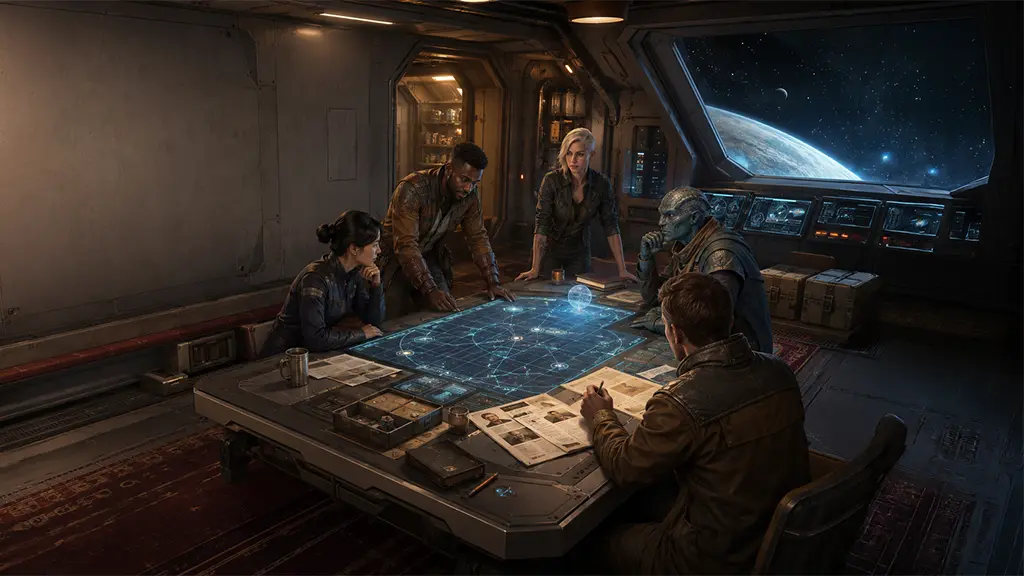
Traveller works best when the group thinks of itself as a crew. The party is not just a bundle of combat roles. It is a working group with overlapping needs and different specialties.
A strong Traveller crew usually needs people who can handle movement, information, negotiation, technical problems, danger, and social pressure. That does not mean every role must be perfectly covered. Gaps are useful because they create problems. A crew with no doctor handles violence differently. A crew with no engineer treats starship maintenance as a serious threat. A crew with no social specialist may discover that not every door opens with a weapon.
Before the first session, talk about why the characters stay together. Are they shipmates? Employees? Debtors? Relatives? Survivors? Criminal partners? Explorers? Veterans? A simple crew premise makes the campaign easier to run and easier to play.
The Ship Is More Than Transportation
In Traveller, a ship is often more than a vehicle. It can be home, workplace, money pit, escape route, cargo hold, tactical asset, source of debt, and campaign engine.
Once a ship enters the campaign, the game gains pressure. Where can the crew refuel? How long does travel take? Can they afford maintenance? Who owns the ship? What happens if they miss a payment? What cargo pays enough to justify the risk? Who wants the ship inspected, seized, repaired, stolen, or sabotaged?
This is why starship play creates momentum. The ship gives the crew freedom, but freedom is expensive.
For practical ship support, use the Traveller RPG Ship Travel Time Calculator, the Traveller 100D Calculator, and the Traveller Ships Mortgage Calculator.
Patrons, Jobs, and Trouble Drive Adventures
Traveller adventures often begin with practical problems. A patron needs cargo moved, a passenger protected, a signal investigated, a stolen ship recovered, a survey completed, a deal negotiated, or a person found before someone else gets there first.
A good patron is not just a quest giver. A patron is pressure. They have motives, limits, enemies, secrets, money, leverage, and incomplete information. Sometimes the job is honest. Sometimes it is not. Sometimes the patron is telling the truth but still wrong.
That uncertainty is a major part of the fun. Traveller crews often succeed by asking better questions, preparing carefully, and deciding which risks are acceptable.
Traveller Combat Is Dangerous
Traveller combat can be fast, sharp, and dangerous. This changes how players approach problems. A fight may solve something, but it can also create legal trouble, medical costs, damaged equipment, angry enemies, and dead characters.
New players should not assume combat is the default solution. Traveller often rewards preparation, negotiation, caution, armor, cover, medical readiness, escape routes, and knowing when not to fight.
This does not mean Traveller avoids action. It means action has weight. When violence begins, the table should feel the risk.
Trade, Debt, and Consequences Create Campaign Momentum
Traveller campaigns often become compelling because the consequences keep moving. Money matters. Repairs matter. Favors matter. Fuel matters. Reputation matters. Rivals remember. Patrons return. Authorities ask questions. A missed payment, damaged engine, unpaid crew, or angry contact can become the next adventure.
This is different from games where the campaign only moves when the main plot advances. In Traveller, ordinary obligations can create extraordinary trouble.
That is why the referee does not need to script everything. Give the crew a ship, a destination, a job, a few NPCs, a problem, and a reason to care. Then let decisions create the next set of consequences.
What Should New Players Learn First?
New Traveller players do not need to master the whole game before session one. Learn in this order:
- What your character is good at.
- How basic skill checks work.
- How to read your character sheet.
- What your career history says about your past.
- How your character fits the crew.
- What the shared ship, job, patron, or situation is.
- Why combat is risky.
- How money, gear, allies, and consequences affect play.
Once you understand those pieces, you can play. You can learn the deeper systems as they become relevant.
What Should New Referees Learn First?
New Traveller referees should resist the urge to build the entire universe before the first session. Start smaller and more playable.
- Begin with a crew problem, patron job, ship issue, or local conflict.
- Give players useful choices.
- Let failed rolls create complications instead of dead ends.
- Make consequences visible.
- Track NPCs, debts, rivals, repairs, and obligations.
- Prepare situations, not scripts.
- Build the setting outward as the crew travels.
The referee does not need to know every star system on day one. The referee needs enough pressure, opportunity, and consequence to make the next decision interesting.
What Do You Need to Start Playing?
To start playing Traveller, you need a few basic things: a rulebook for the version your group is using, ordinary six-sided dice, character sheets, a group, and a starting situation. If you are playing online, you may also want a virtual tabletop, shared notes, and digital maps.
Beginners should not buy everything at once. Start with the core rules, learn the basic flow of play, and add tools when they solve a real table problem.
If you are ready for a low-friction starting point, download the free Intro to Traveller PDF. It gives you a clearer path into the game before you start chasing every rule, supplement, and campaign idea.
If you need the current core rules, you can also get the Traveller Core Rulebook Update 2022 on DriveThruRPG.
Recommended Next Steps
Here is the simplest beginner path:
- Download the free Intro to Traveller PDF.
- Read one character creation guide before making your first Traveller.
- Learn how basic skill checks work.
- Start with a crew premise instead of a giant campaign bible.
- Watch the beginner playlist when you want the video version of these ideas.
You can watch the Traveller RPG Start Here playlist for more beginner-friendly Traveller explanations.
Traveller RPG Beginner FAQ
Is Traveller RPG hard to learn?
Traveller can look intimidating because it has character lifepaths, skills, starships, trade, travel, combat, and setting assumptions. It becomes easier when you learn the play loop first: crew problem, information, plan, skill checks, complications, choices, and consequences.
Do you need to know science to play Traveller?
No. Traveller is science fiction, but you do not need to be a scientist. You need enough shared understanding to make the fiction feel consistent. The referee can decide how realistic or cinematic the campaign should be.
Is Traveller like D&D in space?
Not really. Traveller can have action, danger, exploration, and strange worlds, but it is not built around classes, levels, and balanced combat encounters. It is usually more about skilled people making risky decisions in a living science fiction setting.
Which version of Traveller should beginners use?
Use the version your group is playing. Many current beginners start with Mongoose Traveller because it is actively supported and easier to find in current play communities. The most important thing is that everyone at the table uses the same rules reference.
Can you play Traveller online?
Yes. Traveller works well online with voice chat, shared notes, digital character sheets, and a virtual tabletop when maps are useful. For more help, read How To Play Traveller RPG Online With VTT.
Can you play Traveller solo?
Yes, with the right procedures, oracles, prompts, and campaign tools. Solo Traveller works best when you focus on clear situations, consequences, travel, patrons, and character goals instead of trying to pre-write a whole plot.
What dice do you need for Traveller RPG?
Most Traveller play uses ordinary six-sided dice. If you are coming from fantasy RPGs with many polyhedral dice, Traveller’s dice requirements are refreshingly simple.
How long does Traveller character creation take?
It depends on the group, the version, and how much discussion happens during the lifepath. For a first session, allow extra time and treat character creation as part of play, not as paperwork before the fun begins.
Can a Traveller character die during creation?
That depends on the version and options being used. Some older versions are famous for this idea, while many modern tables use rules that avoid removing a character before play begins. Ask your referee which approach the group is using.
What should I buy first for Traveller RPG?
Start with the core rules for the version your group is using. After that, buy only what supports the campaign you are actually playing: character tools, starship resources, setting material, or referee aids.
E-mail Notification Opt-in
Want more Traveller RPG articles, tools, and referee resources?
Join my private mailing list and I’ll let you know when new Traveller-related posts are published.
YES! Please notify me of new Traveller RPG posts!
You can also join me and other Traveller fans on the CyborgPrime Discord server.