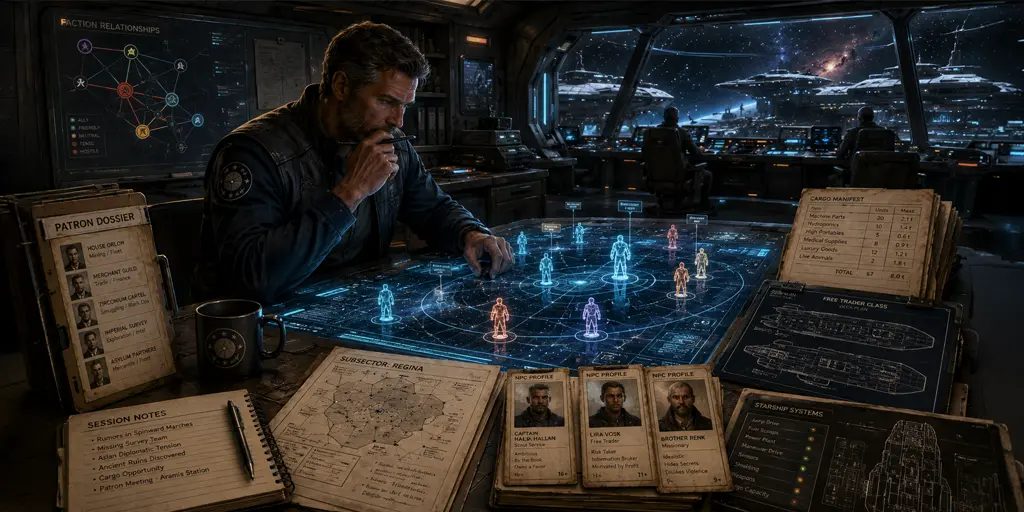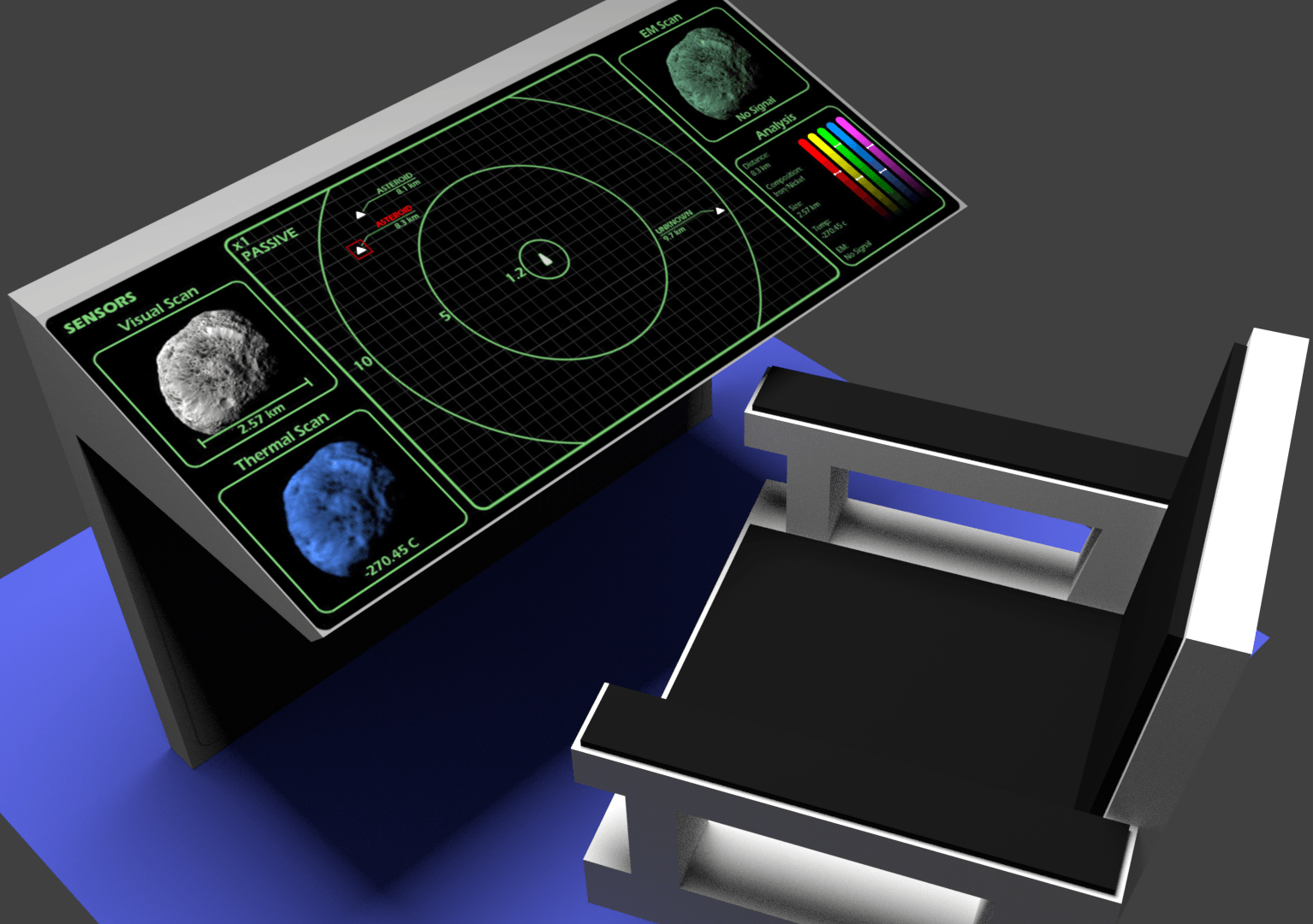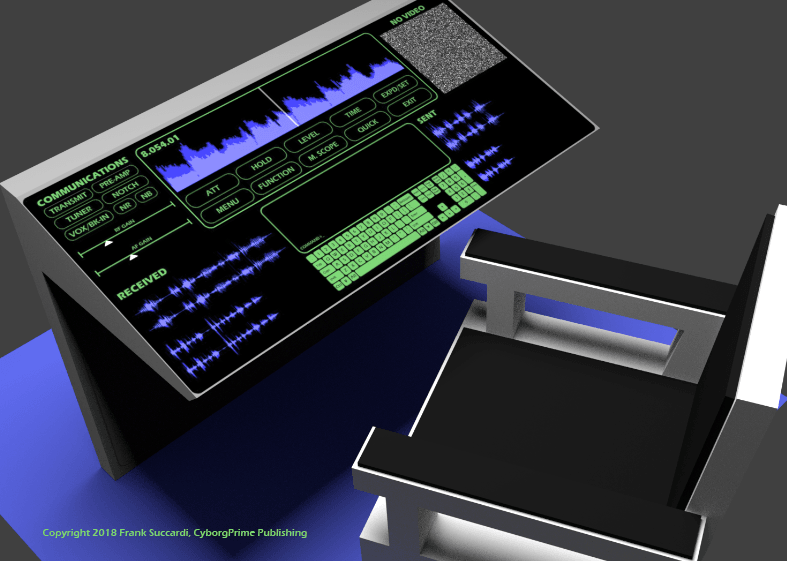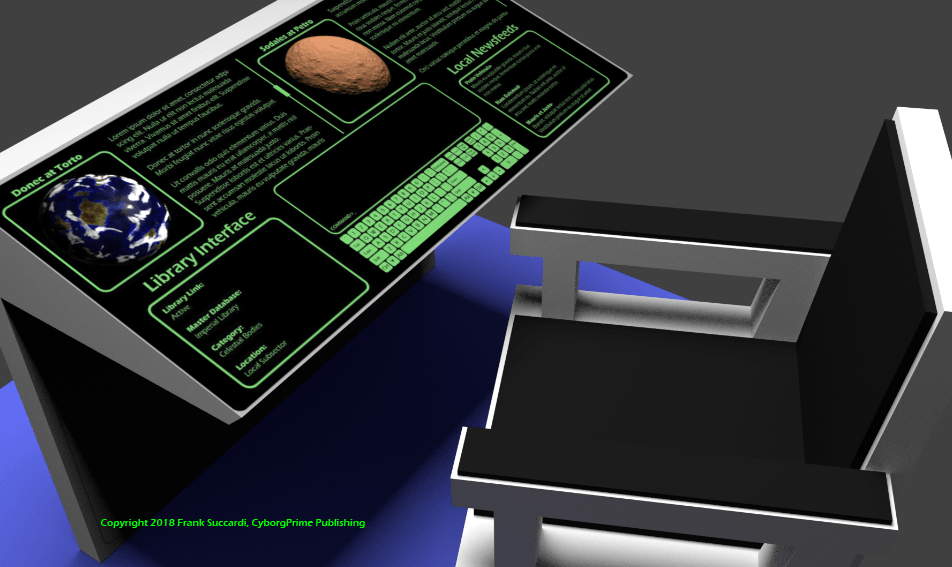
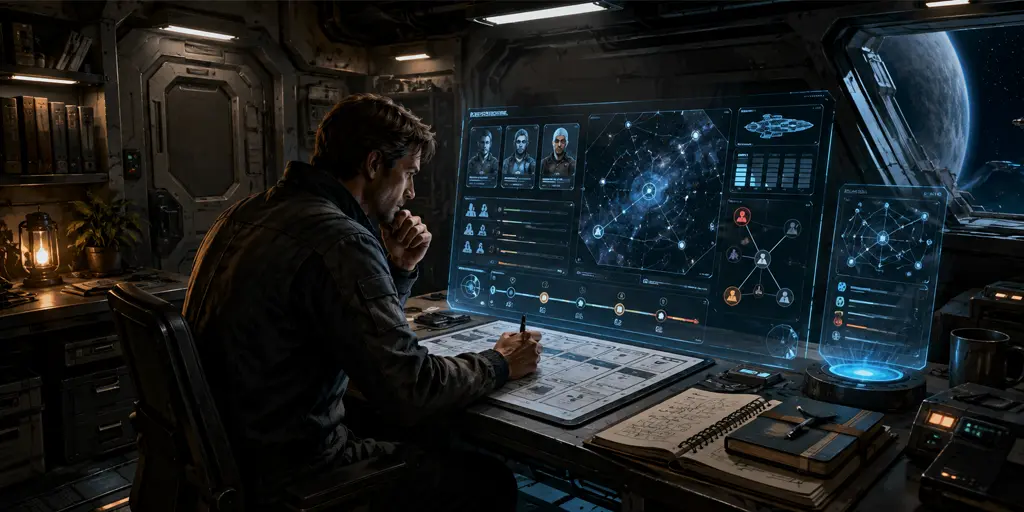
You do not need to prepare an entire subsector for tonight’s Traveller session—you need one unstable situation, three active pressures, a few usable people, and a clear idea of what happens if the crew does nothing.
Traveller RPG session prep can expand until it feels like campaign design. The crew can travel, negotiate, trade, investigate, fight, accept a patron, reject a patron, change worlds, pursue personal goals, or become entangled in local politics. That freedom is one of Traveller’s strengths, but it makes exhaustive preparation impossible.
The solution is not to predict every choice. Prepare a situation that can respond to choices. The workflow below gives you a strict thirty-minute boundary for preparing the next playable session.
This method is designed for routine session preparation. It is not a substitute for learning an unfamiliar ruleset, reading a published adventure for the first time, designing a complete campaign, or repairing major continuity problems.
The Five Questions Your Prep Must Answer
A playable Traveller session needs enough decision fuel for the referee to answer five questions:
- Where does the session begin?
- What is happening right now?
- Who wants something?
- What pressure prevents the crew from ignoring it?
- What changes if the players act—or refuse to act?
Use these questions as a filter for every note you add. If a detail does not help answer one of them, it can usually wait.
The 30-Minute Traveller RPG Session Prep Workflow
Minute 0–3: Review the Current Campaign State
Review only the information that can affect the next session. Do not reread the entire campaign archive. Write a three-line summary:
- Crew position: Where the Travellers are and which resources, damage, cargo, passengers, or restrictions matter.
- Immediate obligation: What they promised, accepted, owe, or must address.
- Unresolved pressure: What becomes worse if they do nothing.
This summary is your continuity filter. Any detail that does not affect one of those lines probably does not need attention tonight.
Minute 3–7: Define the Session Situation
Write one sentence describing the situation at the start of play:
The crew is trying to [goal], but [opposition or complication] is creating pressure because [consequence].
For example: The crew is trying to deliver medical cargo, but the starport authority has impounded their ship because a passenger is travelling under a false identity.
This is not a plot. It does not dictate what the crew must do. It gives them a problem with several possible approaches.
Minute 7–11: Identify Three Situation Drivers
Choose three elements capable of changing the situation:
- An actor: One person or faction with a clear objective.
- A constraint: One environmental, legal, financial, or logistical pressure that can worsen.
- A concealed conflict: One hidden complication, secret, or competing interest.
In the medical-cargo example, the situation drivers might be a customs inspector who wants the passenger surrendered, cargo that will spoil in six hours, and a passenger carrying evidence against the local government.
Each driver should be able to affect play independently. Three useful pressures are easier to run than ten factions that may never appear.
Minute 11–15: Prepare Three Useful NPCs
Prepare only enough information to portray each NPC and understand how that person can affect the situation. Record:
- Role
- Immediate desire
- Visible manner
- Leverage
- One concealed concern
Inspector Vara Kel might be a patient, formal customs officer who wants the passenger surrendered quietly. Her leverage is the ship impound order. Her concealed concern is that her superior has ordered her to make the passenger disappear.
Full statistics are unnecessary unless conflict is likely to depend on them. Use a familiar NPC template or a minimal skill line rather than building every person from scratch.
Minute 15–19: Prepare Three Discoverable Facts
Write three facts that change how the crew understands the situation. For example:
- The impound order was issued before the ship landed.
- The passenger sent an encrypted transmission during jump.
- Another vessel carrying similar cargo disappeared last month.
Do not attach each fact to one mandatory skill roll. Let the crew uncover information through conversation, technical access, bribery, surveillance, contacts, records, sensors, or legal research.
A failed roll should usually introduce a cost, delay, exposure, or incomplete answer rather than stopping the session.
Minute 19–23: Build One Escalation Clock
Decide what happens when the crew delays or fails to resolve the pressure. Use three stages:
- Pressure appears. Customs seals the ship.
- The situation becomes harder. The cargo begins to spoil and the recipient threatens legal action.
- A consequence changes the campaign. Security boards the ship while the passenger attempts to escape.
The clock is not a script. Advance it when time passes, the crew attracts attention, or a failure creates a meaningful consequence.
Minute 23–26: Prepare Two Flexible Locations
Prepare only the spaces most likely to matter. Give each location:
- One distinctive feature
- One useful feature the crew can exploit
- One danger or restriction
A starport detention concourse might have transparent interview booths overlooking the landing pads, a maintenance corridor leading toward the customs offices, and facial-recognition surveillance covering public areas.
A reusable deck plan, a generic interior, or a few theatre-of-the-mind details are enough unless spatial decisions are central to play.
Minute 26–28: Create a Strong Opening
Begin with a decision, demand, discovery, or visible consequence. An official arrives with an impound order. A patron changes the terms. A distress transmission interrupts routine operations. Cargo is missing. A faction offers protection at a price.
Do not spend the first part of the session asking what the players want to do when nothing is pressing them to decide.
Minute 28–30: Gather Rules, Tools, and Names
Use the final two minutes to collect only the references likely to interrupt play:
- One relevant rule
- One ship or vehicle profile
- A short name list
- An NPC template
- A map or deck plan
- A random complication table
- Your current campaign notes
Put them in one session document, browser group, VTT journal, or reference page. The goal is not more material. It is less search friction during play.
30-Minute Prep Checklist
Use this table as a final timer check. Each stage should produce one compact, playable output.
| Time | Task | Output |
|---|---|---|
| 0–3 minutes | Review campaign state | Three-line status summary |
| 3–7 minutes | Define the situation | One playable situation |
| 7–11 minutes | Choose situation drivers | Three active pressures |
| 11–15 minutes | Prepare NPCs | Three usable NPCs |
| 15–19 minutes | Prepare information | Three discoverable facts |
| 19–23 minutes | Add escalation | One three-stage clock |
| 23–26 minutes | Prepare locations | Two flexible locations |
| 26–28 minutes | Create the opening | One immediate decision |
| 28–30 minutes | Gather references | References ready for play |
When the timer ends, stop expanding the notes. Start the session with the situation you have prepared and add detail only when play demands it.
What Not to Prepare
Fast Traveller game preparation depends as much on deciding what to omit as on choosing what to write. Do not routinely prepare:
- Every room in the starport
- A complete planetary history
- Full statistics for every NPC
- Dialogue scripts
- One correct solution to each problem
- Every destination the crew could choose
- Detailed maps that will probably not be used
Unused preparation is not automatically wasted. A location, NPC, or complication can be recycled later. The problem is repeated over-preparation that delays play and trains the referee to value documentation over decisions.
Prepare Decisions, Not Scenes
Scene-based preparation assumes a fixed chain: the crew meets a patron, visits a warehouse, fights smugglers, finds stolen cargo, and pursues a ship. That sequence breaks when the players investigate the patron, contact the authorities, negotiate with the smugglers, or refuse the job.
Decision-based preparation survives those choices. Prepare what the patron wants, why the cargo matters, what the smugglers want, what happens if nobody intervenes, which evidence connects the factions, and why delay is costly.
The players can then choose their method while your preparation remains useful. You know who reacts, which facts can be discovered, and how the pressure changes.
If the crew resolves the central problem faster than expected, advance the concealed conflict, reveal a consequence, or ask which unresolved obligation they address next. Do not add a disconnected encounter merely to fill time.
Traveller-Specific Prep Priorities
Traveller sessions often gain momentum from obligations, constraints, relationships, and consequences rather than from a fixed sequence of encounters.
Obligations
Look for ship payments, patrons, contracts, passengers, cargo deadlines, legal responsibilities, and faction promises. An obligation gives the crew a reason to engage without removing their freedom.
Constraints
Fuel, maintenance, jump time, life support, travel time, local law, social status, and limited communication turn ordinary decisions into meaningful tradeoffs. Use only the constraints already relevant to the current situation.
Relationships
Career contacts, rivals, allies, former employers, patrons, family, and faction ties create continuity. Reuse a relationship before inventing another NPC when doing so makes the campaign feel connected.
Consequences
Reputation, legal trouble, damaged relationships, lost access, debt, opportunity cost, and faction responses give player decisions weight. Prepare one consequence that can carry into a later session.
How to Use AI Without Letting It Take Over
AI-assisted RPG prep works best when the referee controls the scope. Use it to reduce blank-page work and retrieval time, not to surrender judgment.
Useful tasks include:
- Summarizing the previous session
- Extracting unresolved threads
- Proposing several complications for review
- Drafting NPC desires, leverage, and concealed concerns
- Suggesting alternative escalation stages
- Reorganizing notes into a one-page session sheet
- Producing names or sensory details
- Identifying possible continuity conflicts
- Suggesting consequences for likely approaches
Give the tool relevant campaign context, request a limited structure, select or reject suggestions, revise the useful material, and keep only what matters tonight. Asking for an entire unconstrained adventure often recreates the original problem by producing more material than you can evaluate.
Remove private player information, unpublished commercial text, or sensitive campaign material before submitting notes to an external tool.
Copyable Traveller Session Prep Sheet
Use this compact structure to turn the workflow into one page of playable notes:
Campaign State
- Crew position:
- Immediate obligation:
- Unresolved pressure:
Starting Situation
The crew is trying to:
But:
Because:
Three Situation Drivers
- Actor and objective:
- Constraint that worsens:
- Concealed conflict:
Three NPCs
- Role, desire, manner, leverage, concealed concern:
- Role, desire, manner, leverage, concealed concern:
- Role, desire, manner, leverage, concealed concern:
Three Discoverable Facts
Escalation Clock
- Pressure appears:
- The situation becomes harder:
- A consequence changes the campaign:
Locations and Opening
- Location one: Distinctive feature, useful feature, danger or restriction.
- Location two: Distinctive feature, useful feature, danger or restriction.
- Opening decision:
- References to gather:
Prepare Enough, Then Play
Preparation should make the game easier to run. It should not become a separate hobby that prevents the session from happening.
For a routine session, thirty focused minutes can produce a playable situation, active pressures, usable NPCs, discoverable facts, flexible locations, and consequences that respond to the crew’s decisions. Campaign depth can emerge over time as those decisions create continuity.
Prepare enough to create meaningful choices, then let the crew show you what the campaign needs next.
Frequently Asked Questions
Can every Traveller session be prepared in 30 minutes?
No. Thirty minutes is a practical boundary for preparing a routine next session when you already understand the campaign and rules. A new campaign, an unfamiliar published adventure, or a major continuity problem may require more time.
What if the players leave the prepared location?
Follow the situation drivers rather than trying to preserve a planned scene. The NPCs still want something, the pressures still advance, and the consequences still matter. Move those elements to the new location when that makes sense, or pause only long enough to establish the next immediate situation.
Do Traveller NPCs need full statistics?
Usually not. Prepare a role, desire, manner, leverage, and concealed concern. Add full statistics only when the NPC is likely to enter a conflict where those numbers will affect play.
Can this method work with published adventures?
Yes, after you understand the material. Use the workflow to identify the part of the adventure most likely to matter in the next session, the active forces involved, the information the crew can discover, and the consequences of delay. It is not a replacement for reading an unfamiliar adventure for the first time.
What if the crew resolves the situation early?
Reveal the concealed conflict, advance a consequence, or return to an unresolved obligation. Use the material already connected to the campaign instead of adding an unrelated encounter to occupy time.
Make Your Next Prep Session Easier
Get practical Traveller referee tools, preparation ideas, and campaign resources designed to help you create meaningful choices without writing an entire subsector before every session.