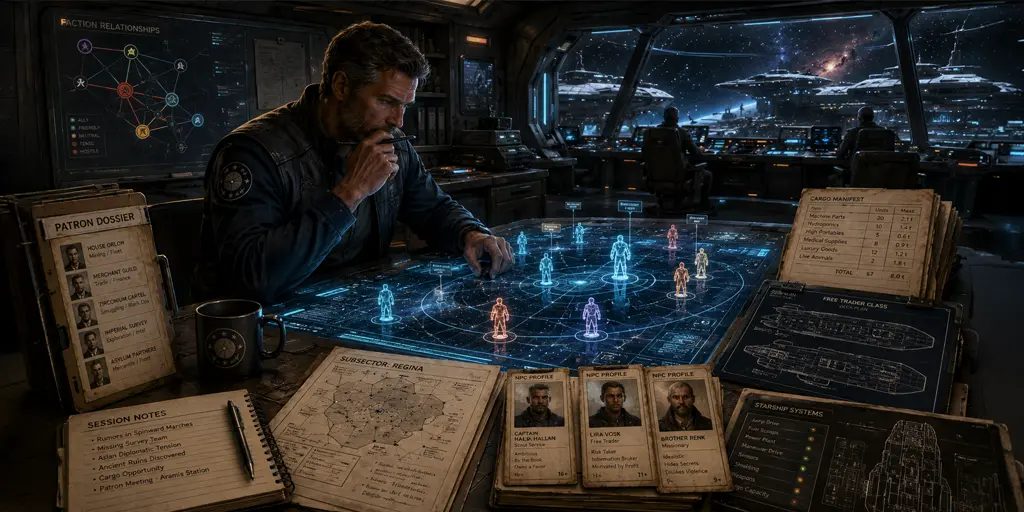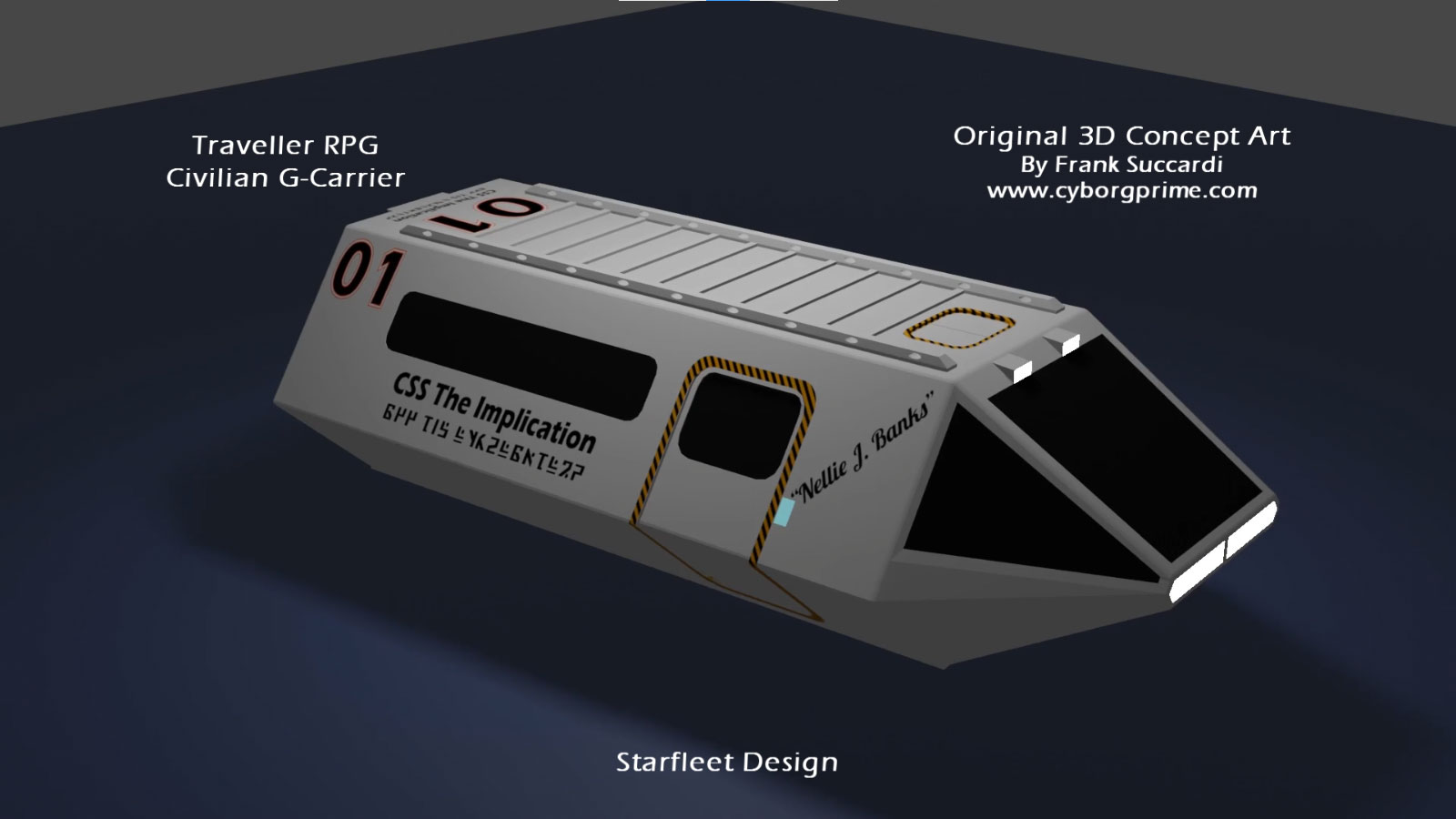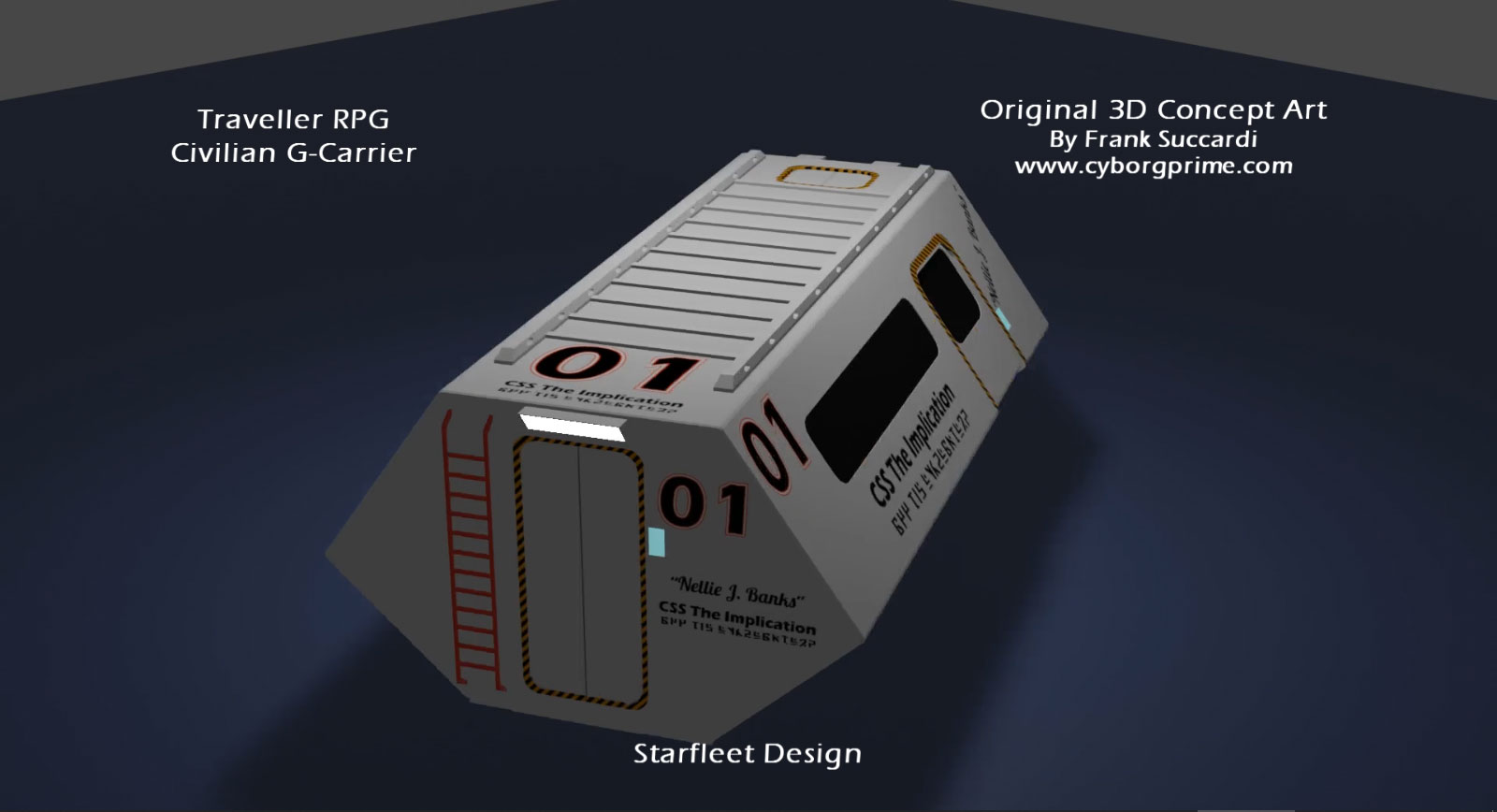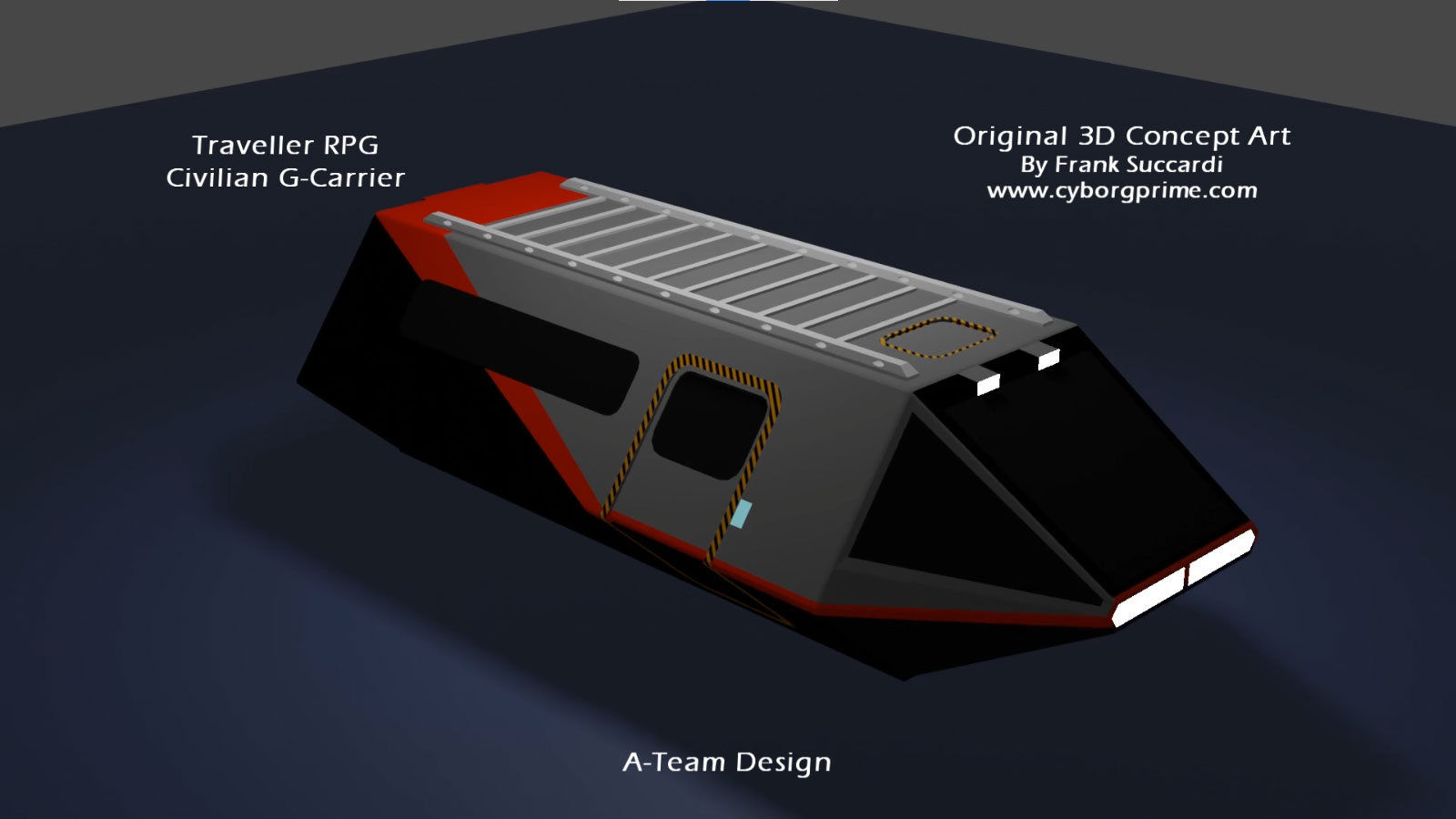
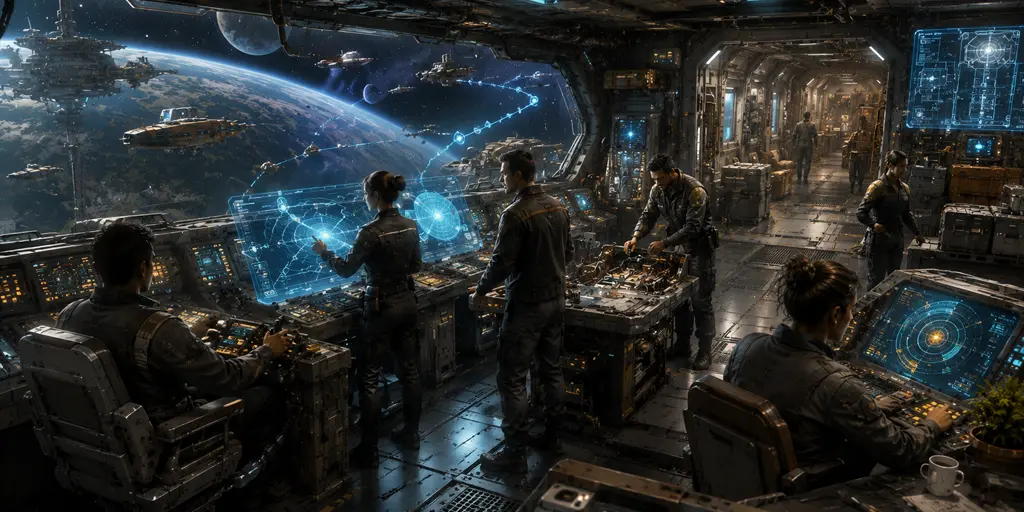
A Traveller starship is more than transportation: it is the crew’s workplace, financial obligation, adventure location, and campaign engine.
Your Ship Is the Campaign’s Operating System
A starship can be the crew’s home, workplace, largest asset, largest debt, main source of income, route to new adventures, and most frequently used adventure location. That combination makes Traveller starships unusually powerful campaign tools.
The group does not need to own a ship outright to build a campaign around one. The characters might share ownership, lease a vessel, operate it for a corporation, serve aboard a government ship, borrow it from a patron, claim it as salvage, or control it under questionable legal circumstances.
The useful questions are not limited to whether the crew owns the ship. Ask who controls it, who pays for it, who maintains it, who decides where it travels, and what happens when something goes wrong.
Think of the ship as five connected systems:
- An asset someone owns or controls.
- An obligation that creates continuing financial or political pressure.
- A workplace requiring competent people and clear responsibilities.
- A location where conversations, conflicts, searches, rescues, and emergencies happen.
- A campaign engine that creates routes, jobs, deadlines, relationships, and consequences.
Quick Navigation: What Ship Problem Are You Solving?
Use the following shortcuts to find the part of ship operations that matters to your current session.
| I Need Help With… | Go Here |
|---|---|
| Calculating normal-space travel time | Traveller Ship Travel Time Calculator |
| Estimating mortgage payments | Traveller Ships Mortgage Calculator |
| Understanding safe jump distance | Traveller 100D Calculator |
| Calculating distance travelled | Traveller Ship Distance Traveled Calculator |
| Organizing the crew | Crew Operations |
| Running shipboard trouble | Encounters and Emergencies |
| Choosing a VTT map format | Deck Plans, VTT Maps, and Roll20 |
Getting and Paying for a Ship
What Does “Having a Ship” Mean?
Control, ownership, and financial responsibility do not always belong to the same person. A captain might make operational decisions while a corporation owns the vessel and a lender retains a financial claim. A crew may possess legal ownership while still being constrained by debt, service obligations, insurance requirements, or contracts.
Common arrangements include equal crew ownership, one-character ownership, mortgage-financed ownership, corporate assignment, government service, patron-provided access, family ownership, lease, charter, salvage claim, and disputed possession.
Each arrangement answers three separate questions:
- Who has the legal right to the ship?
- Who has practical command of the ship?
- Who absorbs the cost when the ship loses money or suffers damage?
Ship Shares
Ship shares can represent prior service, investment, inheritance, or bargaining power. Their most useful campaign effect is not a line on an accounting sheet. They influence authority, financial exposure, profit distribution, and the crew’s ability to make major decisions.
A character with a larger legal stake may expect greater control. Other crew members may disagree, especially when they provide the skills that keep the vessel flying. Shares can also create complications when a shareholder leaves, dies, sells an interest, disappears, or attempts to use ownership as leverage.
Mortgages and Operating Costs
A Traveller ship mortgage is a recurring campaign pressure. It creates deadlines, minimum income requirements, pressure to keep moving, conflict over risk, and temptation to postpone repairs. The lender may also become a source of patrons, demands, political influence, or unwanted scrutiny.
Use the Traveller Ships Mortgage Calculator when the group needs to estimate the financial obligation attached to a vessel.
Debt becomes playable when it forces a decision. Repairs may consume money reserved for the next payment. A dangerous cargo may be the only profitable work available. A lender may offer relief in exchange for a favor. A passenger may offer enough money to solve the immediate problem while creating a much larger one.
Crew Agreements
A practical crew agreement reduces confusion before credits, danger, or authority become points of conflict. The agreement does not need to be a legal document, but the group should answer these questions:
- Who legally controls the ship?
- Who commands during routine operations?
- Who commands during emergencies?
- How are operating costs paid?
- Are salaries paid before profit shares?
- How are profits divided?
- Who approves repairs and upgrades?
- Who decides which jobs to accept?
- What happens when a crew member leaves?
- What happens when the ship cannot make a payment?
- What happens when the crew disagrees about risk?
- Who owns equipment purchased with shared funds?
Ownership Model and Campaign Effect
| Ownership Model | Who Controls the Ship? | Campaign Effect |
|---|---|---|
| Equal partnership | The crew collectively | Major decisions require agreement. |
| Captain-owned | One character | Authority is clear, but resentment may grow. |
| Mortgage-financed | Crew or captain, subject to the lender | Income deadlines drive job selection. |
| Corporate vessel | Employer or company | The crew has resources but limited freedom. |
| Government vessel | Service or agency | Missions and restrictions come from above. |
| Patron-provided | The patron retains leverage | Access depends on continued cooperation. |
| Stolen or disputed | Whoever currently holds it | Every port may create legal danger. |
Who Does What Aboard the Ship?
A Ship Needs Functions, Not Just Job Titles
Small Traveller crews rarely have one specialist for every title. A better approach is to identify the functions the ship requires and decide who covers each one. One person may fill several functions, automation may cover part of the workload, and hired NPCs may fill important gaps.
Direction
Direction includes command, setting priorities, making time-sensitive decisions, coordinating the crew, representing the vessel, and negotiating with authorities, patrons, passengers, and clients.
Movement
Movement includes piloting, docking, undocking, hazardous approaches, atmospheric operations where applicable, evasive action, combat positioning, astrogation, jump plotting, route assumptions, fuel planning, and timing.
Survival
Survival includes engineering, drives, power, fuel systems, preventive maintenance, life support, damage control, emergency repairs, and keeping the ship functional after the original plan fails.
Awareness
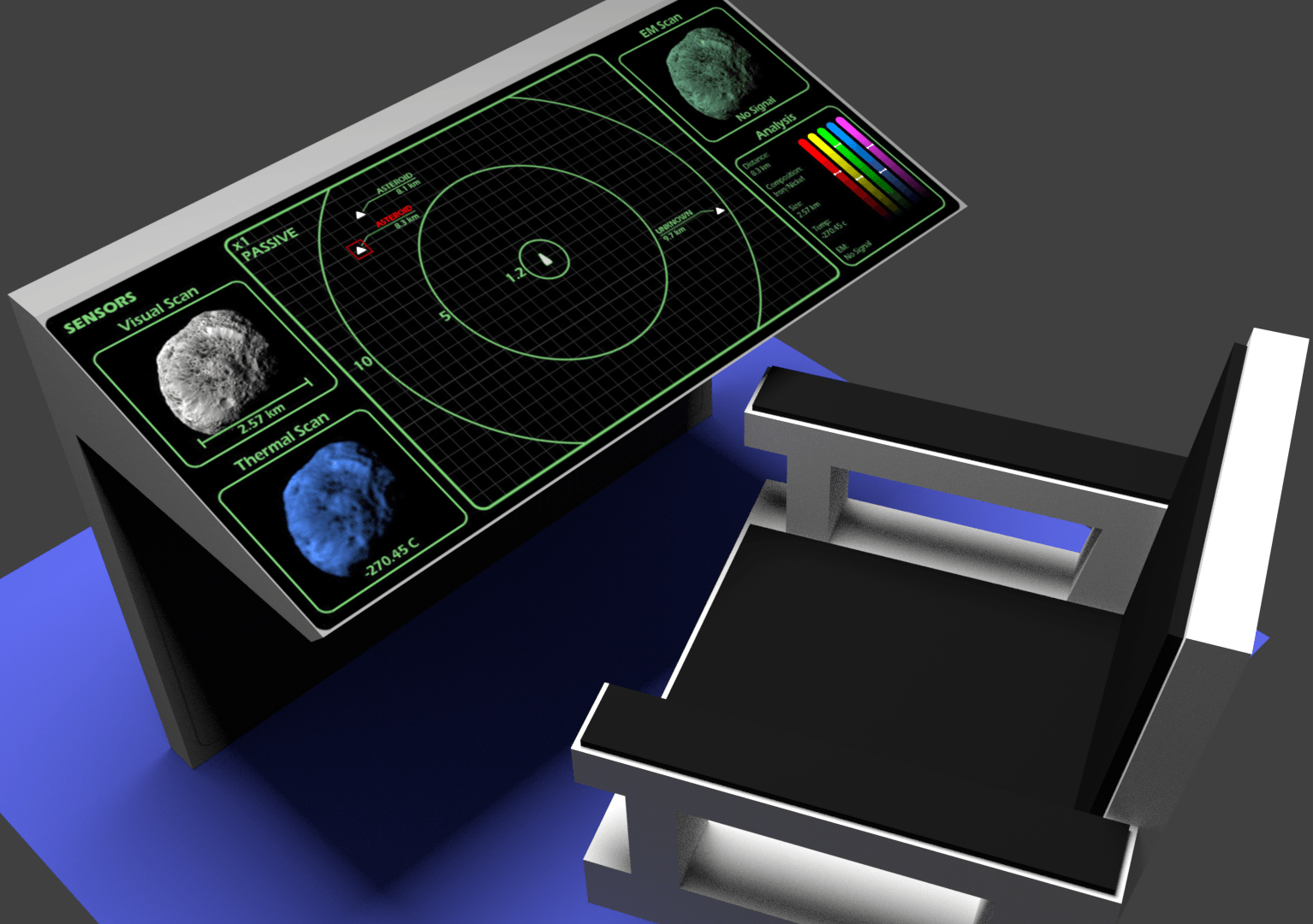
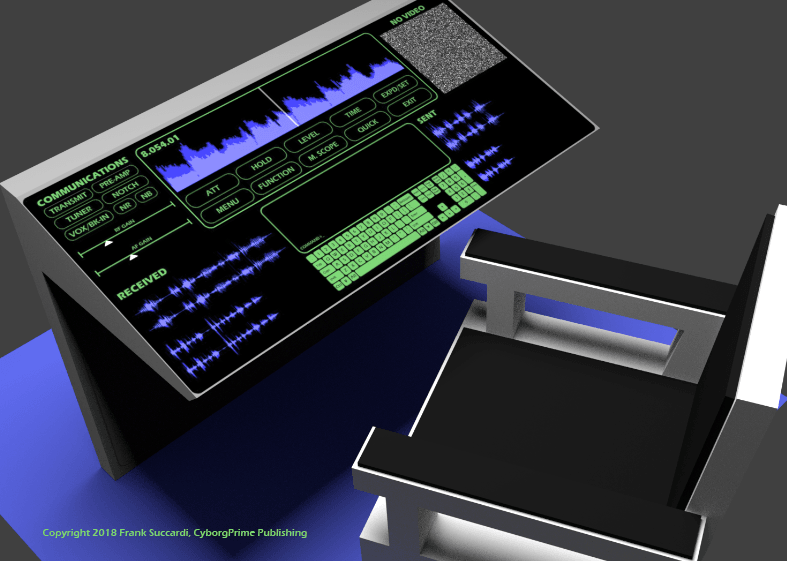
Awareness includes sensors, communications, contact identification, hazard detection, emissions monitoring, electronic countermeasures, and maintaining an accurate picture of the situation outside the hull.
People and Payload
People and payload includes medical care, passenger service, cargo handling, documentation, administration, security, gunnery, small-craft operations, and crew welfare.
What Crew Does a Traveller Starship Actually Need?
The answer depends on the ship, its automation, the mission, expected danger, the available characters, hired NPCs, passengers, commercial requirements, and whether combat is likely.
For the ship in your campaign, identify:
- Functions that are essential for routine operation.
- Functions one character can reasonably combine.
- Functions partly covered by automation.
- Functions assigned to NPC crew.
- Functions nobody can currently perform.
- Functions that need backup coverage.
Redundant Skills
A single point of failure can strand the ship or end the campaign. For every essential function, identify a primary operator, a backup operator, an emergency substitute, and any function no one can perform.
Ask what happens if the only engineer is injured, the pilot is unconscious, the astrogator is unavailable, the medic becomes the casualty, or the captain disappears with the financial records.
How Traveller Starship Travel Works
Normal-Space Travel
A ship still needs time to move between worlds, moons, stations, refueling locations, local destinations, and safe jump distance. Arrival in a star system does not mean immediate arrival at the destination world.
Normal-space travel creates schedules, interception opportunities, fuel concerns, sensor contacts, passenger time, crew downtime, and limits on emergency response.
Use the Traveller RPG Ship Travel Time Calculator to estimate normal-space journeys.
The 100-Diameter Limit
Large masses interfere with safe jump operations. Ships generally need to move clear before entering jump, and a ship emerging from jump is not automatically beside the destination world. Travel to and from the jump limit consumes time.
The 100-diameter limit creates predictable approaches, patrol zones, interception opportunities, rescue delays, travel-time decisions, and room for encounters before and after jump.
Use the Traveller 100D Calculator when determining a practical jump-clearance distance.
Jump Travel
A practical flight sequence looks like this:
- Move clear of major gravity sources.
- Prepare the vessel.
- Calculate and verify the jump.
- Enter jump space.
- Spend approximately one week isolated from normal space.
- Emerge near the destination system.
- Confirm the ship’s position and local conditions.
- Travel toward the destination world, station, or facility.
Jump travel creates isolation, limited external communication, planning time, maintenance opportunities, passenger tension, and uncertainty about what has changed outside.
Fuel
Fuel is most useful when treated as a route decision rather than repetitive bookkeeping. Ask how much the ship needs, where it will refuel, whether refined fuel is available, whether skimming is possible, how much reserve remains, and what happens if fuel is contaminated or politically difficult to obtain.
Maintenance
Maintenance includes routine work, preventive checks, spare parts, annual service, repair facilities, improvised fixes, and deferred work. A repair postponed today becomes maintenance debt: an unresolved weakness waiting for a stressful moment.
Do not make every delayed repair produce immediate catastrophe. Record the compromise, then allow it to affect later choices.
Misjumps
A misjump should be a serious campaign event rather than casual random punishment. Possible consequences include unexpected arrival, lost time, fuel shortage, uncertainty, isolation, damage, political complications, rescue requirements, or a destination that no longer matches the crew’s plans.
Use the Traveller ship calculators: The Ship Distance Traveled Calculator, Ship Travel Time Calculator, Traveller 100D Calculator, and Traveller Ships Mortgage Calculator can handle common operational questions while the article remains focused on decisions and consequences.
Running Life Aboard Ship
The Ship Is a Shared Home
A crew lives with limited space, machinery noise, smells, temperature differences, shared facilities, personal possessions, rank, habits, and unresolved stress. A character cannot simply go home after an argument.
Watches
Watch schedules determine who monitors the bridge, engineering, sensors, communications, passengers, and security. They affect sleep, privacy, readiness, social interaction, fatigue, and emergency response.
Privacy
Privacy pressures may involve shared cabins, personal communications, relationships, restricted compartments, cultural expectations, rank differences, secrets, surveillance, or private projects.
Passengers
Passengers create income, responsibility, medical concerns, security risks, demands, secrets, potential patrons, possible enemies, and legal complications.
Cargo
Cargo becomes playable when it has qualities beyond value and tonnage. It may be dangerous, illegal, perishable, politically sensitive, alive, mislabelled, stolen, fragile, contaminated, or wanted by several factions.
Repairs and Downtime
Downtime can support repairs, training, research, messages, relationships, personal projects, investigation, planning, medical recovery, and consequences from previous jobs.
Crew Conflict
Build conflict around decisions instead of forcing arbitrary drama. Which job is too dangerous? Which repair can be delayed? Who receives scarce medical treatment? Is the passenger worth the risk? Should the crew surrender the cargo?
Starship Encounters and Emergencies
Boarding Actions
A boarding action requires more than a deck plan. Determine why the boarding is happening, what each side wants, whether the target intends to resist, which entrances are usable, whether gravity and life support function, what weapons might damage, and whether either side needs the vessel intact.
Rescue Operations
Rescue situations include distress beacons, disabled ships, medical emergencies, escape pods, failed jumps, life-support collapse, derelicts with survivors, stranded passengers, and calls that may be traps.
Wrecks and Derelicts
Wrecks support salvage, investigation, environmental danger, horror, missing-person searches, corporate claims, quarantine, evidence recovery, and faction competition.
Patrols and Customs
Customs and patrol encounters can test documentation, cargo legality, crew identity, passenger status, weapons permits, warrants, tariffs, political allegiance, ship registration, and ownership claims.
Pirates
Pirates should want something specific. They may demand cargo, fuel, hostages, information, passage, repairs, revenge, a passenger, a particular container, or access to a hidden route.
Preparing an Emergency
Possible emergencies include drive failure, power loss, fire, decompression, collision, contamination, medical outbreak, navigation error, sensor blindness, hostile software, fuel failure, sabotage, cargo breach, and passenger violence.
Prepare a shipboard emergency by answering four questions:
- What failed?
- What is immediately endangered?
- What decision must the crew make?
- What becomes worse if they delay?
Deck Plans, VTT Maps, and Roll20
What a Deck Plan Does
A deck plan answers practical questions. Where is everyone? Which route is blocked? What can be sealed? Where can intruders enter? How far is engineering from the bridge? Which compartments are exposed?
When You Actually Need a Deck Plan
A detailed map is useful when position, routes, doors, compartments, simultaneous movement, damage spread, or time pressure affect the decisions being made.
Boarding, rescue, sabotage, quarantine, intruder searches, damage control, and derelict exploration all benefit from clear spatial information.
Downloadable VTT Asset Packs
Downloadable asset packs provide portable maps or media files for virtual tabletops that support imported assets. They offer flexibility across platforms and custom workflows.
Roll20-Native Marketplace Packs
Roll20-native packs are designed for use inside Roll20. Depending on the specific product, a pack may include platform-ready pages or support features such as walls, doors, line of sight, and dynamic lighting.
Check the individual product description for confirmed features rather than assuming every pack includes every possible Roll20 function.
Choosing the Correct Format
| Need | Best Choice |
|---|---|
| Use maps across different VTTs | Downloadable asset pack |
| Customize the setup personally | Downloadable asset pack |
| Play primarily in Roll20 | Roll20 Marketplace version |
| Reduce Roll20 preparation | Roll20 Marketplace version |
| Print or repurpose map files | Downloadable asset pack |
Explore starship maps: Browse CyborgPrime deck plans and VTT resources on the Roll20 Marketplace.
For a low-friction introduction to using ship interiors in play, download the free Far Trader illustrated deck plans.
Traveller Starship Operations FAQ
Does a Traveller group need to own a ship?
No. A ship-centered campaign can work with a leased, corporate, government, patron-provided, borrowed, salvaged, or disputed vessel. The important questions are who controls it, who pays for it, and what obligations come with access.
What is the minimum crew for a Traveller starship?
There is no single answer for every vessel. Identify the functions required for movement, survival, awareness, command, and people or payload, then decide which characters, NPCs, or automated systems cover them.
Why are backup skills important?
A crew with only one pilot, engineer, astrogator, or medic has a single point of failure. Backup coverage keeps an injury, absence, or emergency from ending the campaign.
How does the 100-diameter limit affect play?
It creates travel time before and after jump, predictable approach routes, patrol zones, interception opportunities, and delays that matter during rescues, pursuits, and deadlines.
What happens during a week in jump space?
The crew can repair systems, train, investigate, plan, recover, manage passengers, resolve conflicts, and prepare for arrival. Jump time is useful downtime, not empty time.
When should I use a deck plan?
Use one when routes, doors, compartments, movement, damage spread, or simultaneous actions affect the outcome. Routine travel and simple conversations usually do not need detailed tactical mapping.
Should I buy a downloadable deck plan or a Roll20-native pack?
Choose a downloadable asset pack for portability and customization. Choose a Roll20-native version when you play primarily in Roll20 and want to reduce setup. Always check the individual product description for confirmed features.
Get Traveller Starship and VTT Resources by E-mail
Want more Traveller ship tools, deck plans, referee advice, and practical VTT resources?
Join the CyborgPrime mailing list for starship articles, calculators, downloadable resources, and new Traveller support material.
Get Traveller starship resources and updates:
Make the Ship Create Decisions
A Traveller starship works best when the group understands who controls it, who pays for it, which functions the crew must cover, how travel shapes time and risk, what happens when systems fail, and when a detailed deck plan improves play.
The ship should feel like more than equipment. It should create choices, obligations, relationships, opportunities, and trouble.
Explore Traveller starship resources: Browse CyborgPrime starship deck plans and VTT maps on Roll20, use the Traveller ship calculators for operational questions, or begin with the free Far Trader illustrated deck plans.