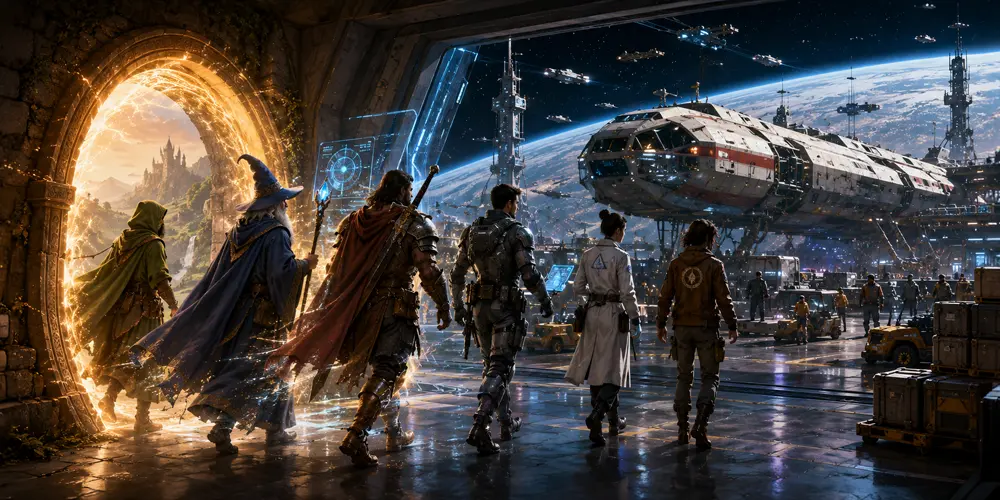
If you already know Dungeons & Dragons, you are closer to understanding Traveller than you might think.
Traveller for D&D Players: The Short Version
Traveller is a science-fiction tabletop RPG focused on exploration, trade, starships, problem-solving, and player freedom.
While D&D often follows heroes becoming more powerful, Traveller focuses on capable people making smart decisions in a dangerous universe.
Start with the free Introduction to Traveller, then continue with The Ultimate Guide to Playing Mongoose Traveller RPG.
If You Know D&D, You Can Learn Traveller
Many D&D players assume Traveller is a complicated science-fiction simulation.
It is not.
Traveller's core mechanics are surprisingly simple. Like D&D, you will create a character, roll dice, solve problems, work as a team, explore dangerous places, earn rewards, and tell memorable stories.
The biggest adjustment is not the rules. It is how the game approaches character progression, risk, adventure structure, and player choice.
D&D vs Traveller at a Glance
| D&D | Traveller |
|---|---|
| Classes | Careers |
| Levels | Skills, terms, and life experience |
| Magic | Technology and occasional psionics |
| Treasure | Trade, contracts, salvage, and opportunities |
| Dungeons | Worlds, starships, stations, and sectors |
| Heroic power growth | Broadening expertise |
| Long rests | Medical treatment and recovery time |
| Adventure paths | Sandbox freedom |
| Combat-focused solutions | Problem-solving solutions |
This does not mean one game is better than the other. They are designed to create different kinds of stories.
The Biggest Difference: You Are Not Heroes (At First)
In many D&D campaigns, characters begin as adventurers and eventually become legendary heroes.
Traveller takes a different approach.
You are not necessarily destined to save the galaxy. You might be a retired naval officer, a merchant captain, a scout, a scientist, a former marine, an engineer looking for work, or a drifter with a complicated past.
At first glance, that may sound less exciting. In play, many players find it more immersive because Traveller characters feel like real people with real histories.
Classes vs Careers
One of the first surprises for D&D players is that Traveller does not use traditional character classes.
Instead of choosing Fighter, Rogue, Wizard, or Cleric, Traveller characters build a history through careers.
Common careers include:
- Navy
- Marines
- Army
- Scouts
- Merchants
- Nobility
- Scholars
- Agents
These careers shape your skills, benefits, contacts, rivals, and life events before the campaign even begins.
Learn more about the process in Mongoose Traveller Character Creation: Careers.
Character Creation Creates Stories Before Play Begins
A D&D character often begins with a backstory.
A Traveller character generates one.
During character creation, your Traveller may serve in the military, survive a border war, make allies, gain enemies, suffer injuries, acquire benefits, earn promotions, wash out of a career, or retire with useful connections.
That means a starting Traveller character can begin play with years of experience, personal history, and unfinished business.
For many D&D players, this is the moment Traveller clicks. Your character sheet is not just a list of abilities. It is a record of what happened before the first session.
Start with How To Play Traveller: Traveller RPG Character Creation, then continue with Traveller Character Creation: Best Background Skills.
Levels vs Terms and Life Experience
This is where many D&D players make incorrect assumptions.
Traveller terms are not levels.
In D&D, levels usually represent adventuring achievement and increasing power. In Traveller, a term represents four years of a character's life.
A character who has completed multiple terms has accumulated training, experience, contacts, benefits, and events. That does not mean they are dramatically more powerful in the way a high-level D&D character is.
For example, a first-level D&D fighter might be a new adventurer. A starting Traveller character might have served twelve years in the Navy, survived a war, developed a rival, built professional contacts, and acquired valuable skills.
Traveller characters usually grow broader rather than exponentially stronger.
Magic vs Technology
Traveller replaces most fantasy magic with advanced technology.
Instead of fireballs, teleportation, magic swords, and resurrection spells, you will encounter jump drives, fusion weapons, advanced medicine, artificial intelligence, robotics, cybernetics, sensors, and starships.
Traveller does include psionics in some campaigns, but psionics usually occupy a much smaller role than magic does in most fantasy settings.
Dungeons vs Sandboxes
Many D&D adventures provide clear objectives.
Defeat the dragon. Recover the artifact. Rescue the prince.
Traveller campaigns tend to be more open. The referee presents opportunities, but the players decide what matters.
You might spend an entire session negotiating a cargo contract, investigating a mystery, exploring a newly discovered world, avoiding a war, managing ship finances, or hunting pirates.
Many Traveller players eventually discover they enjoy this freedom far more than they expected.
Monsters vs Problems
Traveller certainly contains dangerous creatures, hostile aliens, pirates, mercenaries, and enemies.
But most Traveller adventures are not built around combat encounters in the same way many fantasy adventures are.
Traveller presents problems.
In D&D, the problem might be:
A dragon is guarding the treasure.
In Traveller, the problem might be:
Your life support system will fail in six hours, your cargo is illegal, and pirates are tracking your ship.
Neither game is better. They simply reward different player instincts.
Traveller tends to reward planning, caution, creative thinking, negotiation, and knowing when to walk away.
Treasure vs Trade
D&D often rewards characters with treasure.
Traveller rewards characters with opportunity.
The crew may earn money through trade, passenger transport, exploration, mercenary contracts, salvage operations, corporate missions, survey work, or patron jobs.
Economic decisions become part of gameplay.
Fuel matters. Ship maintenance matters. Mortgages matter. Cargo matters.
If your group enjoys that side of play, the Traveller Ships Mortgage Calculator and Traveller RPG Ship Travel Time Calculator can help make starship operations easier to manage.
Your Starship Is Your Stronghold
In D&D, players may eventually acquire a castle, guildhall, tavern, tower, or stronghold.
In Traveller, your starship often fills that role from the beginning.
Your ship is transportation, home, business, lifeline, adventure hook, and sometimes the crew's biggest financial problem.
Many campaigns revolve around maintaining and improving the crew's vessel.
The ship gives the players freedom, but it also gives them responsibilities. That combination is one of Traveller's strongest campaign engines.
Combat Is Different
This is where many D&D players experience culture shock.
Combat in Traveller is dangerous.
Winning a fight is not always the goal. Avoiding the fight may be smarter. Negotiating may be smarter. Running away may be smarter.
Traveller encourages players to think before drawing a weapon because consequences matter.
This does not mean Traveller cannot support action-heavy campaigns. Military, mercenary, pirate, and naval campaigns can be exciting. But even then, combat tends to feel risky rather than routine.
Why Some D&D Players Struggle With Traveller
Most D&D players who bounce off Traveller do so for one of four reasons.
- They expect combat to solve every problem.
- They wait for the referee to provide a quest.
- They treat terms like levels.
- They underestimate how dangerous combat can be.
Once players embrace Traveller's sandbox style, many discover a level of freedom they never experienced in fantasy RPGs.
What D&D Players Usually Fall in Love With First
Every table is different, but D&D players often fall in love with the same Traveller elements:
- Character creation that creates real history
- Owning or operating a starship
- Freedom to choose the crew's direction
- Exploring strange worlds
- Meaningful consequences
- Problems that cannot always be solved with combat
- The feeling of being a crew instead of a party of heroes
Many players arrive for the science fiction but stay for the freedom.
The Firefly Test
If you have ever watched Firefly and thought, “I want to be part of that crew,” Traveller may be exactly what you are looking for.
A small ship. A struggling crew. Risky jobs. Unreliable patrons. Unexpected opportunities. Big consequences.
That feeling is Traveller's natural habitat.
Traveller can also support campaigns that feel closer to military science fiction, exploration fiction, political intrigue, corporate espionage, frontier survival, or hard science-fiction mystery.
What About Traveller 5E?
You may have heard about Traveller 5E.
Traveller 5E is a separate adaptation that brings Traveller concepts into a 5E-style rules framework. This article focuses primarily on traditional Traveller, especially Mongoose Traveller, because that is the main version most new Traveller players encounter today.
If you are coming directly from D&D, Traveller 5E may sound appealing because the rules language is more familiar. However, traditional Traveller is not especially hard to learn, and it delivers the classic Traveller experience more directly.
Why D&D Players Often Love Traveller
Many Traveller fans started with D&D.
They discovered Traveller when they wanted more player freedom, more meaningful choices, science-fiction adventures, starships, exploration, and sandbox campaigns.
Traveller does not replace D&D. It offers a different flavor of roleplaying.
Many players happily enjoy both.
How to Start Your First Traveller Game
The easiest path is simple.
Step 1: Download the Free Introduction
Start with the free Introduction to Traveller.
Step 2: Learn Character Creation
Read How To Play Traveller: Traveller RPG Character Creation.
Step 3: Create a Crew
You do not need an enormous campaign to begin.
Start with one ship, one crew, one simple job, and one destination.
That is enough for your first adventure.
Optional Referee Toolkit: NPCs, Names, and Ship Trouble
If you are moving from D&D to Traveller-style science fiction, it helps to have table-ready tools for the moments when players talk to an unexpected NPC, inspect a suspicious ship, or need a contact at the starport.
The Sci-Fi RPG Starter Pack bundles ready-to-use NPCs, modern name generators, and starship complications for busy referees.
Use it to create marines, merchants, contacts, rivals, crew members, and believable ship problems without stopping the game.
Step 4: Pick Up the Core Rules
When you are ready to go deeper, pick up the Traveller Core Rulebook Update 2022.
Disclosure: Some product links may be affiliate links that help support CyborgPrime at no additional cost to you.
Frequently Asked Questions
Is Traveller harder than D&D?
No. Many players find Traveller easier to learn mechanically than D&D. The main adjustment is learning a different style of play.
Is Traveller a good alternative to D&D?
Yes, especially if your group wants science fiction, starships, exploration, trade, dangerous combat, and more sandbox freedom.
Can D&D players learn Traveller quickly?
Yes. If you already understand roleplaying games, teamwork, character decisions, and dice mechanics, you can learn the basics of Traveller quickly.
Does Traveller have character levels?
No. Traveller uses skills, careers, and life experience instead of levels. Characters usually become broader and more capable rather than dramatically more powerful.
Which Traveller edition should beginners start with?
Most new players should start with the current Mongoose Traveller line, especially the Traveller Core Rulebook Update 2022.
Is Traveller good for science-fiction fans?
Absolutely. Traveller remains one of the most respected science-fiction roleplaying games ever published.
Can I still run combat-heavy campaigns?
Yes. Traveller supports military, mercenary, pirate, and naval campaigns very well. Combat is simply more dangerous than many D&D players expect.
Can I play Traveller online?
Yes. Start with How To Play Traveller RPG Online With VTT.
Is Traveller like Star Wars?
Not exactly. Traveller is generally more grounded and often focuses on exploration, economics, politics, trade, and realistic science-fiction problems. Many players compare it more closely to Firefly, The Expanse, or Alien.
Related Resources
New Player Resources
Character Creation
- How To Play Traveller: Traveller RPG Character Creation
- Mongoose Traveller Character Creation: Careers
- Traveller Character Creation: Best Background Skills
Useful Traveller Tools
- Traveller RPG Ship Travel Time Calculator
- Traveller Ships Mortgage Calculator
- Traveller 100D Calculator
- d66 Dice Roller
Suggested Videos
- What Makes Mongoose Traveller RPG So Fun?
- Traveller RPG Characteristics Explained
- Traveller RPG Skill Checks Made Super Easy!
Final Thoughts
For many D&D players, Traveller feels familiar enough to learn quickly and different enough to feel fresh.
The biggest shift is not from fantasy to science fiction. It is moving from a game about becoming powerful heroes to a game about making meaningful decisions in a living universe.
If that sounds appealing, Traveller may become your next favorite RPG.
Ready to Go Beyond Fantasy?
If you are a D&D player looking for something different, Traveller offers a universe where your choices matter, your ship becomes home, and every jump can change your future.
Download the free Introduction to Traveller, create your first character, and discover why Traveller has remained one of the greatest science-fiction roleplaying games ever created.
Your next adventure may be waiting at the nearest starport.