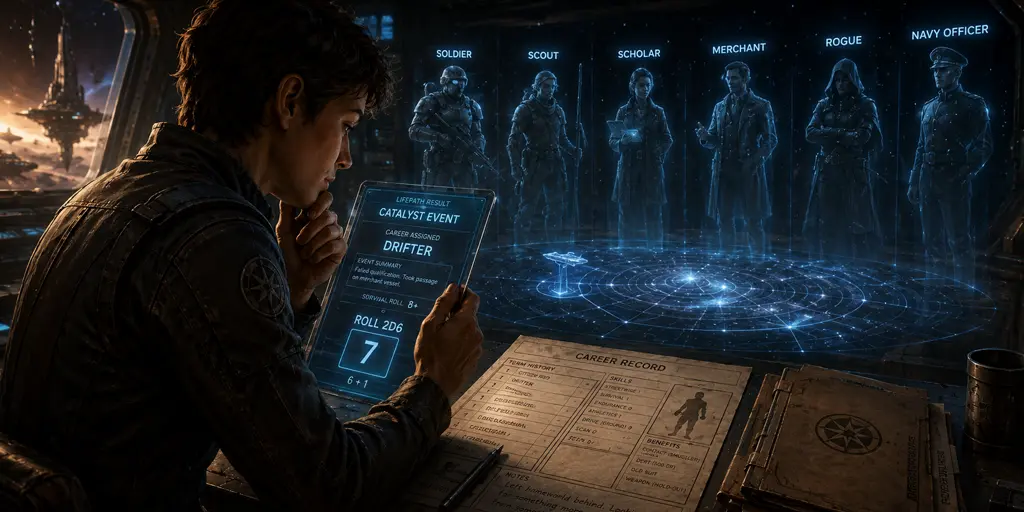
Traveller character creation did not ruin your character when the dice gave you the wrong career; it may have handed you the beginning of a better story.
I Wanted To Be a Marine. Why Am I a Scholar?
You sit down to create a Traveller character with a plan. Maybe you want to play a decorated Marine, a daring Scout, a clever Agent, a noble diplomat, or a hard-trading Merchant captain.
Then the dice get involved.
You fail to qualify. You get drafted. You suffer a mishap. You leave a career early. You pick up unexpected skills. Suddenly the character in front of you does not match the character you imagined.
That can feel like Traveller character creation gave you the wrong career.
The good news is that this is not always a problem. Sometimes it is the exact moment your Traveller character becomes interesting.
Traveller character creation is discovery, not build optimization. That does not mean you have to play a character you hate. It means your first response should be curiosity instead of frustration.
Why Traveller Character Creation Can Surprise You
Traveller character creation feels different from many roleplaying games because your character is shaped by a lifepath. You do not simply choose a finished build and start play. You find out what happened to your character before the campaign begins.
Careers, qualification rolls, survival, advancement, events, mishaps, aging, skills, benefits, and mustering-out results can all change the direction of the character. That is why a planned concept can drift into something unexpected.
If you are still learning how Traveller careers work, start with Mongoose Traveller Character Creation: Careers. If your character has already left a career and you are working through final benefits, continue with Mongoose Traveller Character Creation: Mustering-Out Benefits.
The important shift is this: Traveller is not asking, “Did you perfectly build the character you pictured?” It is asking, “What life did this person survive before the campaign started?”
The Wrong Career Might Be the Start of the Story
A wrong career result is often a story engine. It gives you tension, regret, unfinished goals, old contacts, rivalries, debts, and reasons to leave home. Those are useful things at the table.
| Wanted | Got | Story Possibility |
|---|---|---|
| Marine | Scholar | A military hopeful became a battlefield medic, tactical researcher, weapons analyst, or xenobiologist attached to a war zone. |
| Scout | Drifter | A failed Scout candidate learned survival the hard way on frontier worlds before joining a crew. |
| Noble | Rogue | A court exile, black sheep, scandal survivor, or disgraced heir learned how the underside of society works. |
| Merchant | Navy | A trade-family child was pulled into service and learned discipline, shipboard life, and command structure before returning to commerce. |
| Agent | Entertainer | A performer became useful to intelligence services through propaganda, contacts, celebrity access, or social manipulation. |
Instead of asking, “How do I undo this?” ask, “Why did this happen?” That one question turns a disappointing result into backstory.
Option 1: Roll With It
The simplest answer is often the best one: roll with it.
If the character is playable, has useful skills, and still gives you something to work with, try accepting the result. Traveller characters are often more interesting when they are imperfect. A character who did not get what they wanted has motivation. A character who failed out of a dream career has history. A character with odd skills can surprise the group later.
Rolling with it works especially well when the result adds tension without destroying your interest in the character. Maybe your would-be Marine became a Scholar, but still has a physical background, a military family, or a reason to prove themselves. Maybe your would-be Scout became a Drifter, but now knows the frontier better than any official survey pilot.
Do not rush to erase every surprise. Traveller’s lifepath system works because risk matters. If every unexpected result is corrected immediately, the system loses much of its story value.
Option 2: Reinterpret Your Character Concept
You may not need to change the mechanics. You may only need to change the explanation.
The career on the sheet tells you part of the character’s history, but it does not have to erase the concept you wanted. Many concepts can survive if you reinterpret the route the character took.
| Original Concept | Possible Reinterpretation |
|---|---|
| “I wanted to be a Marine.” | You trained for combat but washed out, became Army, Navy security, a bodyguard, or a mercenary later. |
| “I wanted to be a Scout.” | You never qualified, but you became a frontier survivor who learned exploration the unofficial way. |
| “I wanted to be a Merchant captain.” | You began as a broker, cargo handler, passenger liaison, shipboard crew member, or family employee. |
| “I wanted to be a noble diplomat.” | You are a disgraced noble, political fixer, hostage negotiator, court-connected outsider, or useful embarrassment. |
| “I wanted to be an Agent.” | You were never officially an intelligence officer, but you worked near secrets, informants, surveillance, or propaganda. |
This is one of the best ways to keep player excitement alive. Keep the emotional target of the concept, then let the dice tell you the messy route that got the character there.
Option 3: Ask the Referee for a Small Adjustment
Sometimes the dice result is close, but one detail makes the character feel wrong. In that case, ask the Referee for a small adjustment.
This should be a conversation, not a demand. Traveller character creation has risk and consequence, and the Referee should not be expected to rewrite every result that disappoints someone. But small adjustments can help a new player stay excited without breaking the spirit of the lifepath.
| Adjustment | When It Works |
|---|---|
| Swap one equivalent skill | The concept is close, but one skill feels off-theme. |
| Reframe an assignment | The mechanics work, but the label does not match the player’s idea. |
| Allow a second qualification attempt | A new player misunderstood the career path or made a choice without enough context. |
| Let the player choose a related career | The table wants stronger concept alignment and everyone agrees. |
| Add a story explanation | The dice result is fine, but the player needs a reason to care about it. |
The best adjustments are small, transparent, and table-approved. They preserve the surprise while helping the player connect with the character.
A good rule of thumb is this: adjust the result only enough to restore buy-in. Do not adjust so much that the lifepath no longer matters.
Option 4: Use the Career as Backstory, Not Destiny
Your Traveller career history is not your campaign destiny.
A former Scholar can become a gunner. A retired Navy officer can become a trader. A failed Marine can become a dangerous mercenary. A Drifter can become the heart of the crew. A Merchant can leave commerce behind and become a patron hunter, courier, smuggler, explorer, or reluctant hero.
The campaign begins after character creation. Your past explains where you came from. It does not permanently decide what you are allowed to do next.
This is useful for players who feel boxed in by an unexpected result. You are not necessarily playing “a Scholar campaign” because your character was once a Scholar. You are playing a Traveller campaign with a person who used to be a Scholar and now has a reason to board a ship, take risks, and join the rest of the crew.
If you want help turning career results into a stronger personality, motivation, and table-ready role, read Mongoose Traveller RPG Character Development.
Option 5: Roll a New Character
Rolling with surprises is great. Playing a character you hate is not.
If the result genuinely kills your interest, talk to the Referee and roll a new character. Traveller should feel dangerous, surprising, and alive. It should not feel like a punishment for being new.
Starting over is especially reasonable when:
- You misunderstood the career system.
- The character no longer fits the campaign premise.
- The rest of the group has a clear crew role that your character cannot support.
- You feel no interest in playing the result after trying to reinterpret it.
- The session is still in character creation and no one has built story around the character yet.
Do not throw away the old character immediately. Save them. Traveller character creation produces useful NPCs almost by accident.
What Referees Should Do When Players Are Disappointed
Referees can make this much easier for new players.
Before character creation begins, explain that Traveller uses a lifepath. Tell players that careers can fail, change, or end unexpectedly. Make it clear that this is part of the game, not a personal mistake.
| Referee Action | Why It Helps |
|---|---|
| Explain lifepath randomness before rolling | Players are less surprised when the dice change their plan. |
| Ask what the player wanted from the concept | You can preserve the emotional target even if the mechanics change. |
| Offer framing help before mechanical changes | The rules stay meaningful while the player gains buy-in. |
| Keep unused characters | They become NPCs, rivals, patrons, passengers, replacement characters, or crew. |
| Do not mock disappointed players | New players may already feel lost, and ridicule makes Traveller feel hostile. |
Unused characters do not have to go to waste. Referees can turn them into contacts, rivals, patrons, passengers, replacement characters, or crew. The Sci-Fi RPG Starter Pack is useful when you need ready-to-use sci-fi NPCs, names, and complications at the table.
Examples of Better Characters Created by Wrong Turns
Here are a few ways a disappointing career result can become a stronger character.
The Failed Marine Who Became a Medic
The player wanted a combat monster. The dice pushed the character toward a medical or scholarly path. Instead of abandoning the concept, the player reframes the character as someone who tried to enter military service, failed to become the warrior they imagined, and became obsessed with saving the people who did make it to the battlefield.
Now the character has guilt, competence, and a reason to dislike reckless commanders.
The Scout Who Never Qualified
The player wanted an official Scout. The character never qualified and ended up drifting on frontier worlds. That is not a dead end. It creates a character who knows the borderlands without the badge, the pension, or the protection of an institution.
They may know routes no Scout survey recorded. They may also owe favors to the wrong people.
The Merchant Who Got Drafted
The player wanted a trader. The dice sent the character into military service. Now the character understands discipline, ship operations, regulations, and the difference between legal cargo and strategic cargo.
When that character finally returns to trade, they bring a military past into every negotiation.
The Noble Who Became a Rogue
The player wanted influence and refinement. The lifepath created scandal. That can be excellent. A noble who became a Rogue may know court etiquette and criminal etiquette, which is often more useful than either one alone.
The character can open doors in high society, then survive what happens in the alley behind the estate.
The Scholar With a Violent Past
The player wanted an academic. Career events, skills, or mishaps suggest something harsher. Maybe the Scholar studied war, survived one, caused one, or covered one up.
Now the character is not just “the smart one.” They are someone with knowledge they may regret having.
Related Traveller Character Creation Guides
If you are working through Traveller character creation, these guides can help you make sense of the next steps:
- How To Play Traveller: Traveller RPG Character Creation
- Mongoose Traveller Character Creation: Rolling Characteristics
- Mongoose Traveller Character Creation: Background Skills
- Traveller Character Creation: Best Background Skills
- The Ultimate Guide to Playing Mongoose Traveller RPG
- Free Introduction to Traveller PDF
Final Advice
If Traveller character creation gives you the wrong career, pause before you fix it.
Ask what the result adds. Ask what disappointment it creates for the character, not just for the player. Ask what contacts, rivals, scars, and motivations came from that unexpected turn. Ask whether the career is really wrong, or whether it simply tells a different story than the one you expected.
Then choose the best response:
- Roll with it if the surprise gives you a playable character.
- Reinterpret the concept if the emotional core still works.
- Ask the Referee for a small adjustment if the result is close but awkward.
- Use the career as backstory if it does not match what the character wants now.
- Roll a new character if the result genuinely kills your interest.
Traveller character creation is discovery, not build optimization. The dice are not always giving you what you wanted. Sometimes they are giving you the reason your character left home.
Get More Traveller Character Creation Help
Want more help with Traveller careers, background skills, characteristics, mustering-out benefits, lifepath surprises, and character development?
Join the Traveller Character Creation list and I’ll send character creation tips, career guides, skill resources, and CyborgPrime updates.
You can also join me and other Traveller fans on the CyborgPrime Discord server.