Learn how to roll and assign Traveller RPG characteristics, what STR, DEX, END, INT, EDU, and SOC mean, and which scores matter most during Mongoose Traveller character creation.
Part of the Traveller character creation learning path. Start with the Traveller Character Creation Guide if you want the full lifepath overview.
Traveller Characteristics Explained
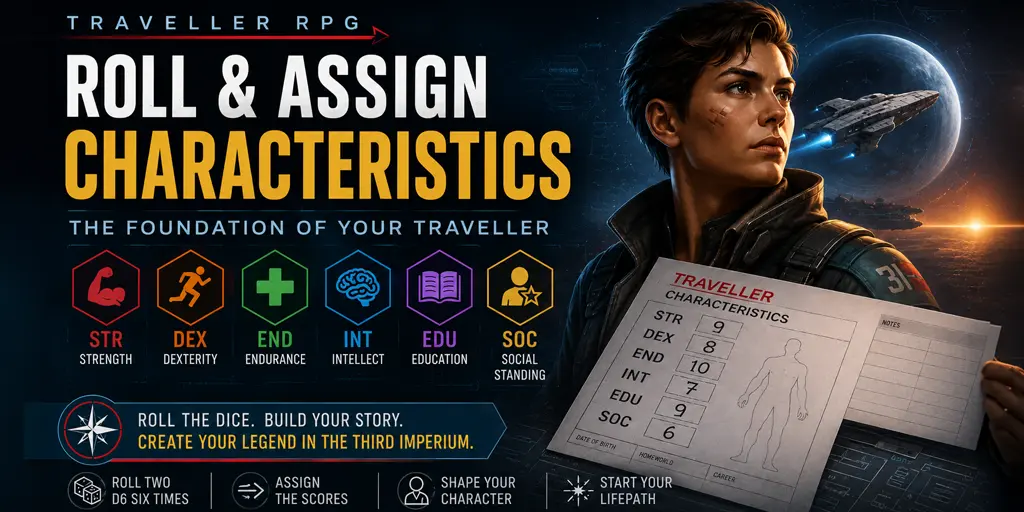
In Mongoose Traveller character creation, your characteristics are the foundation of your character. They describe your physical ability, mental ability, education, social position, and raw survivability before careers, skills, events, benefits, injuries, and connections begin shaping the rest of the lifepath.
The six standard Traveller characteristics are:
- STR — Strength
- DEX — Dexterity
- END — Endurance
- INT — Intellect
- EDU — Education
- SOC — Social Standing
These are sometimes called stats or attributes in other tabletop RPGs. In Traveller, they matter because they affect survival, career qualification, skill rolls, damage, aging, social access, and the kind of character story the lifepath system creates.
For the complete official character creation rules, use the Traveller Core Rulebook Update 2022. If you want a shorter introductory version of the rules, the Traveller Explorer's Edition is a useful introductory PDF.
Quick Character Creation Links
Characteristics are only the first step in Traveller character creation. These related guides can help you follow the full lifepath:
- Traveller Character Creation Guide
- Mongoose Traveller Character Creation: Background Skills
- Traveller Character Creation: Best Background Skills
- Mongoose Traveller Character Creation: Mustering-Out Benefits
- What To Do When Traveller Character Creation Gives You the Wrong Career
New to Traveller? Download the free Introduction to Traveller PDF.
How to Roll Traveller Characteristics
When creating a new Traveller character, the first thing you usually do is roll your characteristics.
Roll two six-sided dice and add them together. Do this six times, once for each characteristic score. Depending on the character creation method your Referee uses, the results may be assigned in order or placed to support a character concept.
For example, you might roll:
- 10
- 9
- 8
- 7
- 6
- 5
Confirm the method before assigning the scores. If your group allows placement, assign them where they best support the character concept and campaign.
A future Marine may want strong physical characteristics. A Scholar may want high INT and EDU. A Noble may care about SOC. A Scout may value DEX, END, INT, and EDU because they need to survive, travel, operate equipment, and solve problems far from support.
The Six Traveller Characteristics
Each characteristic tells you something different about the character.
Strength / STR
Strength measures physical power, lifting ability, muscle, and brute force.
High STR can help with heavy labor, melee attacks, carrying gear, physical intimidation, climbing, breaking things, and surviving some physical challenges.
Low STR does not make a character useless. It just means they may need tools, planning, allies, technology, or different tactics when physical force matters.
Dexterity / DEX
Dexterity measures agility, coordination, reflexes, balance, aim, and fine motor control.
High DEX can help with combat, piloting, stealth, athletics, careful movement, precision tasks, and situations where speed or coordination matters.
DEX is especially attractive for characters who expect to shoot, sneak, fly, dodge danger, or perform delicate work under pressure.
Endurance / END
Endurance measures stamina, toughness, pain tolerance, and the ability to withstand hardship.
END is one of the safest characteristics for new players to value highly because Traveller damage affects physical characteristics. A strong END score helps your character survive combat, injury, exhaustion, exposure, disease, and dangerous situations.
When in doubt, END keeps you alive.
Intellect / INT
Intellect measures cleverness, perception, problem-solving, creativity, awareness, and quick thinking.
High INT helps when your character needs to improvise, investigate, analyze, spot patterns, react under pressure, or solve problems that do not have a simple procedural answer.
INT is useful for almost any Traveller character because Traveller adventures often involve incomplete information, strange situations, technical problems, negotiations, and risky decisions.
Education / EDU
Education measures formal learning, training, academic background, technical knowledge, and professional competence.
High EDU is useful for knowledge skills, science, medicine, engineering, administration, navigation, computers, trade, military procedure, and many technical or professional tasks.
EDU also matters during character creation because it can affect career paths, background skills, training, and the character’s long-term competence.
When in doubt, EDU helps you do useful things.
Social Standing / SOC
Social Standing measures status, reputation, social class, rank, influence, and access to powerful people or institutions.
Some new players underestimate SOC because it does not look as immediately useful as DEX or END. That can be a mistake.
In the right campaign, SOC can affect noble status, patron access, political influence, military protocol, social expectations, legal treatment, high-society events, and the way important NPCs react to the character.
Ask your Referee how much SOC is likely to matter in the campaign.
Physical, Mental, and Social Characteristics
Traveller characteristics can be grouped into broad categories:
| Category | Characteristics | Why They Matter |
|---|---|---|
| Physical | STR, DEX, END | Combat, survival, movement, injury, physical danger |
| Mental | INT, EDU | Problem-solving, technical work, knowledge, investigation, career competence |
| Social | SOC | Status, influence, rank, social access, politics, patron relationships |
This split matters because different campaigns emphasize different parts of play. A military campaign may lean harder on physical characteristics. A merchant or investigative campaign may make INT and EDU extremely valuable. A noble, diplomatic, or political campaign may make SOC far more important than new players expect.
Psionic Characters and PSI
If your Referee allows psionics, your character may also have a PSI characteristic.
Psionics are not available in every Traveller campaign. Some groups treat psionic powers as rare, illegal, hidden, experimental, dangerous, or tied to specific setting assumptions.
Do not build your whole character around psionics unless your Referee confirms that PSI is allowed and appropriate for the campaign.
Characteristic Scores and Maximums
Characteristic values vary by species and campaign rules. Some species may have higher or lower maximums than humans.
For normal humans, starting characteristics usually fall within the range created by rolling two six-sided dice, though later events, aging, training, medical treatment, cybernetics, or other rules may change scores during character creation or play.
Do not think of a low score as a failed character. Traveller characters are not built like superheroes. A weak score can create useful texture, risk, humor, drama, or tactical problems.
Characteristic Modifiers
Characteristic modifiers are bonuses or penalties added to rolls during play.
The Traveller rulebook includes a chart for converting characteristic scores into modifiers. These modifiers matter because they affect your odds of success on tasks related to that characteristic.
Write your characteristic modifiers clearly on your character sheet. You will use them often during skill checks, career qualification, survival, advancement, and other parts of the game.
Which Traveller Characteristics Are Most Important?
The most important characteristics depend on the character you want to play and the kind of campaign your Referee is running.
A Marine, Scout, Rogue, Scholar, Merchant, Agent, Entertainer, and Noble may all care about different scores.
Still, a few characteristics tend to matter often.
END Keeps You Alive
Strength, Dexterity, and Endurance matter because Traveller damage affects physical characteristics.
Traveller characters do not rely on a separate hit point total in the same way many fantasy RPG characters do. When physical damage starts reducing your characteristics, your character becomes less capable and more vulnerable.
Endurance is especially useful because it contributes to physical resilience and can matter during injury, exhaustion, exposure, and other dangerous situations.
If you are new to Traveller and do not know where to put a strong roll, END is rarely a bad choice.
EDU Makes You Useful
Education is one of the most broadly useful characteristics in Traveller.
Many Traveller campaigns involve starships, worlds, trade, law, medicine, science, computers, engineering, navigation, military structure, and technical problems. EDU helps characters understand and act within that kind of universe.
High EDU can support professional competence, useful background skills, career options, and knowledge-based task checks.
INT Helps You React
Intellect is valuable when the character needs to notice, adapt, analyze, improvise, or solve a problem under pressure.
Traveller often creates situations where the crew does not have perfect information. A high INT character can be extremely valuable when the plan breaks, the patron lied, the ship is damaged, or the enemy is not doing what the players expected.
SOC Depends on the Campaign
Social Standing can be minor in some campaigns and extremely important in others.
If the campaign includes nobles, military rank, patrons, politics, diplomatic missions, law enforcement, corporate hierarchy, or high-society trouble, SOC may open doors that weapons cannot.
Before dismissing SOC, ask your Referee what kind of campaign they are running.
Simple Advice for Assigning Your Scores
Here is a practical way to assign your first Traveller character’s characteristics:
- Put one of your highest rolls in the characteristic most important to your concept.
- Put another high roll in END or EDU unless you have a strong reason not to.
- Avoid making END too low unless you are comfortable with a fragile character.
- Do not assume SOC is useless; it may matter a lot in the right campaign.
- Think about your first career before assigning every score.
- Ask your Referee which characteristics are likely to matter most.
For example, a future Marine may value STR, DEX, and END. A Scholar may value INT and EDU. A Merchant may value EDU, INT, and SOC. A Scout may want a broad spread because scout characters often face travel, danger, technology, and isolation.
Characteristics and Career Choice
Your characteristics matter because they affect more than task rolls during play. They can also influence career qualification, survival, advancement, and the kind of lifepath your character is likely to experience.
Before you choose a career, look at the scores you rolled and ask:
- Which careers fit these characteristics naturally?
- Which career would be risky but interesting?
- Which characteristic is most important to the character I wanted to make?
- Which low score might create the most interesting problem?
- Would I rather optimize the character or discover who they become?
Traveller characters are often more interesting when the dice complicate your plan.
Continue to Traveller RPG Careers Explained when you are ready to choose a career path.
Characteristics and Background Skills
After characteristics, the next step is usually choosing background skills.
Background skills represent the things your character learned before their first career. They are often shaped by homeworld, upbringing, early training, and the assumptions of the campaign.
Your characteristics do not tell the whole story, but they can suggest what kinds of background skills make sense.
A high EDU character might have strong formal education. A high DEX character might have athletic, piloting, stealth, or precision skills. A high SOC character might have social, administrative, diplomatic, or leadership experience.
Continue with Mongoose Traveller Character Creation: Background Skills when you are ready for the next step.
New Player Summary
If you are new to Traveller, remember these points:
- STR helps with strength, lifting, melee, and physical force.
- DEX helps with reflexes, aim, coordination, stealth, and piloting.
- END helps with survival, injury, combat damage, and hardship.
- INT helps with awareness, improvisation, investigation, and problem-solving.
- EDU helps with knowledge, technical skills, training, and career competence.
- SOC helps with status, access, rank, reputation, and social influence.
For many first characters, END keeps you alive and EDU helps you contribute. But the best characteristic is the one that supports the kind of Traveller you actually want to play.
Where to Go Next
After you roll and assign your characteristics, the next step is choosing your background skills.
Continue with the next article in this character creation series:
Mongoose Traveller Character Creation: Background Skills
You can also return to the full character creation hub here:
Traveller Character Creation Guide
Related Traveller Character Creation Resources
Continue with the next step in the lifepath, return to the full character creation guide, or use the free introduction for a broader overview.
- Mongoose Traveller Character Creation: Background Skills
- Traveller Character Creation Guide
- Free Introduction to Traveller PDF
Frequently Asked Questions
What Are the Six Main Traveller Characteristics?
The six standard characteristics are Strength, Dexterity, Endurance, Intellect, Education, and Social Standing. They describe physical ability, mental ability, education, resilience, and social position.
Which Traveller Characteristic Is Best for Beginners?
There is no single best characteristic. Endurance is often a safe priority for resilience, while Education is broadly useful for technical, professional, and knowledge-based tasks.
Can Players Assign Their Traveller Characteristic Rolls?
The method depends on the rules and character creation procedure the Referee is using. Confirm whether results are assigned in order or placed to support a character concept before assigning scores.
Is a Low Characteristic Bad in Traveller?
No. A low characteristic creates limitations and risks, but skills, equipment, teamwork, preparation, and good decisions can help compensate for a weaker score.
Why Is Endurance Important in Traveller?
Endurance contributes to physical resilience and can matter when a character faces injury, exhaustion, exposure, disease, or other dangerous conditions.
Does Social Standing Matter in Every Campaign?
No. Its importance depends on the campaign. Social Standing becomes more useful when play involves nobles, military hierarchy, diplomacy, politics, corporate influence, or institutional access.
Get More Traveller Character Creation Help
Get practical guidance for Traveller characteristics, careers, background skills, lifepath events, mustering-out benefits, and character development.
No spam. Just character creation tips, career guides, lifepath resources, and CyborgPrime updates. Unsubscribe anytime.